Madhya Pradesh Sugam Bus Service for Women Launch
Source:tripurachronicle ↗
Why It Matters
State-sponsored welfare and transport schemes targeting women are frequently asked in MPPSC State Service Exams. The details regarding execution agencies (AICTSL), routes, and the integration with central schemes (PM e-Bus Seva) are key study areas for MP general knowledge.
Summary
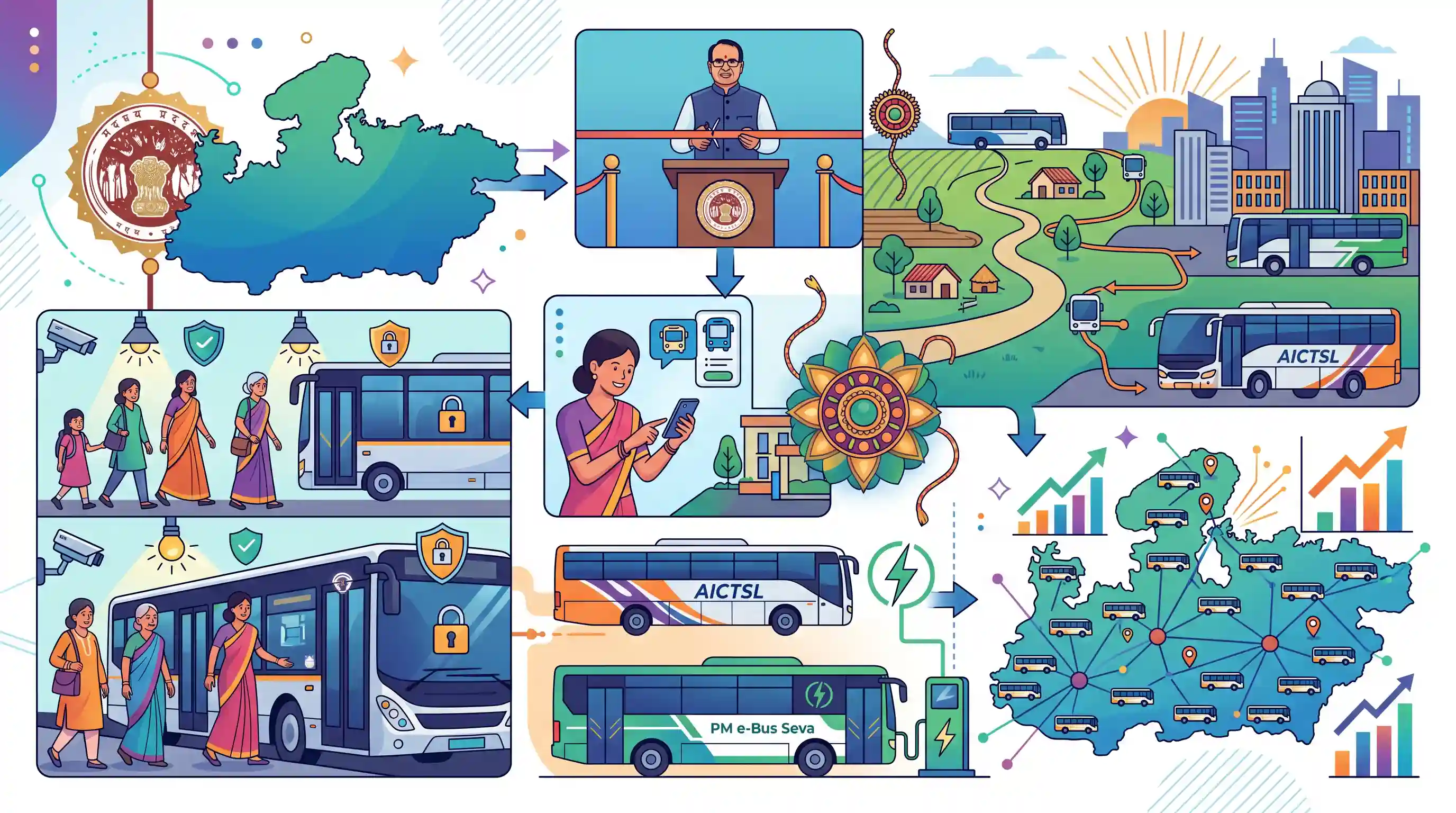
The Madhya Pradesh government is set to launch the 'Chief Minister Easy Transport Service' (Mukhyamantri Sugam Parivahan Seva) for women ahead of Raksha Bandhan. The initiative aims to provide secure and convenient travel, focusing on rural connectivity. Starting in the Indore division under AICTSL, the scheme will initially deploy intercity, city, and interstate buses, complemented by PM e-Bus Seva electric buses. The state-wide blueprint envisions over 5,000 buses across 1,164 routes to connect regional and district headquarters.
Key Points
- The Madhya Pradesh government under CM Mohan Yadav is launching the 'Chief Minister Easy Transport Service' (Mukhyamantri Sugam Parivahan Seva) to provide safe, convenient, and reliable travel for women across the state, timed with the Raksha Bandhan festival.
- The scheme aims to address the critical public transport deficit in rural and remote areas, helping to reduce the safety hazards associated with traveling in overloaded private vehicles.
- The implementation will begin in phases, starting with high-demand routes in the Indore region. The Atal Indore City Transport Service Limited (AICTSL) will oversee bus operations across the Indore Division.
- In the initial phase in Indore, operations will cover 121 intercity routes (608 buses), 28 city and suburban routes, and 101 interstate routes (276 buses connecting to Maharashtra, Gujarat, Rajasthan, and Uttar Pradesh).
- Additionally, 150 electric buses under the Central government's PM e-Bus Seva will ply in Indore, and a state-wide deployment of 5,206 buses across 1,164 routes is planned to connect 7 regional headquarters to district headquarters.
Important Terms
PM-eBus Sewa

A centrally sponsored scheme to deploy 10,000 electric buses in city bus services across India under a public-private partnership (PPP) model, aimed at enhancing green urban mobility and infrastructure.
UPSC context
GS Paper III (Infrastructure, Environment); tests knowledge of clean energy initiatives and sustainable urban transportation policies.
Mukhyamantri Sugam Parivahan Seva
A public transport initiative by the Madhya Pradesh government to establish an organized, safe, and affordable passenger bus network across urban and rural areas using a three-tier public-private partnership (PPP) model.
UPSC context
GS Paper II (Welfare Schemes) and GS Paper III (Infrastructure); tests awareness of state-level public transit and connectivity initiatives.
Atal Indore City Transport Service Limited (AICTSL)
A Special Purpose Vehicle constituted in 2005 by the Madhya Pradesh government, pioneering India's first public-private partnership (PPP) model to operate sustainable, organized urban bus transport services in Indore.
UPSC context
GS Paper III (Infrastructure and Public-Private Partnerships); tests understanding of municipal transport models and SPV governance structures.
Prelims Trap
PM-eBus Sewa covers all urban agglomerations across India, prioritizing mega-cities with populations exceeding 10 million.
The PM-eBus Sewa scheme specifically excludes mega-cities with populations exceeding 1 crore, focusing instead on capital cities, UTs, and tier-2/3 cities.
Static Concepts Connected
What are the key features and targets of the PM-eBus Sewa scheme?
- Targeted Deployment: Aims to deploy 10,000 electric buses on a Public-Private Partnership (PPP) model across eligible cities.
- Population Threshold: Focuses on cities with a population of 3 lakh and above (Census 2011), excluding mega-cities with populations over 1 crore.
- Two-pronged Structure: Segment A deploys buses and charging infrastructure; Segment B funds Green Urban Mobility Initiatives like NCMC fare collection.
How do Special Purpose Vehicles (SPVs) operate in Indian urban governance?
- Legal Identity: SPVs are separate legal entities, often registered under the Companies Act, created to execute specific infrastructure projects efficiently.
- Risk Isolation: Protects the parent municipal body from financial liabilities by ring-fencing the project's financial risks.
- Democratic Deficit: Critics argue SPVs bypass elected urban local bodies, undermining the democratic decentralization envisioned under the 74th Amendment Act.
Cross-Topic Patterns
Gender-responsive transit + FLFP growth
Safe, affordable municipal transit directly addresses the physical mobility barrier, which is a major structural bottleneck preventing the expansion of India's low female labor force participation rate.
Urban decentralization + Corporatisation of SPVs
Merging municipal transport SPVs into a centralized state-level holding company reflects a structural shift from decentralized urban local bodies to corporate-style governance models.

PM-eBus Sewa's strict eligibility criteria (excluding cities >1 crore population) and PPP model may be tested in a multi-statement Prelims question.
Linked PYQs · 2
Linked PYQs · 2
- 2025MPPSC_PRELIMSGS1
The objective of "Mukhyamantri Ladli Behna Yojana" implemented in entire Madhya Pradesh, in addition to economic self-reliance is:
- 2019MPPSC_PRELIMSGS1
In Madhya Pradesh the amount of financial help given to the marriageable girls of poor families under "Mukhya Mantri Kanyadan Yojna" was increased in the year 2019 to
