Madhya Pradesh Seeks Higher Moong Procurement Target Amid Protests
Source:lokmattimes ↗
Why It Matters
Effective procurement mechanisms and Minimum Support Prices (MSP) are critical safeguards for farmers against market volatility, especially during bumper harvests. This issue highlights the ongoing agricultural marketing challenges and the importance of pulse cultivation for India's food security and rural economy.
Summary
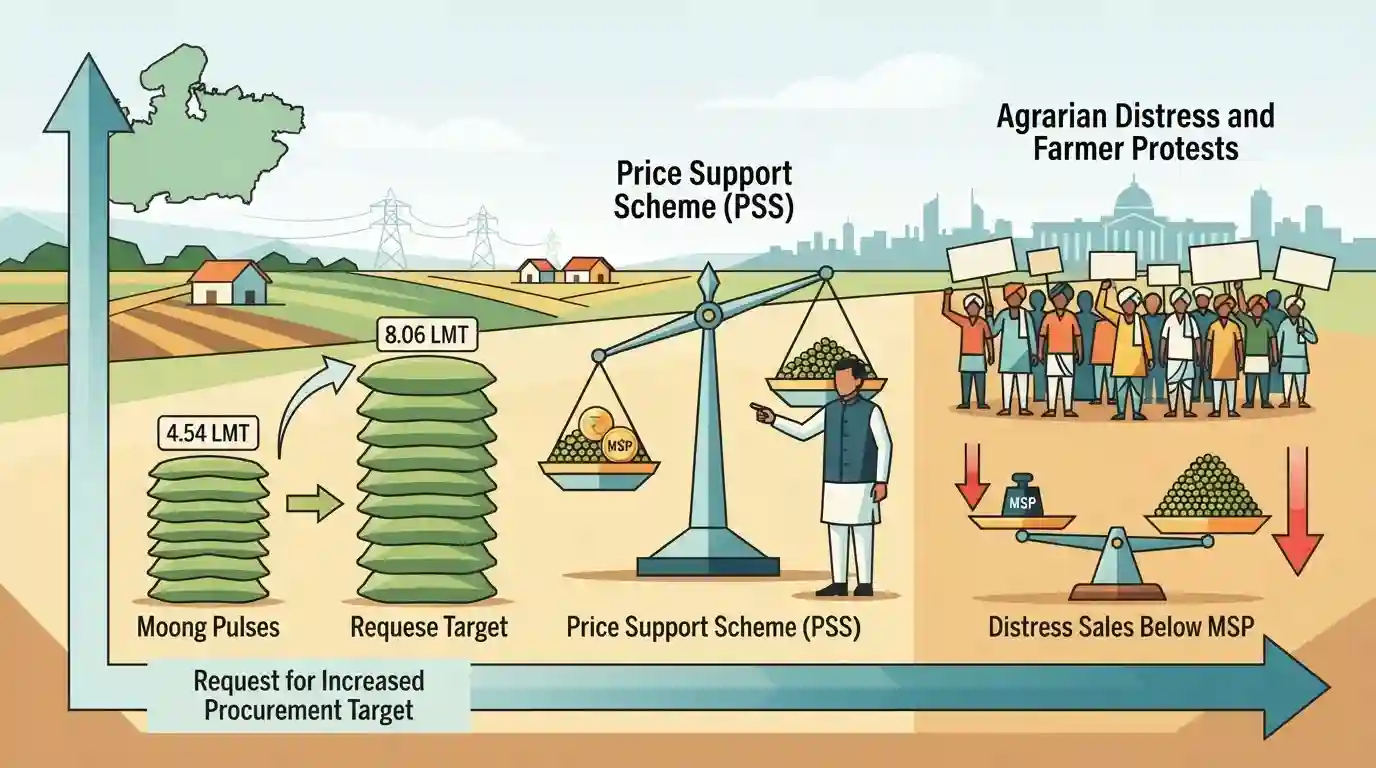
The Madhya Pradesh government has formally requested the Central Government to increase the procurement target for summer moong under the Price Support Scheme (PSS) from 4.54 lakh metric tonnes to 8.06 lakh metric tonnes. Driven by bumper production and ongoing farmer protests in Bhopal against potential distress sales below the Minimum Support Price (MSP), State Agriculture Minister Aidal Singh Kansana highlighted that ensuring MSP benefits is crucial to sustaining pulse cultivation and farmer livelihoods.
Key Points
- The Madhya Pradesh government has urged the Centre to raise the summer moong procurement target under the Price Support Scheme to 8.06 lakh metric tonnes, representing 40% of the state’s estimated output.
- In the current season, MP has sown moong across 14.30 lakh hectares with an estimated total production of 20.16 lakh metric tonnes.
- The Centre initially approved a procurement quota of 4.54 lakh metric tonnes, which farmers and the state government argue is insufficient.
- Hundreds of farmers are protesting in Bhopal demanding increased procurement limits to avoid being forced to sell their bumper harvests below the Minimum Support Price (MSP).
- Expanded procurement is deemed necessary to prevent distress sales, stabilize rural incomes, and encourage continued pulse production for national food security.
Important Terms
Price Support Scheme (PSS)

A market intervention scheme under PM-AASHA where central agencies physically procure pulses, oilseeds, and copra at the Minimum Support Price (MSP) during harvest gluts to protect farmers from distress sales.
UPSC context
GS Paper 3 (Agriculture). Tests understanding of government procurement mechanisms, agricultural price stabilization, and market intervention schemes.
Minimum Support Price (MSP)
The guaranteed floor price set by the Government of India, recommended by the CACP, at which it procures designated crops directly from farmers to shield them from sharp market price drops.
UPSC context
GS Paper 3 (Agriculture). Tests knowledge of agricultural pricing, buffer stocks, food security, and farmer welfare policies.
PM-AASHA (Pradhan Mantri Annadata Aay SanraksHan Abhiyan)
An umbrella scheme launched in 2018 to guarantee MSP for pulses, oilseeds, and copra, comprising the Price Support Scheme, Price Deficiency Payment Scheme, and Private Procurement pilot.
UPSC context
GS Paper 3 (Government Schemes). Tests understanding of income-support policies and procurement reforms for non-cereal crops.
Zaid Crops
Short-duration summer crops grown during the transition period between Rabi and Kharif seasons (March to June), requiring warm, dry weather and including crops like watermelon, cucumber, and summer moong.
UPSC context
GS Paper 1 (Geography) and GS Paper 3 (Agriculture). Tests knowledge of Indian cropping seasons, cropping patterns, and crop water requirements.
Prelims Trap
The Price Support Scheme (PSS) allows unlimited 100% physical procurement for all notified pulse varieties.
Only Tur, Urad, and Masur are exempted from the 25% procurement cap; other pulses like Moong still face strict ceilings, triggering state-level negotiations.
Static Concepts Connected
What is the PM-AASHA scheme and its core operational mechanisms?
- Price Support Scheme: Physical procurement of pulses, oilseeds, and copra by NAFED/NCCF at MSP, traditionally capped at 25% of state crop production.
- Price Deficiency Payment: Covers oilseeds where registered farmers receive direct cash transfers of the difference between MSP and market price, avoiding physical storage.
- PSF and MIS: Includes the Price Stabilization Fund (PSF) for consumer price control and the Market Intervention Scheme (MIS) for perishable horticultural crops.
What are the primary characteristics of India's pulses sector?
- Global Position: India is simultaneously the world's largest producer (~25%), consumer (~27%), and importer (~14%) of pulses to satisfy domestic nutritional needs.
- Crop Share: Gram (chickpea) is the leading pulse crop, constituting nearly 50% of national production, followed by Tur and Urad.
- Ecological Value: Leguminous pulse crops fix atmospheric nitrogen, enhancing soil fertility and requiring significantly less water than water-guzzling cereals.
Cross-Topic Patterns
MSP caps vs. groundwater depletion
Open-ended procurement of wheat/paddy contrasts with restricted pulse procurement (like Moong), disincentivizing crop diversification away from water-intensive crops in dryland regions.
PSS procurement and WTO Amber Box
Aggressive physical procurement under PSS risks exceeding India's 10% de minimis limit under the WTO Agreement on Agriculture, challenging domestic agricultural support limits.

Prelims 2026 will likely test crop-specific procurement exemptions under PM-AASHA and why certain pulses face strict procurement caps.
Linked PYQs · 2
Linked PYQs · 2
- 2020MPPSC_PRELIMSGS1
Main crop of Madhya Pradesh is
- 2024MPPSC_PRELIMSGS1
UNNATI (Agri-GISl project of Madhya Pradesh Government is for :
