Madhya Pradesh completes procurement of summer moong at MSP
Source:fmbharat ↗
Why It Matters
Highlights Madhya Pradesh's significant role in pulse (moong) production and illustrates the functioning of central procurement schemes (PM-AASHA) and agricultural insurance reforms (PMFBY, RWBCIS) for ensuring farmers' income security.
Summary
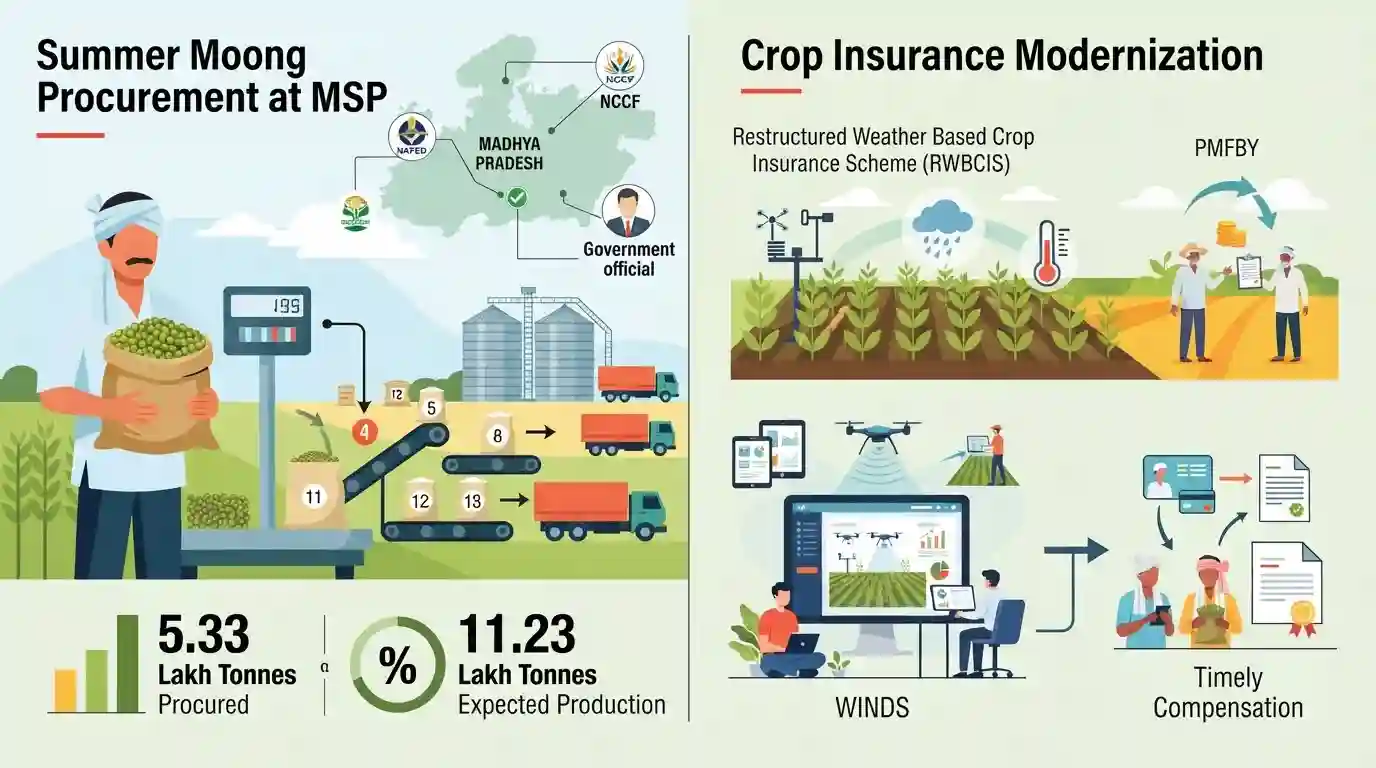
The Madhya Pradesh government has procured 5.33 lakh tonnes of summer moong at the Minimum Support Price (MSP) during the 2026 season. Union Agriculture Minister Shivraj Singh Chouhan confirmed the approval under the PM-AASHA scheme, nearly fulfilling the state's request to procure 5.37 lakh tonnes via central agencies NAFED and NCCF. This procurement provides critical income support to farmers amid an expected state production of 11.23 lakh tonnes of moong. In addition, the Centre approved Madhya Pradesh's integration into the Restructured Weather Based Crop Insurance Scheme (RWBCIS) under PMFBY and emphasized adopting the WINDS framework and expanding crop-cutting experiments to modernize agricultural data management and ensure timely insurance compensation for weather-induced crop losses.
Key Points
- The Madhya Pradesh government has successfully procured 5.33 lakh tonnes of summer moong at Minimum Support Price (MSP).
- Union Agriculture Minister Shivraj Singh Chouhan approved the procurement of this quantity under the Price Support Scheme component of PM-AASHA, largely fulfilling the state's request for 5.37 lakh tonnes.
- Procurement operations are being carried out by central agencies NAFED and NCCF to ensure fair compensation to farmers against an expected production of 11.23 lakh tonnes of summer moong in the state.
- The Centre also approved Madhya Pradesh's integration into the Restructured Weather Based Crop Insurance Scheme (RWBCIS) under PMFBY to streamline compensation for weather-related crop losses.
- There is a push to implement the WINDS framework and expand Crop Cutting Experiments (CCEs) to modernize agricultural data management in the state.
Important Terms
Minimum Support Price (MSP)

A government-guaranteed floor price for agricultural produce protecting farmers against sharp price drops, ensuring remunerative income for crops like summer moong.
UPSC context
MPPSC GS Paper 2 (Agriculture). Tests knowledge of farm income schemes, agricultural pricing policies, and rural welfare measures.
PM-AASHA (Pradhan Mantri Annadata Aay SanraksHan Abhiyan)
An umbrella central scheme integrating multiple price-support mechanisms to ensure remunerative Minimum Support Price realization for farmers growing pulses, oilseeds, and copra.
UPSC context
MPPSC GS Paper 2 (Agriculture Sector). Crucial for evaluating central procurement interventions and strategies preventing distress sales.
Pradhan Mantri Fasal Bima Yojana (PMFBY)
India's flagship crop insurance scheme offering comprehensive financial protection to farmers against non-preventable natural risks, utilizing technology like remote sensing for accurate loss assessments.
UPSC context
MPPSC GS Paper 3 (Agriculture). Relevant for topics on disaster mitigation, agricultural distress, and crop insurance frameworks.
Restructured Weather Based Crop Insurance Scheme (RWBCIS)
A parametric insurance scheme under PMFBY that mitigates financial hardship for farmers by triggering automated payouts based on adverse weather indices like abnormal rainfall or temperature.
UPSC context
MPPSC GS Paper 3 (Agriculture). Tests understanding of climate-resilient farming, weather risk mitigation, and alternative insurance models.
Weather Information Network and Data System (WINDS)
A national initiative installing automatic weather stations and rain gauges at the panchayat level to provide hyperlocal weather data for agricultural advisories and crop insurance.
UPSC context
MPPSC GS Paper 3 (E-technology in aid of farmers). Highlights digital infrastructure and data-driven climate-smart agriculture.
National Agricultural Cooperative Marketing Federation of India (NAFED)
An apex cooperative organization and central nodal agency responsible for the physical procurement of notified agricultural commodities, stabilizing prices for farmers and consumers.
UPSC context
MPPSC GS Paper 2 (Statutory Bodies) and GS 3. Important for cooperative marketing and government procurement mechanisms.
Prelims Trap
RWBCIS compensates farmers based on actual field-assessed crop yield losses.
RWBCIS uses deviations in weather parameters (rainfall, temperature) as proxies for damage to trigger payouts, unlike PMFBY which relies on actual yield-loss data.
Static Concepts Connected
What are the three components of the PM-AASHA scheme?
- PSS: Price Support Scheme focuses on physical procurement of pulses, oilseeds, and copra by central nodal agencies like NAFED and NCCF.
- PDPS: Price Deficiency Payment Scheme pays farmers the difference between the MSP and the market selling price for oilseeds, without physical procurement.
- PPSS: Private Procurement and Stockist Scheme involves private sector participation in procurement operations on a pilot basis.
What characterizes Summer Moong cultivation in Madhya Pradesh?
- Zaid Season: It is a Zaid crop cultivated between the Rabi and Kharif seasons, optimizing land use and increasing cropping intensity in the state.
- Major Hubs: Extensively grown in districts like Narmadapuram, Raisen, and Vidisha, heavily supported by canal irrigation.
- State Dominance: The crop is crucial for maintaining MP's position as the leading pulse-producing state in India.
Cross-Topic Patterns
E-technology in crop insurance
Adopting the WINDS framework and modernizing Crop Cutting Experiments (CCEs) merges e-governance with agricultural risk mitigation to ensure faster insurance payouts.
Pulse diversification via PM-AASHA
MP’s aggressive MSP procurement of Zaid crops like summer moong connects national pulse self-sufficiency targets with state-level farmer income support initiatives.

Multi-statement question likely contrasting PMFBY (yield loss) with RWBCIS (weather proxies) or identifying nodal agencies under PM-AASHA.
Linked PYQs · 2
Linked PYQs · 2
- 2025MPPSC_PRELIMSGS1
During the year 2021-22, which of these states was ranked second in area and first in production of pulses in the country?
- 2024MPPSC_PRELIMSGS1
UNNATI (Agri-GISl project of Madhya Pradesh Government is for :
