MP UCC Panel Submits Report Recommending Tribal Exclusion
Source:etvbharat ↗
Why It Matters
The push for a Uniform Civil Code is a fulfillment of Article 44 of the Directive Principles of State Policy. The recommendation to exempt Scheduled Tribes demonstrates the complexities of harmonizing uniform civil laws with the special constitutional safeguards granted to tribal populations under the Indian Constitution.
Summary
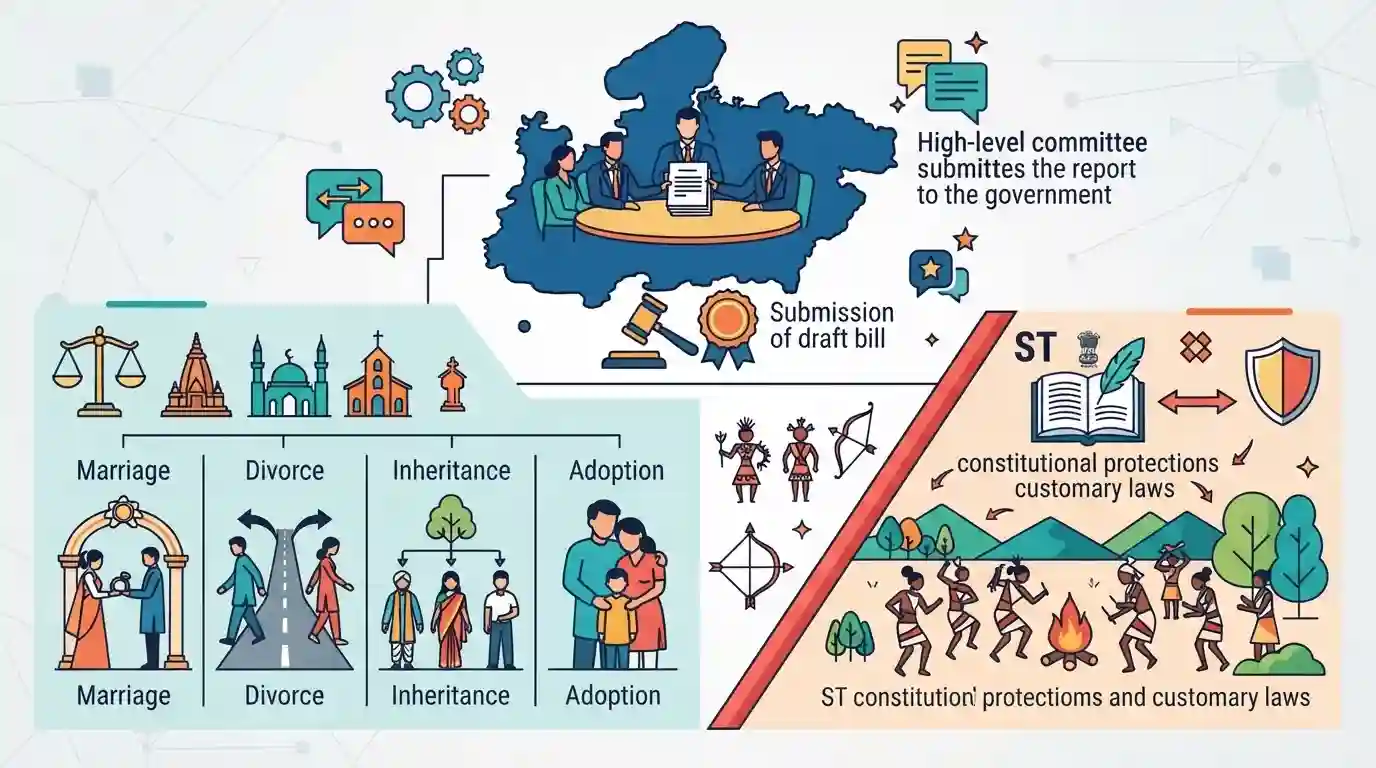
A high-level committee formed by the Madhya Pradesh government has submitted its comprehensive report and a draft bill for the implementation of the Uniform Civil Code (UCC) in the state. The proposed legislation seeks to create uniform civil laws for marriage, divorce, inheritance, and adoption across communities. Notably, the committee has recommended the explicit exclusion of Scheduled Tribes (STs) from the UCC to preserve their distinct constitutional protections and customary laws.
Key Points
- A high-level committee has submitted a report on implementing the Uniform Civil Code (UCC) to Madhya Pradesh Chief Minister Mohan Yadav.
- The Draft UCC Bill contains four parts, 404 sections, and seven schedules, standardizing laws on marriage, divorce, maintenance, inheritance, adoption, and live-in relationships.
- A major recommendation of the committee is to exclude Scheduled Tribes (STs) from the purview of the proposed Uniform Civil Code to protect their customary practices.
Important Terms
Uniform Civil Code (UCC)

A proposed set of common civil laws for all citizens—regardless of religion—covering marriage, divorce, inheritance, and adoption. Enshrined as a Directive Principle in Article 44 of the Constitution.
UPSC context
Highly relevant for GS Paper 2 (Polity). Tests understanding of DPSP (Article 44), secularism, and debates balancing gender justice with cultural rights.
High-Level Committee on UCC
A multi-member panel headed by retired Supreme Court Justice Ranjana Prakash Desai. Formed by the Madhya Pradesh government to draft the state's Uniform Civil Code, it recently submitted its final report.
UPSC context
Relevant for GS Paper 2 (State Governance). Illustrates the process of drafting state-level legislation on Concurrent List subjects and the role of expert committees.
UCC Draft Bill
A 404-section proposed law designed to standardize personal legal matters across Madhya Pradesh, prepared by the Justice Desai committee. It notably exempts Scheduled Tribes to protect their distinct social structures.
UPSC context
Important for GS Paper 2 (Legislative Frameworks). Tests knowledge of how states navigate constitutional protections (like those for STs) while enacting civil reforms.
Prelims Trap
"A state-enacted Uniform Civil Code applies uniformly to all citizens domiciled in that state without any demographic exceptions."
Aspirants assume "Uniform" means absolute application. However, state UCC drafts like those in Uttarakhand and Madhya Pradesh explicitly exempt Scheduled Tribes to protect their customary laws.
Static Concepts Connected
Under which Constitutional provision can States enact a Uniform Civil Code?
- Concurrent List: Entry 5 of the Concurrent List explicitly grants both Center and States the power to legislate on marriage, divorce, adoption, and succession.
- Presidential Assent: Under Article 254(2), a State law contradicting existing Central laws (like the Hindu Marriage Act) requires Presidential assent to be valid.
How does the Constitution protect tribal customary laws from uniform legislation?
- Special Provisions: Articles 371A (Nagaland) & 371G (Mizoram) explicitly restrict Parliament from altering tribal customary law without respective State Assembly consent.
- Fifth & Sixth Schedules: Grants Governors and Autonomous District Councils the power to modify or restrict the application of state or parliamentary laws in designated tribal areas.
Cross-Topic Patterns
UCC vs. Right to Privacy
Mandating the registration of live-in relationships (as proposed in MP and Uttarakhand) triggers constitutional debates around Article 21 and the Puttaswamy judgment on the right to privacy.
Tribal Autonomy vs. DPSP
The explicit exclusion of STs highlights the ongoing constitutional friction between achieving a uniform civil code (Article 44) and safeguarding distinct minority and tribal cultures (Article 29).

Expect a multi-statement Prelims question testing State power to enact UCCs (Concurrent List) alongside ST exemptions under Article 342.
Linked PYQs · 4
Linked PYQs · 4
- 2023MPPSC_PRELIMSGS1
The Directive Principles of State Policy are explained in Part IV of the Indian Constitution. This system has been taken from the Constitution of which country ?
- 2025MPPSC_PRELIMSGS1
In which Article of the Indian Constitution is there a provision of reservation of seats for Scheduled Tribes in the State Assembly?
- 2025MPPSC_PRELIMSGS1
Under which Article of the Indian Constitution does the President issue a public notification for the Scheduled Tribes for a specific state?
- 2020MPPSC_PRELIMSGS1
The provision of reservation of seats for Scheduled Tribes in Municipalities in Madhya Pradesh has been made under which of the following Articles of the Constitution of India?
