Madhya Pradesh Government Imposes Austerity Measures Amid High Debt
Source:daily-pioneer ↗
Why It Matters
Highlights the practical steps states take for fiscal consolidation and expenditure rationalisation when facing high public debt. This is highly relevant for the MPPSC Prelims syllabus covering the Economy of Madhya Pradesh, state budgets, and public finance.
Summary
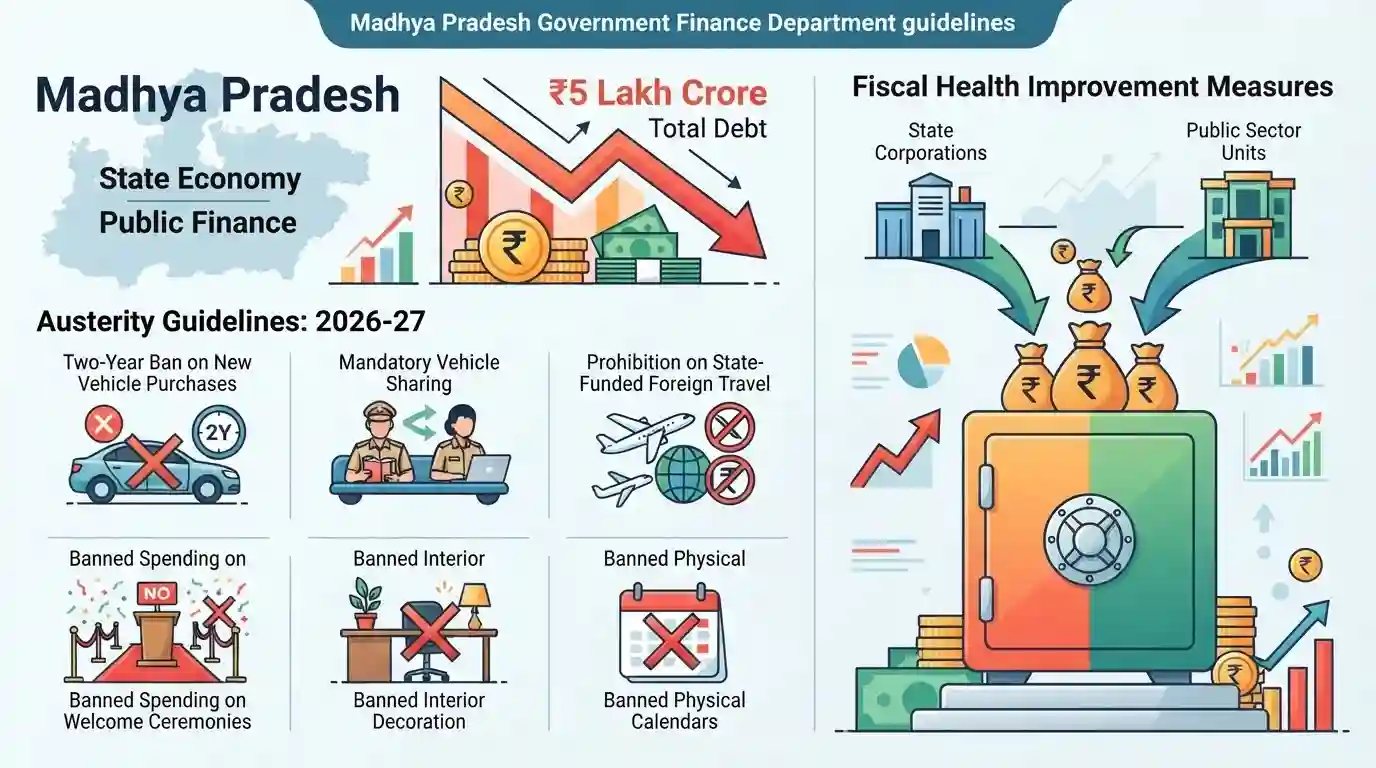
The Madhya Pradesh government has introduced sweeping austerity measures to curtail administrative expenditure in light of the state's total debt exceeding ₹5 lakh crore. The State Finance Department issued guidelines for the 2026-27 fiscal year applicable to all departments, public sector units, and universities. Key restrictions include a two-year ban on new vehicle purchases, mandatory vehicle sharing among officers, and a prohibition on state-funded foreign travel. Additionally, spending on welcome ceremonies, interior decoration, and physical calendars is banned, and state corporations have been ordered to deposit maximum dividends into the state exchequer to improve fiscal health.
Key Points
- The total debt burden of Madhya Pradesh has crossed the ₹5 lakh crore mark.
- The MP Finance Department has issued strict austerity guidelines for the 2026-27 financial year applicable to all departments, state-run corporations, and universities.
- Measures include a complete ban on purchasing new vehicles for two years and mandating two officers to share a single government vehicle.
- Foreign trips at the state government's expense are banned, and domestic air travel is restricted to economy class.
- Expenditures on welcome ceremonies, interior decorations, physical printing of calendars/diaries, and festival celebrations are prohibited.
- State-owned corporations and Public Sector Undertakings (PSUs) have been directed to deposit their maximum possible dividends into the state exchequer to bolster revenue.
Important Terms
Public Debt

The total outstanding financial liabilities or borrowing obligations accumulated by a government (central or state) from internal and external sources to bridge fiscal deficits.
UPSC context
GS Paper III (Indian Economy). Tests understanding of fiscal deficit financing, subnational borrowing limits, and debt sustainability.
Fiscal Austerity
Economic policies involving government spending cuts, tax increases, or structural reforms to reduce budget deficits, contain public debt, and restore fiscal discipline.
UPSC context
GS Paper III (Indian Economy). Tests knowledge of expenditure rationalization, deficit management, and its developmental and social consequences.
Consolidated Fund of the State
The primary state-level public account established under Article 266(1), containing all state revenues, borrowings, and loan repayments, requiring legislative approval for withdrawals.
UPSC context
GS Paper II (Polity/Constitution) & GS Paper III (State Finances). Tests structural mechanics of subnational budgets and legislative financial control.
Fiscal Deficit
The difference between a government's total expenditure and its total non-borrowed receipts (revenue and non-debt capital receipts), indicating its overall borrowing requirement.
UPSC context
GS Paper III (Indian Economy). Tests concepts of government budgeting, structural financial reforms, and macroeconomic health.
Non-Tax Revenue
Government earnings from sources other than taxation, such as interest receipts, fees, user charges, and dividends or profits from public sector undertakings.
UPSC context
GS Paper III (Indian Economy). Tests understanding of budget components, alternative state revenues, and PSU financial management.
Madhya Pradesh Finance Department
The principal state administrative body in Madhya Pradesh responsible for state budget preparation, public expenditure tracking, debt management, and financial rule enforcement.
UPSC context
GS Paper II (State Executive) & GS Paper III (Subnational Finances). Tests structure of state financial machinery and fiscal federalism execution.
Prelims Trap
State governments can independently borrow from foreign financial institutions like the World Bank.
Under Article 293, States cannot borrow externally. All external borrowing is raised by the Union and on-lent to States. Centre's consent is also mandatory for domestic loans if central dues exist.
Static Concepts Connected
What are the constitutional limitations on State borrowing under Article 293?
- External Borrowing: States are prohibited from borrowing directly from foreign sources; all external debt is routed through the Union Government.
- Domestic Borrowing: States can borrow within the territory of India upon the security of the Consolidated Fund of the State.
- Centre's Consent: Mandatory for new domestic loans if the State has any outstanding loans or guarantees from the Government of India.
How did the 15th Finance Commission structure State fiscal deficit limits?
- Standard Limit: The standard fiscal deficit ceiling is pegged at 3.0% of Gross State Domestic Product (GSDP) for the 2023-26 period.
- Conditional Space: States are granted an additional 0.5% borrowing space tied strictly to implementing specified power sector reforms.
Cross-Topic Patterns
State debt + Power sector conditions
The Centre strategically uses state debt vulnerabilities by linking extra borrowing space (0.5% of GSDP) to power distribution reforms, blending macroeconomic fiscal policy with energy sector viability.
Freebies vs. Capital Expenditure
Rising state debts, often fueled by revenue-expenditure populism, trigger austerity measures that disproportionately impact productive capital expenditure, creating a vicious cycle of low growth and revenue generation.

Article 293 restrictions on state borrowing, specifically the Centre's consent mechanism, are highly probable in Prelims 2026.
Linked PYQs · 2
Linked PYQs · 2
- 2025MPPSC_PRELIMSGS1
What percentage of the Madhya Pradesh government's total expenditure budget was allocated to education in 2023-24?
- 2023MPPSC_PRELIMSGS1
Which of the following Article of the Constitution of India is related to expenses of Public Service Commissions?
