Committee Formation for Higher Education Guest Faculty Demands
Source:ani ↗
Why It Matters
Developments in the state's education policies, establishment of new universities (Khargone, Guna, Sagar), welfare relaxations (MPPSC reservations and leaves), and specific governance indicators like Gross Enrolment Ratio (GER) and the 2029 drug-free target are highly important factual areas frequently queried in MPPSC State Service Prelims exams.
Summary
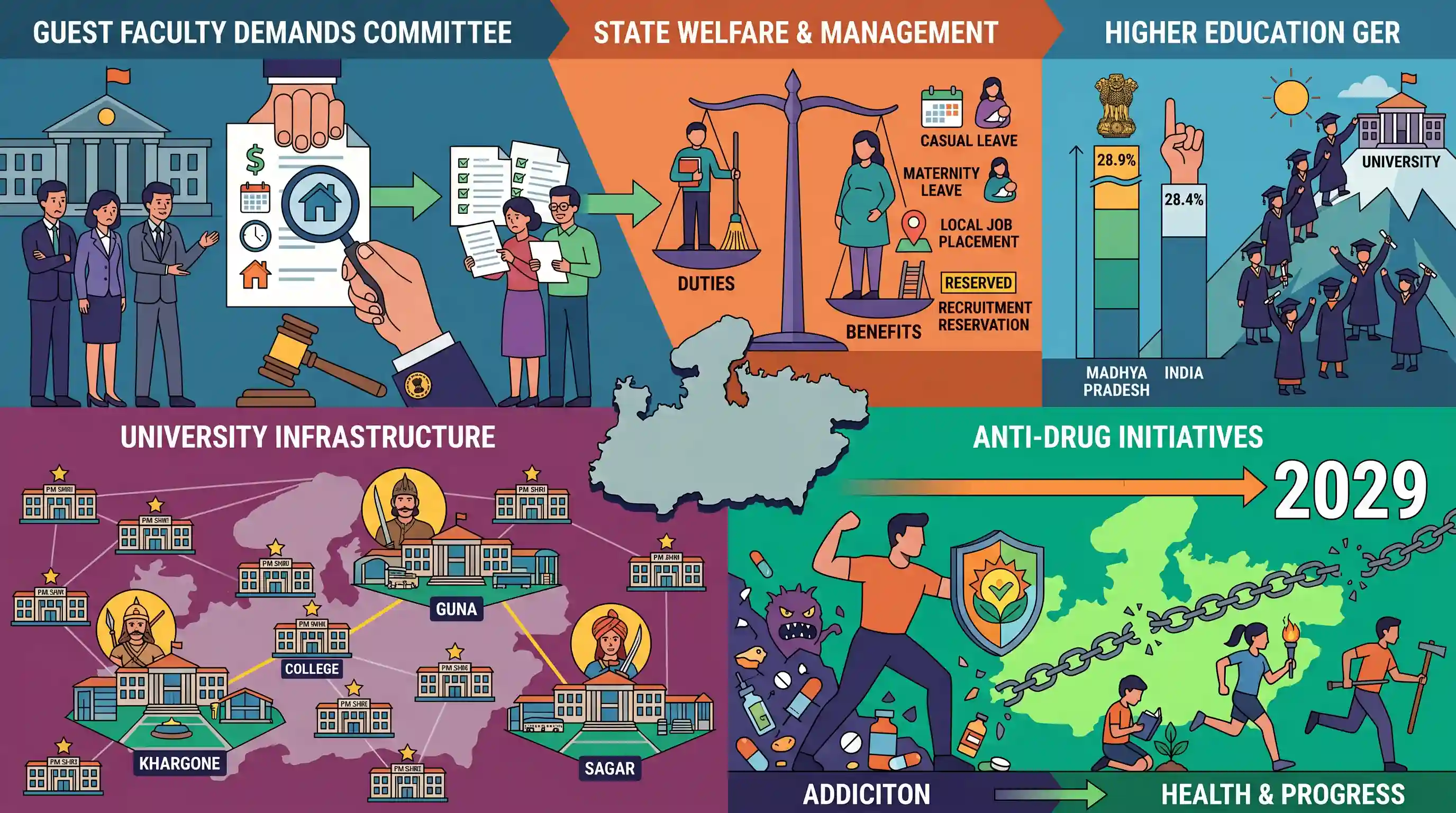
Madhya Pradesh Chief Minister Mohan Yadav announced the formation of a high-level committee to examine the demands of guest faculty members in the Higher Education and Technical Education departments. Speaking at the State-Level Guest Faculty Conference in Bhopal, the CM highlighted key state education achievements, including establishing PM Shri Excellence Colleges in every district, new universities in Khargone, Guna, and Sagar, and the state's GER surpassing the national average. He also declared a state goal to achieve a drug-free MP by 2029.
Key Points
- A high-level committee has been constituted by the Madhya Pradesh government to examine the welfare demands of guest faculty members serving in the Higher Education and Technical Education departments.
- The committee will study guest faculty models implemented in other states to develop and implement the best welfare model for Madhya Pradesh.
- Under existing provisions, guest faculty members in Madhya Pradesh get 13 casual leaves, 3 optional leaves, maternity leave, 25% reservation in MPPSC Assistant Professor recruitment, and a 10-year age relaxation.
- As part of educational developments, one PM Shri Excellence College has been established in every district of MP, and new government universities have been set up in Khargone, Guna, and Sagar.
- Madhya Pradesh's Gross Enrolment Ratio (GER) in higher education has surpassed the national average, and the school dropout rate has reportedly dropped to zero.
- The Chief Minister also appealed to youth to join the state's anti-drug campaign, aiming to make Madhya Pradesh completely drug-free by 2029 in line with the national goal.
Important Terms
PM Shri Excellence College Scheme

An educational initiative in Madhya Pradesh aimed at upgrading state colleges to implement the National Education Policy (NEP) 2020, focusing on holistic, employment-oriented, and multidisciplinary education.
UPSC context
GS-II: Government policies and social sector interventions. Tests candidates' understanding of state-level higher education reforms.
Gross Enrolment Ratio (GER) in Higher Education
A metric representing total student enrollment in higher education as a percentage of the eligible population aged 18-23, used to measure access and equity in education systems.
UPSC context
GS-II: Issues relating to development and management of Education. Tests key quantitative benchmarks of social development.
Madhya Pradesh Public Service Commission (MPPSC)
A constitutional body established under Article 315 of the Constitution of India, tasked with conducting competitive exams and advising on recruitment, promotions, and civil service matters in Madhya Pradesh.
UPSC context
GS-II: Constitutional Bodies. Tests knowledge of the structure, functions, and roles of state public service commissions.
Bharatiya Mazdoor Sangh (BMS)
A prominent central trade union organization in India that operates as a pressure group, advocating for labor rights, social security, and unorganized sector welfare.
UPSC context
GS-II: Pressure groups and formal/informal associations. Tests understanding of civil society groups and labor advocacy dynamics.
Prelims Trap
The male Gross Enrolment Ratio (GER) in Indian higher education remains higher than the female GER.
According to recent AISHE data, the female GER (31.2%) has actually surpassed the male GER. Aspirants often default to assuming male superiority in human development indicators.
Static Concepts Connected
What is Gross Enrolment Ratio (GER) and how is it calculated?
- Definition: Measures the percentage of students enrolled in a specific level of education relative to the official school-age population for that level.
- Formula: Calculated by dividing total enrollment (regardless of age) by the population of the corresponding official age group, multiplied by 100.
- Statistical Anomaly: Can exceed 100% due to the inclusion of under-aged or over-aged students who repeat grades or enter early/late.
What is the NCORD mechanism in India's anti-drug strategy?
- Structure: A multi-tier coordination portal established under the Ministry of Home Affairs to synergize drug law enforcement and demand reduction.
- Levels: Operates at four levels: Apex, State, District, and Sub-divisional, ensuring horizontal and vertical administrative integration.
- Nodal Body: The Narcotics Control Bureau (NCB) acts as the central agency and nodal point for facilitating NCORD coordination.
Cross-Topic Patterns
NEP 2020: Cooperative Federalism in Education
While education is in the Concurrent List, states customizing central NEP blueprints to establish specialized local-heritage universities shows competitive-cooperative federalism in action.
Drug Control: Policing vs Public Health Policy
Linking NCORD's enforcement with Nasha Mukt Bharat's community outreach reflects a structural shift from viewing drug abuse as a pure policing issue to a holistic socio-developmental challenge.

AISHE gender-disaggregated GER trends and the MHA's NCORD 4-pillar drug-control strategy are highly probable targets for 2026 Prelims.
Linked PYQs · 1
Linked PYQs · 1
- 2025MPPSC_PRELIMSGS1
What percentage of the Madhya Pradesh government's total expenditure budget was allocated to education in 2023-24?
