Bhopal Hosts Mango Festival to Promote Horticulture and GI Varieties
Source:khetivyapar ↗
Why It Matters
MPPSC frequently tests candidates on district-level geographical specialties (e.g., Rewa's Sundarja mango, Alirajpur's Noor Jahan), GI tags, agriculture rankings (such as MP's wheat production and vegetable productivity), and state-sponsored economic initiatives.
Summary
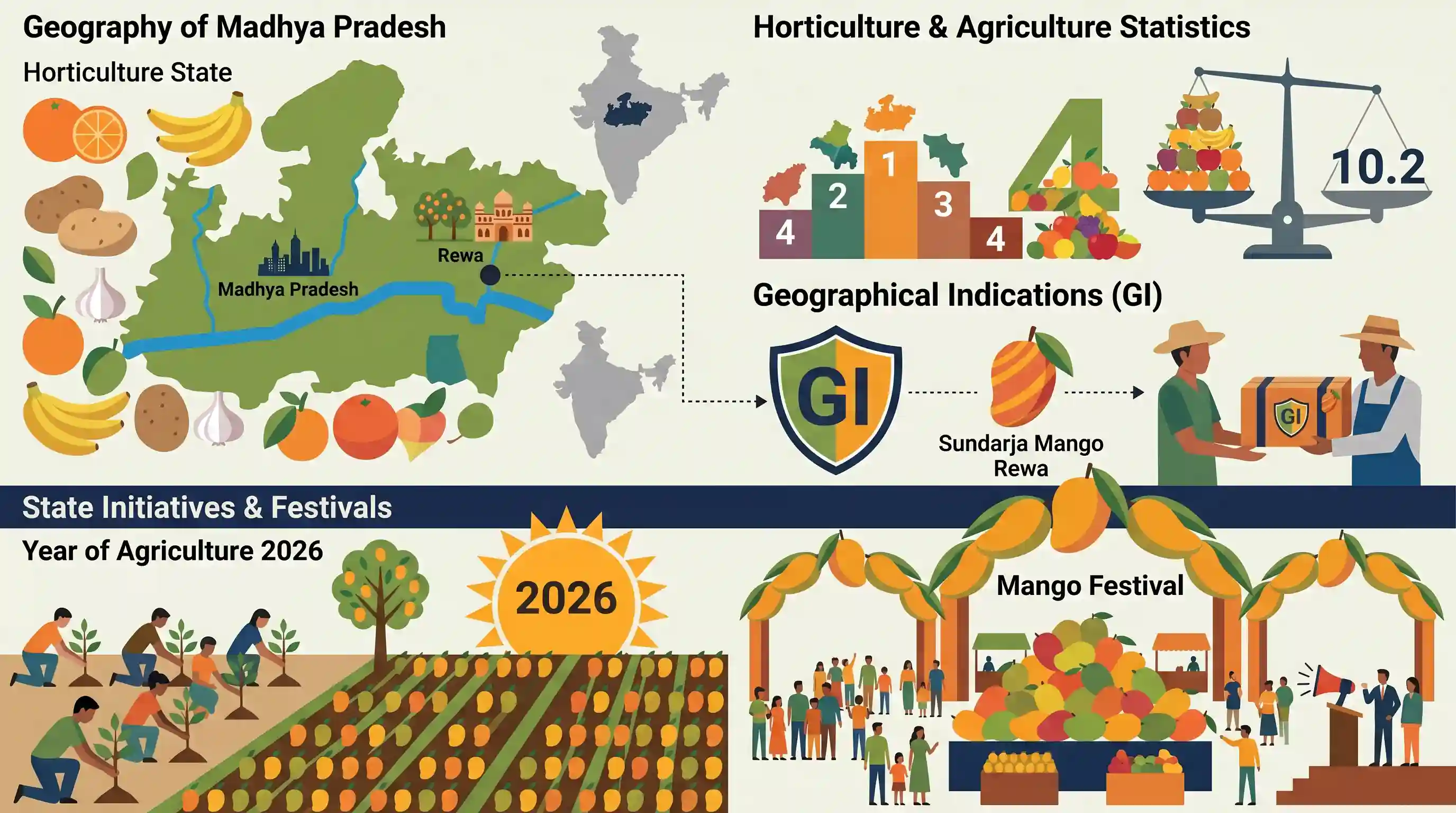
The Government of Madhya Pradesh will host the 'Mango Festival 2026' in Bhopal on June 13, 2026, to showcase the state's expanding horticulture capabilities. Madhya Pradesh ranks as India's 4th largest fruit producer, contributing 10.2 million metric tonnes to national output. Under its 'Year of Agriculture 2026' initiative, the state is expanding mango cultivation across 3,200 hectares and highlighting key regional produce, particularly the GI-tagged Sundarja Mango of Rewa district.
Key Points
- The Madhya Pradesh government is organizing the 'Mango Festival 2026' in Bhopal on June 13, 2026, to promote local mango varieties, foster direct farmer-to-buyer trade, and boost export market linkages.
- Madhya Pradesh is the 4th largest fruit-producing state in India, accounting for approximately 10.2 million metric tonnes out of India's total 117.6 million metric tonnes of fruit production.
- The state government has announced a mango cultivation expansion plan covering nearly 3,200 hectares across multiple districts including Alirajpur, Rewa, Shahdol, Sidhi, Satna, Narmadapuram, Anuppur, and Narsinghpur.
- The Sundarja Mango, native to the Rewa district, has official Geographical Indication (GI) tag recognition, boosting its commercial value and brand image in domestic and global markets.
- Madhya Pradesh has officially declared 2026 as the 'Year of Agriculture,' aiming to diversify smallholder farmers' income into high-value horticulture (fruits, vegetables, and floriculture).
Important Terms
Year of Agriculture 2026 (Madhya Pradesh)

A policy initiative declared by Madhya Pradesh to prioritize farmer welfare, expand irrigation, promote natural farming, digitize Mandis, and accelerate growth in horticulture and allied dairy sectors.
UPSC context
GS Paper 3 (Agriculture & State Policies); tests awareness of sub-national agrarian reforms and rural development strategies.
Sundarja Mango
A premium, naturally low-sugar, and fibre-free mango variety primarily grown in Govindgarh, Rewa district of Madhya Pradesh, which was granted the Geographical Indication (GI) tag in 2023.
UPSC context
GS Paper 1 (Geography) and GS Paper 3 (Agriculture); tests knowledge of region-specific GI crops and agricultural exports.
Geographical Indication (GI) Tag
A sign or name used on products that have a specific geographical origin and possess qualities, reputation, or characteristics attributable to that origin, protected under India’s GI Act of 1999.
UPSC context
GS Paper 3 (Intellectual Property Rights); tests understanding of trade-related agricultural protections and rural livelihood support.
APEDA
A statutory body under the Ministry of Commerce and Industry, established in 1986, responsible for the export promotion and market development of scheduled agricultural and processed food products.
UPSC context
GS Paper 3 (Economy & Agriculture); tests knowledge of trade facilitation institutions, export policies, and agricultural value chains.
Prelims Trap
The giant 'Noorjahan' mango is an indigenous variety native to the Rewa district of Madhya Pradesh.
Noorjahan is of Afghan origin and grown in Alirajpur, whereas Sundarja is native to Rewa. UPSC often swaps regional origins and native/exotic classifications of premium crops.
Static Concepts Connected
What is the legal framework governing Geographical Indications (GI) in India?
- Nodal Act: Governed by the Geographical Indications of Goods (Registration and Protection) Act, 1999, under the Ministry of Commerce and Industry.
- Validity Period: The registration of a Geographical Indication is valid for a period of 10 years, renewable indefinitely.
- Community Ownership: Unlike trademarks, GI tags belong to a community of producers rather than a single individual or company.
What is the mandate and role of APEDA in agricultural exports?
- Statutory Origin: Established under the APEDA Act, 1985, functioning under the Ministry of Commerce and Industry.
- Core Function: Responsible for promoting exports of scheduled products, including fresh fruits, vegetables, floriculture, and processed foods.
- GI Export Facilitation: Acts as the primary agency to set standards, improve packaging, and establish global market linkages for GI-tagged agricultural products.
Cross-Topic Patterns
GI Tags + WTO TRIPS Agreement
The TRIPS Agreement under WTO mandates international GI protection. GI tags like Sundarja help Indian exporters secure premium pricing and legal protection in global markets.
Horticulture + Climate-Resilient Agriculture
Shifting from water-intensive cereals to horticulture crops like mangoes in arid regions acts as a critical climate-adaptation strategy and diversifies smallholder income.

APEDA's promotional role in GI-tagged agri-exports and unique regional crop varieties is highly likely to be tested in Prelims 2026.
Linked PYQs · 3
Linked PYQs · 3
- 2025MPPSC_PRELIMSGS1
In Madhya Pradesh, which vegetable recorded the highest productivity in 2023-24?
- 2024MPPSC_PRELIMSGS1
According to 2021 - 22, the area and production of wheat occupies which place among cereals, in Madhya Pradesh?
- 2020MPPSC_PRELIMSGS1
750 Megawatt (MW) Solar Power Plant is situated in which district of Madhya Pradesh?
