Madhya Pradesh Wildlife Board Approves Proposals and Wildlife Exchange
Source:indianmasterminds ↗
Why It Matters
Highlights Madhya Pradesh's strategic approach to combining wildlife conservation with eco-tourism and tribal welfare. The tiger exchange program reinforces MP's status as the 'Tiger State' of India, which is highly relevant for MPPSC Prelims questions on state policies and environment.
Summary
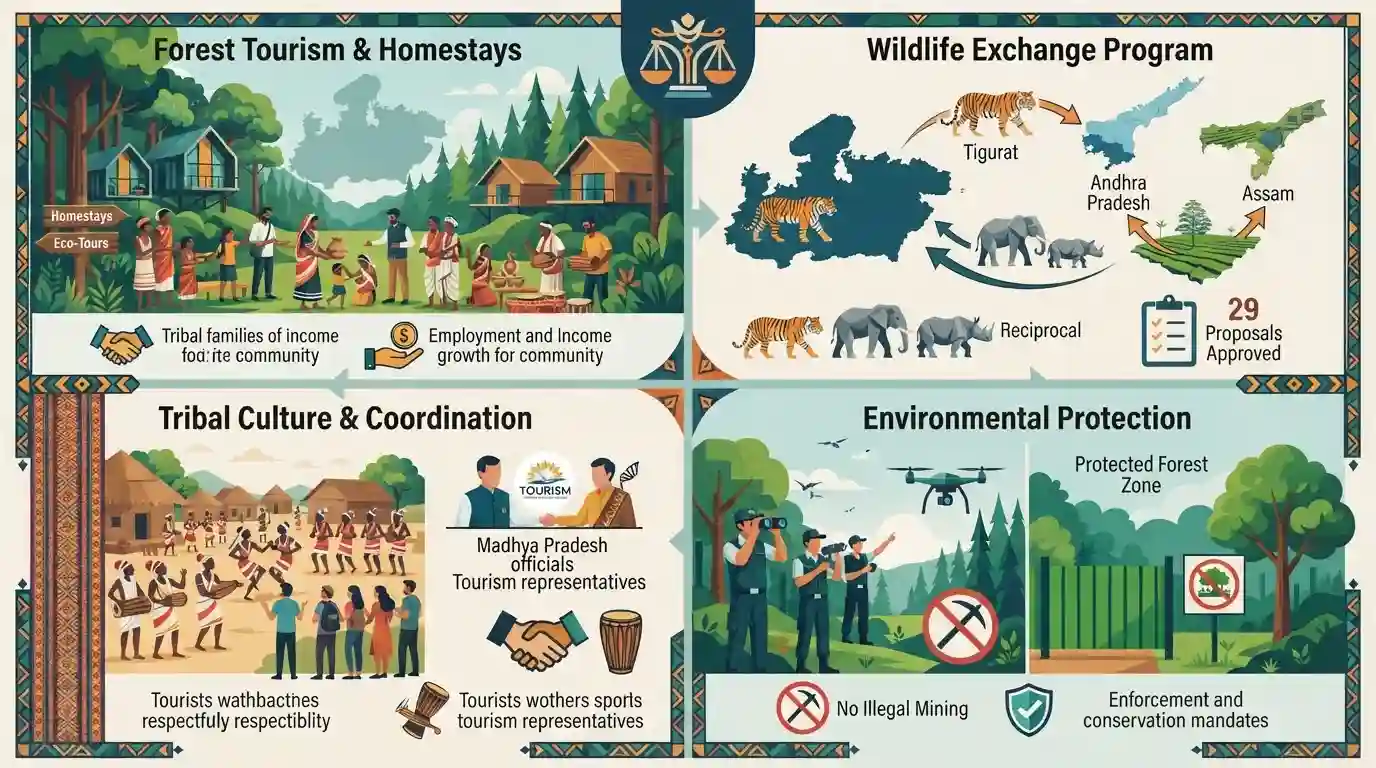
Madhya Pradesh Chief Minister Mohan Yadav has directed the Forest Department to expand forest tourism and homestays to boost employment and incomes for tribal and forest-dwelling communities. Speaking at the 32nd meeting of the State Wildlife Board, he emphasized coordinating with the Tourism Department to offer visitors experiences of local traditions. The board approved 29 proposals, including a wildlife exchange program to send tigers to states like Andhra Pradesh and Assam in return for elephants and rhinos. Strict monitoring against illegal mining and forest land diversion was also mandated.
Key Points
- MP Chief Minister Mohan Yadav directed the Forest and Tourism departments to expand forest tourism and homestays to generate employment for tribal communities.
- The decisions were taken at the 32nd meeting of the Madhya Pradesh State Wildlife Board, which also approved 29 proposals for wildlife conservation and infrastructure development.
- A wildlife exchange program was authorized, allowing MP to send tigers to Andhra Pradesh, Assam, and Karnataka in exchange for elephants, rhinos, and other wildlife.
- The Chief Minister emphasized strict monitoring to prevent the diversion of forest land and illegal mining activities.
Important Terms
Madhya Pradesh State Wildlife Board

A statutory body constituted under the Wildlife (Protection) Act, 1972, chaired by the Chief Minister. It advises the state government on wildlife conservation, policies, protected area management, and conflict mitigation.
UPSC context
Crucial for GS-3 (Biodiversity & Environment) to understand state-level institutional frameworks governing wildlife sanctuaries and conservation projects.
Forest Department
The nodal state agency tasked with managing forest resources, wildlife protection, and enforcing environmental laws. It is increasingly engaging in eco-tourism to balance conservation with tribal livelihood generation.
UPSC context
Relevant for GS-3 (Environment) and GS-2 (Governance), emphasizing the shift from regulatory policing to participatory community forest management.
Tourism Department
The state authority responsible for driving tourism development. It increasingly partners with forest agencies to promote sustainable eco-tourism and community-run homestays, ensuring tourism benefits reach local and tribal populations.
UPSC context
Important for GS-3 (Economy) regarding sustainable tourism models, tribal empowerment, and alternative livelihoods for forest-dwelling communities.
Prelims Trap
State Wildlife Boards can independently authorize inter-state tiger translocation programs.
While State Boards initiate and approve local proposals, inter-state tiger translocations legally require mandatory approval from the National Tiger Conservation Authority (NTCA).
Static Concepts Connected
What is the statutory framework for the State Board for Wildlife (SBWL)?
- Statute: Constituted under the Wildlife (Protection) Act, 1972.
- Chairperson: It is statutorily chaired by the Chief Minister of the respective state (or Administrator in UTs).
- Function: Advises the state government on wildlife conservation, selection/management of protected areas, and policy formulation.
What regulates the diversion of forest land for non-forestry uses?
- Legal Mandate: Governed by the Forest (Conservation) Act, 1980 (amended as Van Sanrakshan Evam Samvardhan Adhiniyam, 2023).
- Central Approval: Requires mandatory prior approval from the Central Government (MoEFCC) before any forest land can be diverted for mining or infrastructure.
- Advisory Body: The Forest Advisory Committee (FAC) is a statutory body that evaluates these large forest diversion proposals.
Cross-Topic Patterns
Wildlife exchange & genetic vigour
MP trading tigers for rhinos highlights how modern wildlife management relies on active inter-state animal exchanges to prevent inbreeding depression in isolated, fragmented reserves.
Ecotourism as a conservation tool
Promoting tribal homestays aligns with the MoEFCC’s 2021 Ecotourism Guidelines, transforming forest-dwelling communities from perceived "encroachers" into primary economic stakeholders in wildlife conservation.

Expect a multi-statement Prelims question testing NTCA's statutory authority versus State Wildlife Boards in inter-state translocations.
Linked PYQs · 4
Linked PYQs · 4
- 2024MPPSC_PRELIMSGS1
In whose name is the Self-Employment Scheme being run for tribals in Madhya Pradesh ?
- 2025MPPSC_PRELIMSGS1
How many total major and medium Integrated Tribal Development Projects are in existence in Madhya Pradesh in 2023-24?
- 2023MPPSC_PRELIMSGS1
Which type of forests are not found in Madhya Pradesh ?
- 2025MPPSC_PRELIMSGS1
On International Tourism Day (September 27, 2024) three villages in Madhya Pradesh were recognized by the Ministry of Tourism, Government of India, for their outstanding sustainable tourism efforts. Which of the following village was not among them?
