Ashoknagar Forest Team Attacked During Anti Timber Smuggling Operation
Source:socialnews-xyz ↗
Why It Matters
The article exemplifies the practical challenges and physical risks associated with forest conservation and administration in Madhya Pradesh. It is relevant for understanding the threats to the state's forest cover posed by illegal logging networks and the necessity for robust enforcement mechanisms.
Summary
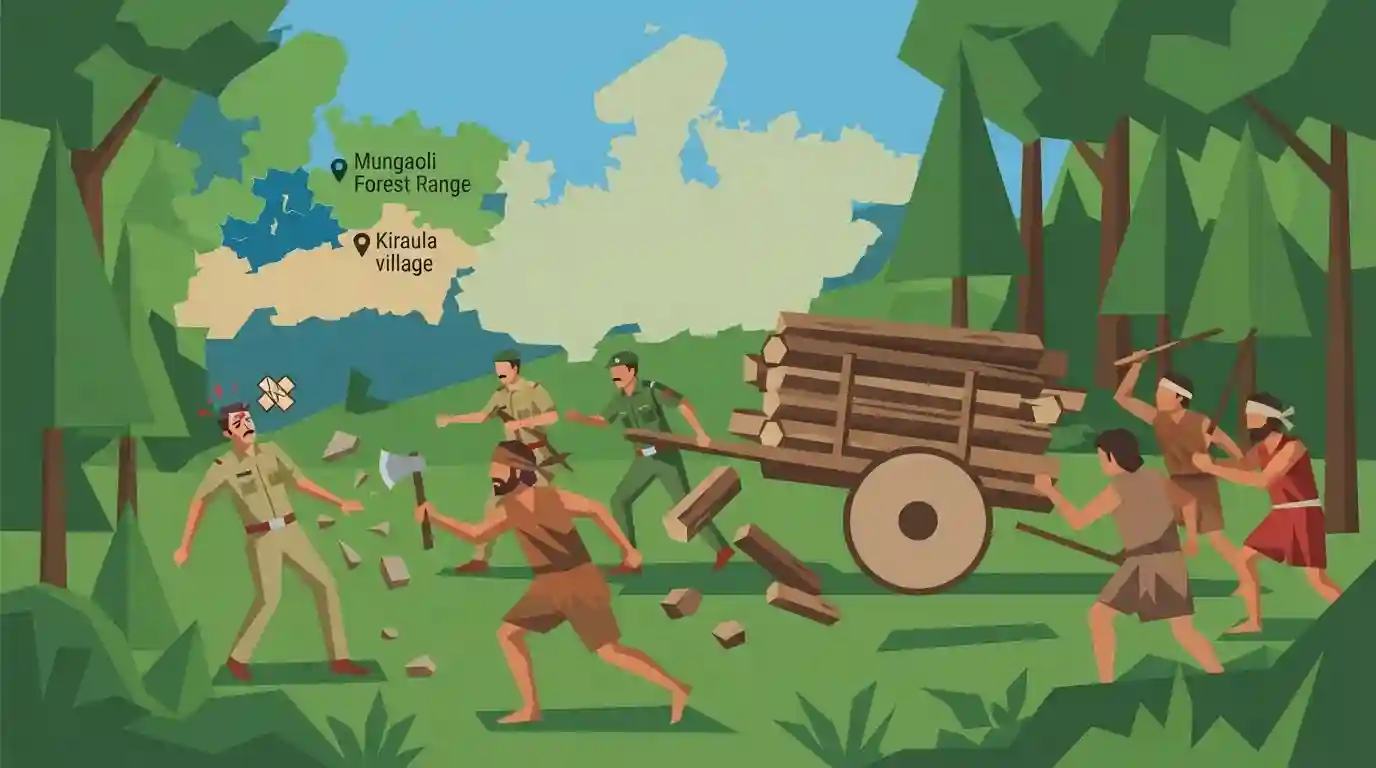
A Forest Department team in Madhya Pradesh's Ashoknagar district was violently attacked while conducting an anti-timber smuggling operation in the Mungaoli Forest Range. Near Kiraula village, attackers armed with sticks, stones, and an axe attempted to free a seized bullock cart loaded with illegally felled timber. During the confrontation, Deputy Ranger Kamlesh Batham sustained severe head injuries. Local authorities have registered a case against an identified suspect and several unknown accomplices as part of efforts to curb illegal logging activities in the region.
Key Points
- A Madhya Pradesh Forest Department team was attacked during an anti-timber smuggling operation in the Mungaoli Forest Range of Ashoknagar district.
- Deputy Ranger Kamlesh Batham suffered severe head injuries after being attacked with sticks, stones, and an axe.
- The violence erupted when attackers attempted to forcibly reclaim a seized bullock cart carrying illegally cut timber near Kiraula village.
- The incident highlights the persistent threat of illegal logging mafias and the occupational hazards faced by forest officials in Madhya Pradesh.
Important Terms
Madhya Pradesh Forest Department

The state government body responsible for managing, protecting, and conserving Madhya Pradesh's forests, which constitute the largest state forest cover by area in India.
UPSC context
GS Paper III (Environment & Geography); tests knowledge of state-level forest resource management, administrative challenges, and conservation.
Indian Forest Service
One of India’s three All India Services, established under the All India Services Act, 1951, to manage and scientifically conserve the country's forestry and wildlife resources.
UPSC context
GS Paper II & III (Governance and Environment); tests understanding of civil services structure, forest governance, and ecological policymaking.
Indian Forest Act, 1927
Colonial-era legislation consolidating forest laws, regulating the transit of timber/forest produce, and dividing forest lands into Reserved, Protected, and Village categories with associated penal provisions.
UPSC context
GS Paper III (Environment & Legislation); tests historical and legal frameworks of forest conservation, community rights, and state control.
Range Forest Officer
A state forest service gazetted officer who serves as the executive head of a Forest Range, managing field-level operations, conservation, and anti-smuggling enforcement.
UPSC context
GS Paper II & III (Administration and Security); tests knowledge of decentralized administrative hierarchies and field-level environmental law enforcement.
Illegal Logging
The unauthorized harvesting, transporting, processing, or selling of timber in violation of state and national laws, which degrades biodiversity and depletes critical carbon sinks.
UPSC context
GS Paper III (Environmental Security); tests understanding of ecological crimes, timber smuggling, and threats to forest conservation and local livelihoods.
Prelims Trap
Madhya Pradesh has the largest forest cover in India both by absolute geographical area and as a percentage of its total state territory.
While MP has the largest forest cover by absolute area (94,689 sq km), Mizoram has the highest forest cover as a percentage of its state territory (~84.5%).
Static Concepts Connected
What is the difference between Reserved, Protected, and Unclassed forests under the Indian Forest Act, 1927?
- Reserved Forests: These are areas of high protection where all activities (like grazing or timber harvesting) are prohibited unless specifically permitted.
- Protected Forests: These have moderate protection where local communities hold rights to graze or collect dry timber unless specifically prohibited.
- Unclassed Forests: These are public/private forests and wastelands not classified as reserved or protected, having the lowest degree of regulatory control.
What are the key characteristics of Tropical Dry Deciduous forests?
- Climatic Range: They thrive in regions receiving an annual rainfall of 70 cm to 100 cm, marking a transition between moist deciduous and thorn forests.
- Vegetative Adaptation: Trees shed their leaves entirely during the dry season to conserve water; common species include Teak, Sal, Bamboo, and Tendupatta.
Cross-Topic Patterns
Forest governance + Internal security conflicts
Smuggling mafias exploit remote forested borders, transforming ecological conservation efforts into high-risk internal security and local law-and-order challenges.
River hydrology + Deciduous forest ecology
The Ashoknagar dry-deciduous belt demonstrates how river systems like the Betwa shape local micro-climates, soil moisture levels, and community-dependent forest economies.

Multi-statement questions testing regional river boundaries (Betwa/Sindh) alongside ISFR forest classifications are highly likely in 2026.
Linked PYQs · 2
Linked PYQs · 2
- 2023MPPSC_PRELIMSGS1
Which type of forests are not found in Madhya Pradesh ?
- 2025MPPSC_PRELIMSGS1
According to India States of Forest Report (ISFR) 2021, which of these districts of Madhya Pradesh has forest cover less than 10 percent (% of the geographical area of the district)?
