Madhya Pradesh Chief Minister Reviews Flood Rescue Operations in State
Source:indianmasterminds ↗
Why It Matters
Floods and erratic monsoon patterns are recurring geographical phenomena in Madhya Pradesh. Understanding the distribution of rainfall (and its anomalies like localized flooding amidst state-wide deficit) is crucial for the MPPSC Prelims Geography section. Familiarity with the state's disaster response apparatus is also relevant for general state administration awareness.
Summary
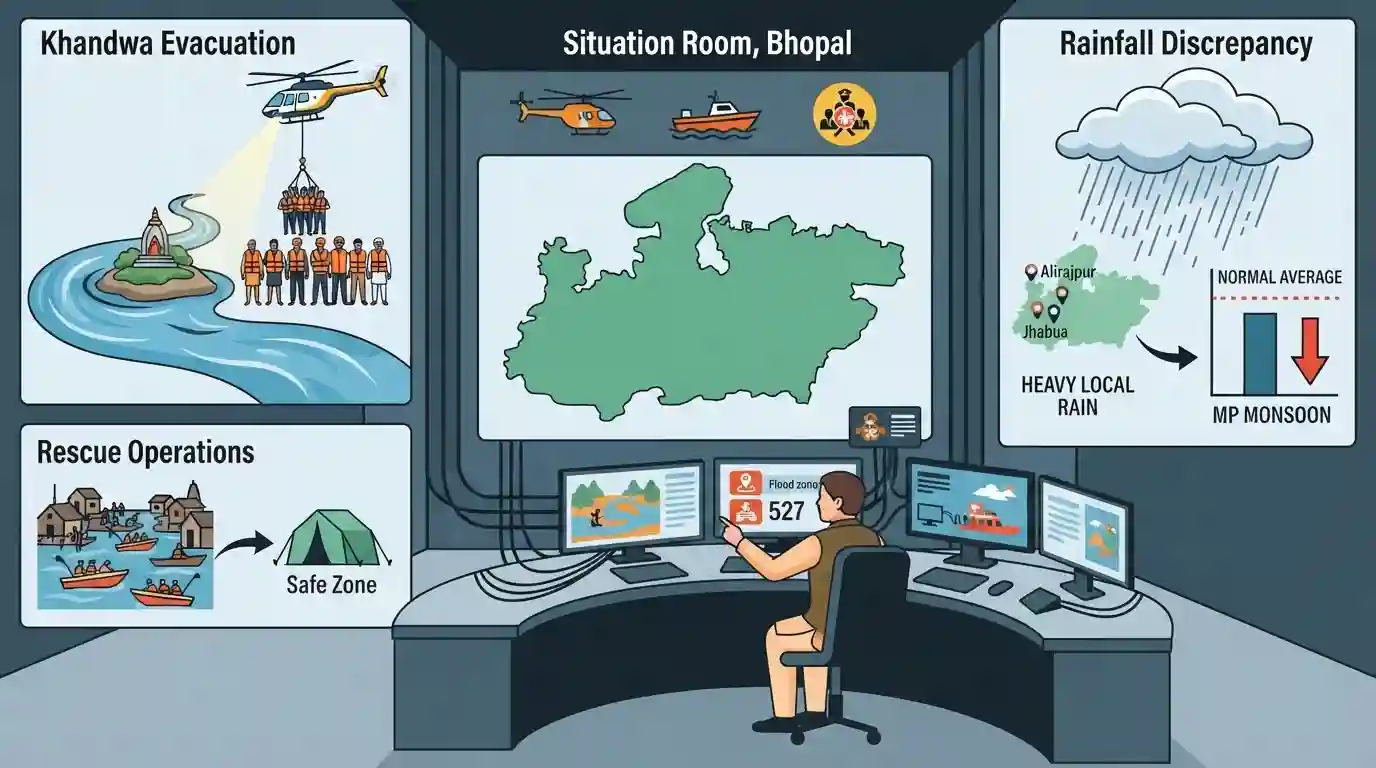
Madhya Pradesh Chief Minister Mohan Yadav reviewed ongoing flood rescue operations across the state from the Situation Room in Bhopal. Due to heavy rains in specific pockets, 527 people have been rescued so far, including a high-profile evacuation of seven Kanwariyas from a river island in Khandwa. Ironically, despite the acute localized flooding and active heavy rainfall alerts for districts like Alirajpur and Jhabua, the state’s overall monsoon rainfall is currently tracking at 15% below the normal average.
Key Points
- Chief Minister Mohan Yadav monitored state-wide rescue operations from the State Disaster Management Situation Room in Bhopal amid flooding caused by heavy rains.
- A total of 527 people have been safely rescued from various flood-affected areas across the state.
- Seven Kanwariyas stranded on an island in the Sukta river in Khandwa district were safely evacuated using boats.
- Despite the localized flooding, Madhya Pradesh as a whole has received 15% less rainfall than the normal average for this time of year.
- Heavy rain warnings (red and orange alerts) remain active for districts such as Alirajpur, Jhabua, and surrounding divisions.
Important Terms
State Disaster Management Authority (SDMA)

An apex state-level body chaired by the Chief Minister, established under the Disaster Management Act, 2005. It formulates disaster policies, approves state plans, and coordinates disaster mitigation, preparedness, and response actions within the state.
UPSC context
GS Paper 3 (Disaster Management). Tests understanding of the decentralized institutional framework for disaster management in India.
State Disaster Emergency Response Force (SDERF)
A specialized state-level force trained and equipped for swift disaster response, rescue, and relief operations. Often working alongside Home Guards, it manages localized emergencies like floods, operating under the respective state's Home Department.
UPSC context
GS Paper 3 (Disaster Management). Important for assessing state-level capacity, emergency response readiness, and local disaster mitigation mechanisms.
National Disaster Response Force (NDRF)
Established in 2006 under the Disaster Management Act, the NDRF is India's premier multi-skilled, national force dedicated to responding effectively to all types of natural and man-made disasters under the Ministry of Home Affairs.
UPSC context
GS Paper 3 (Disaster Management). Key to questions on India's central emergency response framework, disaster resilience, and statutory bodies.
Prelims Trap
Severe flooding across a region indicates that the state has recorded excess cumulative monsoon rainfall for the season.
Climate change causes high spatial variability. Extreme localized precipitation can cause severe flash floods even when the state's cumulative monsoon rainfall remains below average.
Static Concepts Connected
How does the Disaster Management Act, 2005 structure state-level response?
- SDMA Chair: The Chief Minister chairs the State Disaster Management Authority (SDMA), which lays down state-level policies and approves the state plan.
- State Executive Committee: Headed by the Chief Secretary, the SEC assists the SDMA and coordinates the actual disaster response and rescue operations.
- Situation Room: The State Emergency Operation Centre acts as the operational nerve center for active rescue missions and real-time monitoring.
What causes localized flooding during overall monsoon rainfall deficits?
- Spatial Variability: Climate change is altering monsoon patterns, intensifying extreme precipitation events in concentrated areas while reducing the overall mean rainfall.
- Moisture Dynamics: A warmer atmosphere holds more moisture, leading to short, intense bursts of rain (cloudbursts) rather than evenly distributed showers across the season.
Cross-Topic Patterns
Micro-climates & IMD alerts
UPSC often links IMD warning color codes (Red/Orange) with the changing nature of the Indian Summer Monsoon, specifically the rise in high spatial variability and extreme localized precipitation.
River mapping via disasters
Minor rivers in news for floods or rescue operations (like the Sukta) are prime targets for Prelims tributary mapping questions. Sukta is a key tributary of the Narmada system.

Expect a Prelims statement linking localized extreme flood events to monsoon spatial variability despite overall regional rainfall deficits.
Linked PYQs · 4
Linked PYQs · 4
- 2024MPPSC_PRELIMSGS1
The south-eastern part of Madhya Pradesh receives maximum rainfall from :
- 2025MPPSC_PRELIMSGS1
Read the following statements regarding the climate of Madhya Pradesh and select the correct answer from the codes given below: 1. Most of the rainfall in the state is received from the monsoon. 2. Wind speed during winters is faster than in summer and rainy seasons. 3. Distance from sea also affects the distribution of monsoon rains in the state. 4. Summer temperature in Pachmarhi is related to the altitude above sea level. Codes:
- 2018MPPSC_PRELIMSGS1
The climate of Madhya Pradesh is
- 2021MPPSC_PRELIMSGS1
Which one of the following statements is not correct regarding the climate of Madhya Pradesh?
