Chambal Sanctuary Launches Dolphin Survey Under Project Dolphin
Source:timesofindia ↗
Why It Matters
The Gangetic river dolphin is India's National Aquatic Animal, making its conservation status, habitat (specifically the National Chambal Sanctuary shared by MP, Rajasthan, and UP), and regulatory protection under the Wildlife (Protection) Act highly relevant for state and national civil services examinations.
Summary
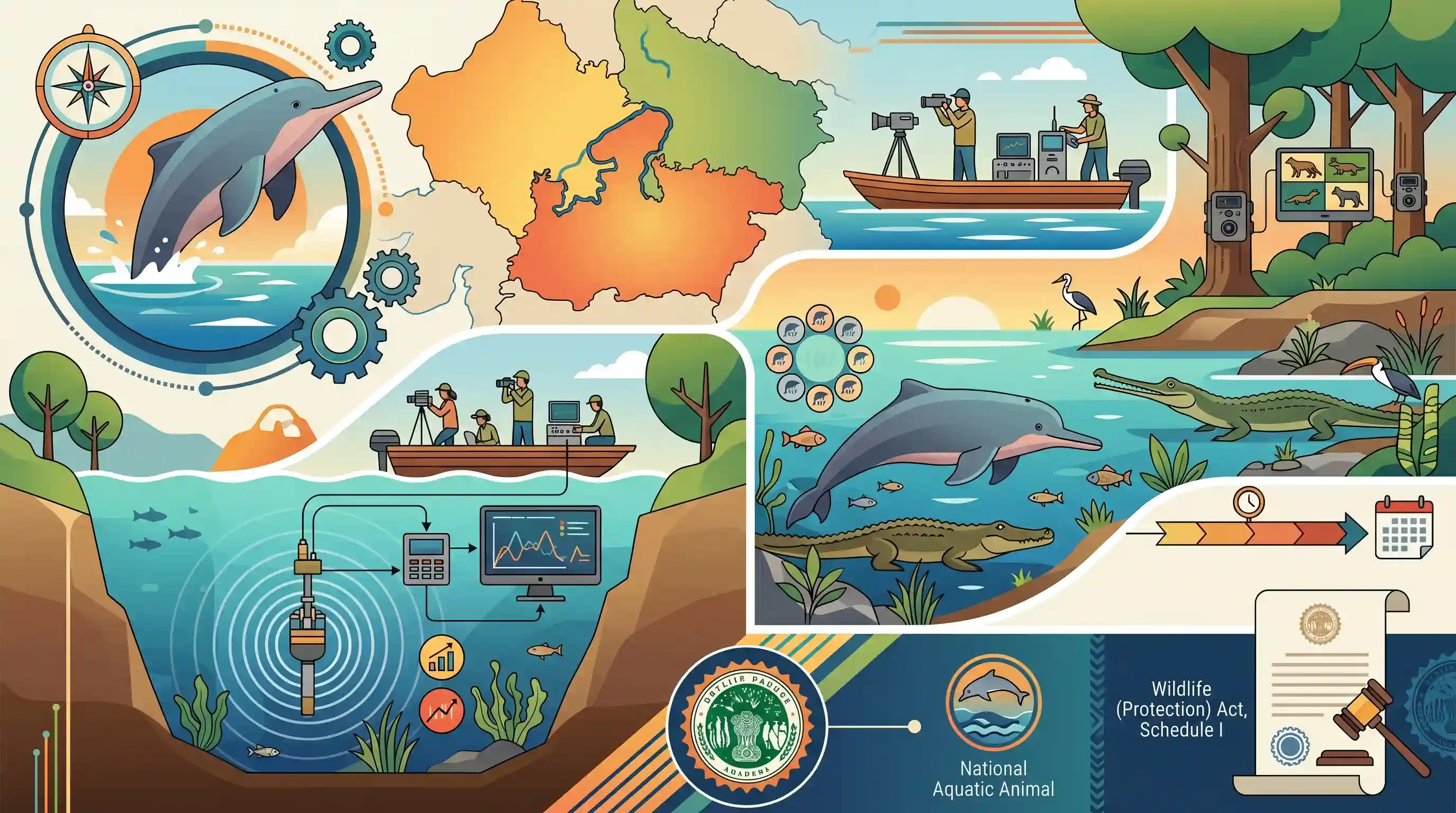
Madhya Pradesh has initiated a three-year scientific survey (2026–2028) in the National Chambal Sanctuary for the endangered Gangetic river dolphin as part of the Centre-backed Project Dolphin. Coordinated by the Wildlife Institute of India (WII), the survey employs modern underwater hydrophone technology and camera traps to estimate populations and study threats. The sanctuary, spanning MP, Rajasthan, and UP, hosts around 167 dolphins, alongside protected gharials and mugger crocodiles. The Gangetic river dolphin, designated as India's National Aquatic Animal in 2009, is protected under Schedule I of the Wildlife (Protection) Act, 1972.
Key Points
- Madhya Pradesh is launching a three-year scientific survey (2026–2028) in the National Chambal Sanctuary to study and protect the endangered Gangetic river dolphin (Platanista gangetica).
- The survey is a part of the second cycle of the 'Rangewide Estimation of Riverine and Estuarine Dolphin' under the Centre-backed Project Dolphin, overseen by the Ministry of Environment, Forest and Climate Change.
- The Wildlife Institute of India (WII), Dehradun, is coordinating the exercise in partnership with state forest departments using tools like underwater acoustic hydrophones and camera traps in Chambal's ravines.
- According to the first nationwide dolphin census (2021–2023), India had an estimated 6,327 river dolphins in major river systems, including 167 in the National Chambal Sanctuary.
- The National Chambal Sanctuary covers approximately 435 km across Madhya Pradesh, Rajasthan, and Uttar Pradesh and also serves as a refuge for other species like gharials and mugger crocodiles.
- The Gangetic river dolphin was declared India’s National Aquatic Animal in 2009 and is protected under Schedule I of the Wildlife (Protection) Act, 1972.
- The expanded second-cycle survey will also cover estuarine species like the Irrawaddy dolphin.
Important Terms
Project Dolphin

A flagship government conservation initiative launched in 2020 by MoEFCC to protect both riverine and marine dolphins, their aquatic habitats, and local livelihoods using advanced technology.
UPSC context
GS Paper III (Ecology and Biodiversity). Tests knowledge of flagship species-specific conservation programs in India.
Rangewide Estimation of Riverine and Estuarine Dolphin (Second Cycle)
A comprehensive scientific survey (2026–2028) coordinated by the Wildlife Institute of India to map and estimate populations of river and estuarine dolphins across India's aquatic habitats.
UPSC context
GS Paper III (Environment & Ecology). Tests understanding of scientific wildlife monitoring, census methodologies, and aquatic biodiversity.
Wildlife (Protection) Act, 1972
India's landmark environmental law that provides a legal framework for protecting wild animals, plants, and habitats, regulating hunting and trade, and classifying species into protective schedules.
UPSC context
GS Paper III (Environmental Legislation). Highly tested in Prelims/Mains regarding wildlife schedules, protected areas, and statutory bodies.
Wildlife Institute of India
An autonomous institution under the Ministry of Environment, Forest and Climate Change, established in 1982 in Dehradun, providing training, research, and advisory services in wildlife conservation.
UPSC context
GS Paper III (Ecology). Tests institutional frameworks, research bodies, and their roles in implementing national conservation plans.
National Board for Wildlife
A statutory apex body constituted under the Wildlife (Protection) Act, 1972, chaired by the Prime Minister, which advises the government on wildlife conservation and clearance of developmental projects.
UPSC context
GS Paper III (Environmental Governance). Tests statutory bodies, environmental clearances, and structural setups of apex conservation councils.
Prelims Trap
The Gangetic river dolphin is an indicator species inhabiting both freshwater river systems and saline estuarine ecosystems.
The Gangetic dolphin is strictly freshwater and cannot survive in saline water. The estuarine component of Project Dolphin covers other species like the Irrawaddy dolphin.
Static Concepts Connected
Why is the Gangetic River Dolphin functionally blind, and how does it navigate?
- Adaptational blindness: It lacks a crystalline lens, rendering it functionally blind; it can only detect light direction and intensity.
- Echolocation: It navigates and hunts in turbid river waters by emitting high-frequency ultrasonic clicks that bounce off prey and obstacles.
- Respiration: Surfaced breathing every 30-60 seconds due to low myoglobin levels produces a distinctive 'Susu' blow sound.
What makes the National Chambal Sanctuary unique among India's protected areas?
- Tri-state jurisdiction: It is India's only riverine sanctuary co-administered by three states: Madhya Pradesh, Rajasthan, and Uttar Pradesh.
- Lotic habitat: Specifically designed to protect a flowing-water (lotic) ecosystem rather than terrestrial landscapes, preserving fragile riverine dynamics.
- Gharial stronghold: It shelters nearly 90% of the world's remaining wild population of the critically endangered Gharial.
Cross-Topic Patterns
Riverine conservation vs federal water disputes
Sanctuary health depends on maintaining minimum ecological flow (E-flow), intersecting directly with inter-state water-sharing disputes and river-linking projects under federal environmental laws.
Passive Acoustic Monitoring in conservation technology
Using hydrophones for dolphin estimation showcases a shift toward non-invasive acoustic tools in wildlife governance, mirroring global marine conservation technologies.

Expect a 2026 question framing Chambal’s tri-state geography alongside the ecological adaptations of the blind Gangetic dolphin.
Linked PYQs · 3
Linked PYQs · 3
- 2016MPPSC_PRELIMSGS1
In which year was the wildlife protection act enforced in India?
- 2020MPPSC_PRELIMSGS1
Chambal Canal Irrigation Project is related with
- 2025MPPSC_PRELIMSGS1
The Government of India passed the Environment (Protection) Act to protect and improve the quality of environment in:
