Madhya Pradesh school education department digital attendance system
Source:bhopal-samachar ↗
Why It Matters
This development highlights how Madhya Pradesh is leveraging ICT tools ('Hamare Shikshak' App) to streamline public service administration, curb absenteeism, and enhance administrative accountability in the school education sector. Understanding such state-specific digital steps is crucial for both governance and ICT-related units of the State Service Prelims.
Summary
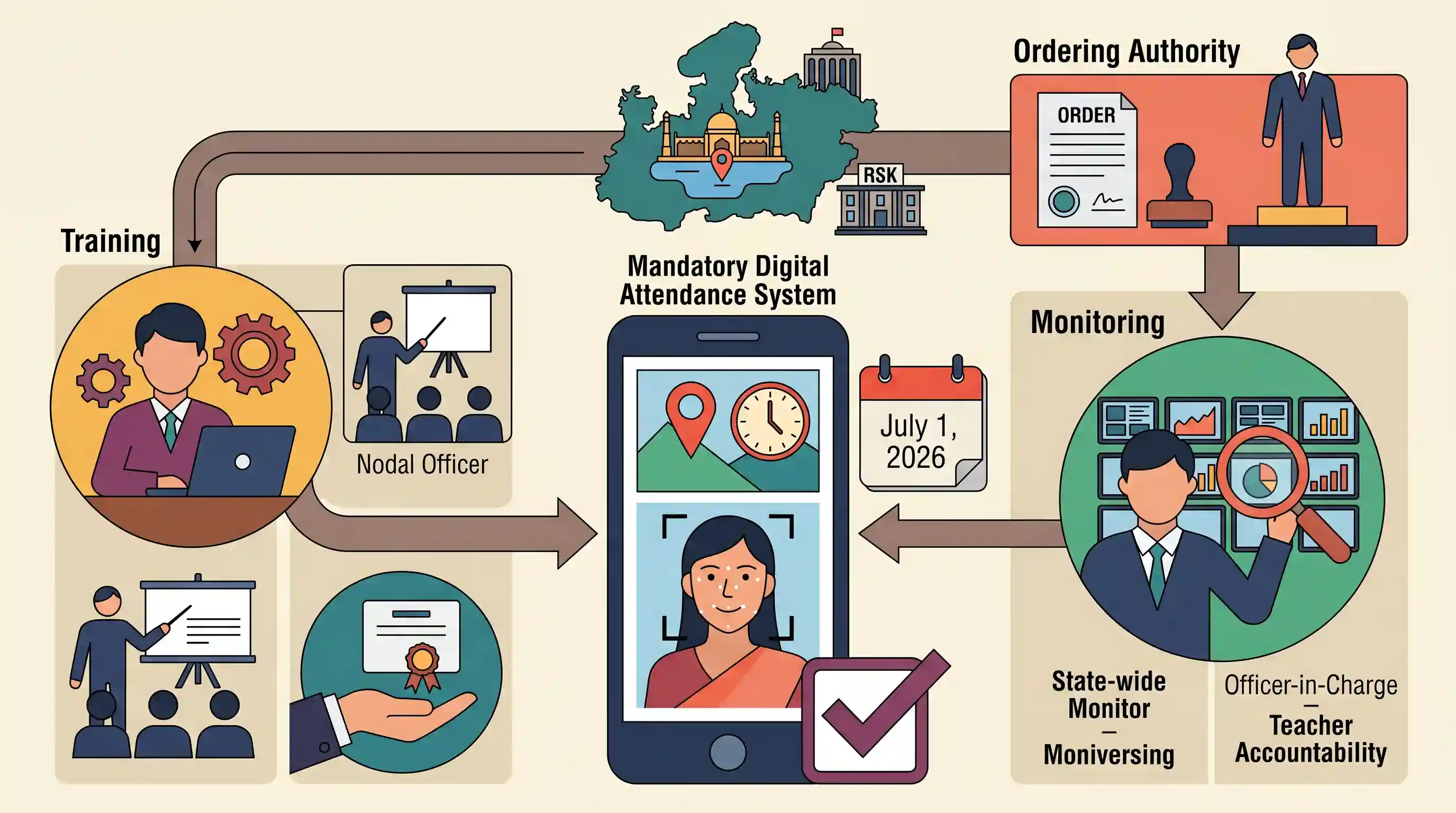
On June 25, 2026, the State Education Center (Rajya Shiksha Kendra - RSK) in Bhopal announced key administrative appointments to ensure the smooth implementation of MP's mandatory digital attendance system, starting July 1, 2026. Mr. Vivek Mishra (Programmer) has been designated as the Nodal Officer to train state and district personnel on using the 'Hamare Shikshak Mobile App'. Additionally, Dr. Arun Singh (Additional Director, RSK) was appointed as the Officer-in-Charge for system monitoring, under orders issued by RSK Director Harjinder Singh.
Key Points
- Mandatory E-Attendance: The Madhya Pradesh School Education Department will completely transition from manual attendance registers to a mandatory digital attendance (E-Attendance) system starting July 1, 2026.
- The 'Hamare Shikshak Mobile App': Government school personnel and education department staff must record their daily attendance online using the dedicated mobile application 'Hamare Shikshak'.
- Appointment of Nodal Officer: Mr. Vivek Mishra, Programmer at the State Education Center (RSK), has been appointed as the Nodal Officer to coordinate training sessions and technical support across state and district levels.
- Supervision & Oversight: Dr. Arun Singh, Additional Director of Rajya Shiksha Kendra, has been appointed as the Officer-in-Charge to oversee and monitor the implementation of the digital system.
- Administrative Issuance: The transition order and official appointments were issued by Harjinder Singh, the Director of the State Education Center (RSK) in Bhopal.
Important Terms
Hamare Shikshak Mobile App

An Android-based application developed by the Madhya Pradesh School Education Department for teachers and staff to register daily attendance via facial recognition and GPS geolocation.
UPSC context
GS Paper II: e-Governance. Tests knowledge of digital tools and ICT interventions used to bring transparency and accountability in public administration.
Rajya Shiksha Kendra (RSK)
A state-level administrative body in Madhya Pradesh responsible for primary education governance, monitoring administrative policies, and coordinating digital initiatives like e-attendance in state government schools.
UPSC context
GS Paper II: Government Policies. Tests understanding of state institutional frameworks in implementing education policies and managing digital reforms.
MP School Education Department
The primary administrative body of the Madhya Pradesh government tasked with formulation and execution of educational policies, curriculum standards, and teacher accountability measures across schools.
UPSC context
GS Paper II: State Executive. Tests structural understanding of sub-national governance systems delivering key public services like primary and secondary education.
Prelims Trap
Mandatory digital attendance systems are unconstitutional violations of privacy unless authorized by a specific legislative Act.
Courts treat digital attendance as administrative executive policy, not requiring specific legislative acts, provided reasonable offline fallbacks prevent technical exclusions.
Static Concepts Connected
How does e-governance enhance administrative accountability?
- Reducing absenteeism: Utilizes GPS and facial recognition to eliminate proxy attendance and chronic absenteeism in public service sectors.
- Real-time auditing: Generates objective, tamper-proof logs for payroll processing, reducing administrative corruption and delays.
- Policy feedback: Provides actionable metadata to assess personnel distribution and structural human resource bottlenecks.
What is the judicial stance on executive policy intervention?
- Judicial restraint: Courts rarely interfere in internal governance policies unless they violate fundamental rights or statutory mandates.
- Reasonable classification: Differentiating public servants for strict digital monitoring is deemed reasonable under Article 14 to ensure public accountability.
Cross-Topic Patterns
E-governance + Right to Education
Using digital monitoring to combat rural teacher absenteeism directly secures the qualitative objectives of the Right to Education under Article 21A.
Administrative law + Privacy limits
Balancing public sector work discipline against state employees' biometric data protection expectations under the Digital Personal Data Protection (DPDP) framework.

2026 Mains may ask how ICT tools like geo-tagged attendance balance administrative efficiency with employees' privacy rights.
Linked PYQs · 2
Linked PYQs · 2
- 2024MPPSC_PRELIMSGS1
UNNATI (Agri-GISl project of Madhya Pradesh Government is for :
- 2025MPPSC_PRELIMSGS1
What percentage of the Madhya Pradesh government's total expenditure budget was allocated to education in 2023-24?
