Datia Assembly Bypoll Protests and Legislator Disqualification
Source:The Hindu ↗
Why It Matters
This event highlights key constitutional and legal mechanisms of legislator disqualification, the geographical routing of major national highways like NH-44 in MP, and local administration challenges during state byelections, which are highly relevant for the MPPSC State Service Prelims.
Summary
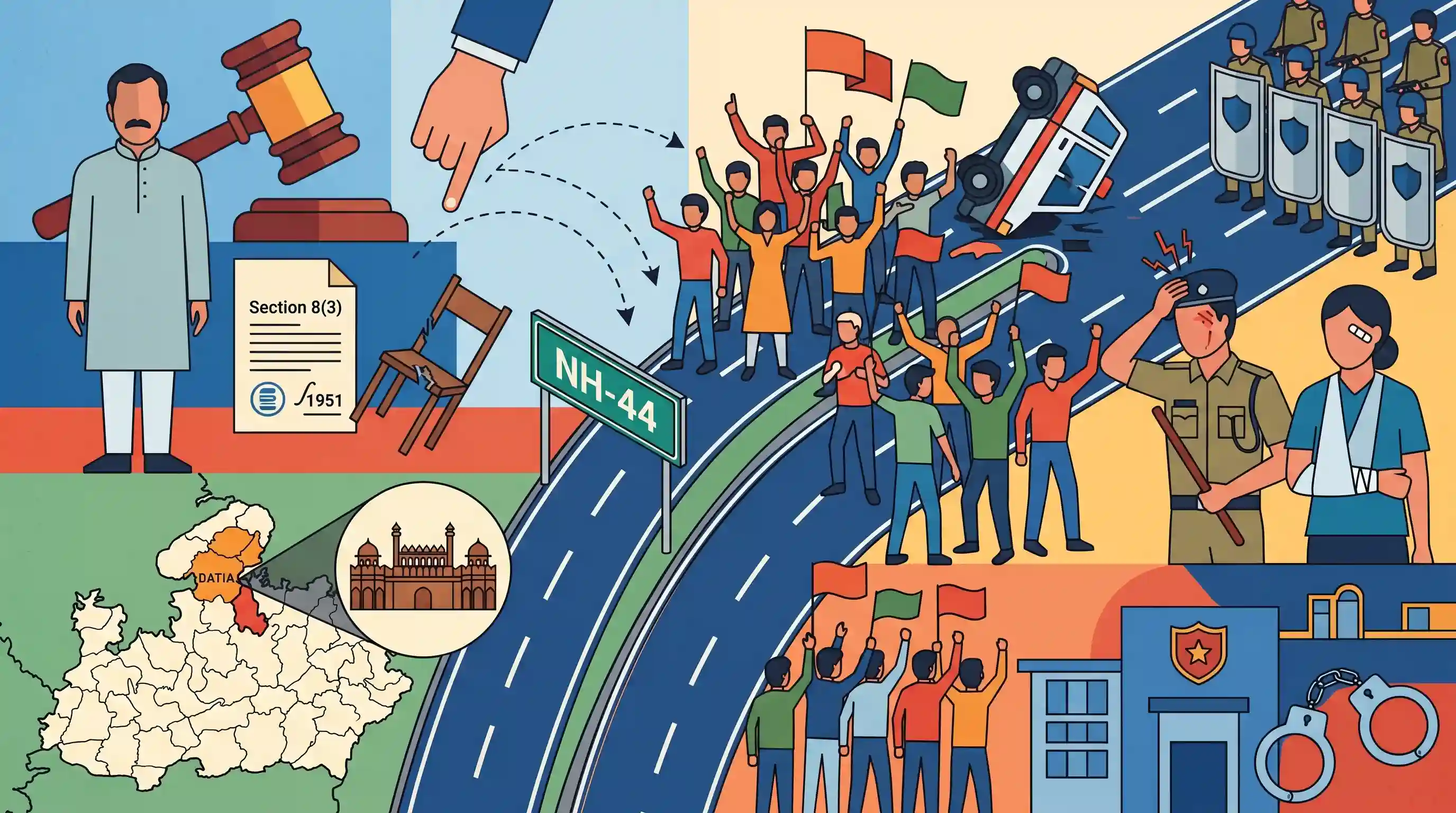
Supporters of veteran BJP leader Narottam Mishra staged violent protests and blocked National Highway 44 (NH-44) in Datia, Madhya Pradesh, after he was denied a ticket for the upcoming Assembly byelection. The byelection was necessitated by the disqualification of sitting Congress MLA Rajendra Bharti under Section 8(3) of the Representation of the People Act, 1951, following his three-year prison sentence in a cheating case. The protests turned violent, resulting in clashes with the police and injuries to the Datia SP and District Collector.
Key Points
- BJP fielded Ashutosh Tiwari for the Datia Assembly byelection scheduled for July 30, 2026, bypassing veteran leader and former Home Minister Narottam Mishra.
- The byelection was triggered because the sitting Congress MLA, Rajendra Bharti, was convicted and sentenced to three years' imprisonment in April 2026, leading to his automatic disqualification.
- Section 8(3) of the Representation of the People Act, 1951 mandates that any legislator sentenced to two or more years of imprisonment stands disqualified immediately, as upheld in the landmark Lily Thomas v. Union of India (2013) ruling.
- Angered by the ticket snub, over 3,000 supporters of Narottam Mishra blocked National Highway 44 (NH-44) in Datia for nearly 12 hours and clashed with the police, resulting in injuries to Datia SP Mayur Khandelwal and Collector Swapnil Wankhede.
- Datia is a strategically and historically significant district in Madhya Pradesh, famous for its Bundela heritage, the seven-storey Veer Singh Deo Palace, and the Pitambara Peeth temple.
- National Highway 44 (NH-44) is the longest national highway in India and traverses Madhya Pradesh, connecting key cities like Sagar and Lakhnadon.
Important Terms
Representation of the People Act, 1951

An Act of the Indian Parliament regulating the conduct of elections, qualifications and disqualifications of legislators, political party registration, and electoral dispute resolution.
UPSC context
GS Paper II (Polity & Governance); tests electoral reforms, disqualification of representatives, and democratic integrity.
Constitution of India (Article 191)
A constitutional provision outlining the grounds for disqualifying members of State Legislative Assemblies and Legislative Councils, including holding offices of profit, unsound mind, insolvency, and foreign citizenship.
UPSC context
GS Paper II (Polity); tests understanding of state legislatures, representative accountability, and federal constitutional provisions.
Model Code of Conduct (MCC)
A consensus-based set of guidelines issued by the Election Commission of India to regulate the conduct of political parties and candidates during elections, ensuring a level playing field.
UPSC context
GS Paper II (Elections); evaluates knowledge of campaign ethics, executive limitations, and fair electoral processes.
Election Commission of India (ECI)
An autonomous constitutional body established under Article 324 to superintend, direct, and control elections to Parliament, State Legislatures, and the offices of the President and Vice-President.
UPSC context
GS Paper II (Constitutional Bodies); tests knowledge of electoral machinery, constitutional powers, and institutional autonomy.
Prelims Trap
A legislator disqualified under Section 8(3) of the RPA, 1951, is barred from contesting elections only during their active prison term.
Under Section 8(3), the disqualification operates for the period of imprisonment AND an additional six years post-release, rather than ending upon release.
Static Concepts Connected
What are the key distinctions between Section 8(1) and Section 8(3) of the RPA, 1951?
- Section 8(1) Trigger: Mandates immediate disqualification for specific grave offenses (e.g., bribery, promoting enmity, rape) even if only a fine is imposed.
- Section 8(3) Trigger: Requires a minimum prison sentence of two years for any other offense to trigger automatic disqualification.
- Post-Release Ban: Under both provisions, the individual remains disqualified for six years after their release from prison.
What are the architectural features of the Veer Singh Deo (Satkhanda) Palace in Datia?
- Material Innovation: Constructed entirely of stone and brick, completely avoiding the use of wood or iron in its structure.
- Symmetric Layout: Designed on a unique symmetric 'swastika' plan, featuring five storeys above ground and two levels below.
- Architectural Style: Serves as a premier historical example of the fusion of Rajput and Mughal architectural styles (Indo-Islamic).
Cross-Topic Patterns
PRASHAD Scheme & Temple Economy
Infrastructure upgrades at sites like Pitambara Peeth link cultural preservation under the Ministry of Tourism to local service-sector economic growth and regional connectivity.
NH-44 & Logistics Efficiency
As India's longest north-south corridor, disruptions to NH-44 highlight how local law-and-order issues directly impact national supply chain resilience.

RPA 1951 Section 8 operational differences (8(1) vs 8(3)) and post-release disqualification timelines are highly likely for Prelims 2026.
Linked PYQs · 2
Linked PYQs · 2
- 2021MPPSC_PRELIMSGS1
Match List-I with List-II and select the correct answer from the codes given below : | List-I (National Highway) | List-II (Pass through) | |---------------------------|-----------------------| | A. NH 30 | i. Khajuraho | | B. NH 39 | ii. Bhopal | | C. NH 46 | iii. Sagar | | D. NH 44 | iv. Jabalpur | Codes : A B C D
- 2024MPPSC_PRELIMSGS1
Which one of the following statements is not correct ?
