Satgarhi Smart Industrial Park and Convention Centre Bhopal
Source:aninews ↗
Why It Matters
This development highlights state-specific industrial growth, infrastructure milestones (such as the largest convention centre in MP), historical political figures (Dr. Syama Prasad Mookerjee), and major administrative moves like the UCC, making it highly relevant for MPPSC Prelims (economy, geography, and current polity of Madhya Pradesh).
Summary
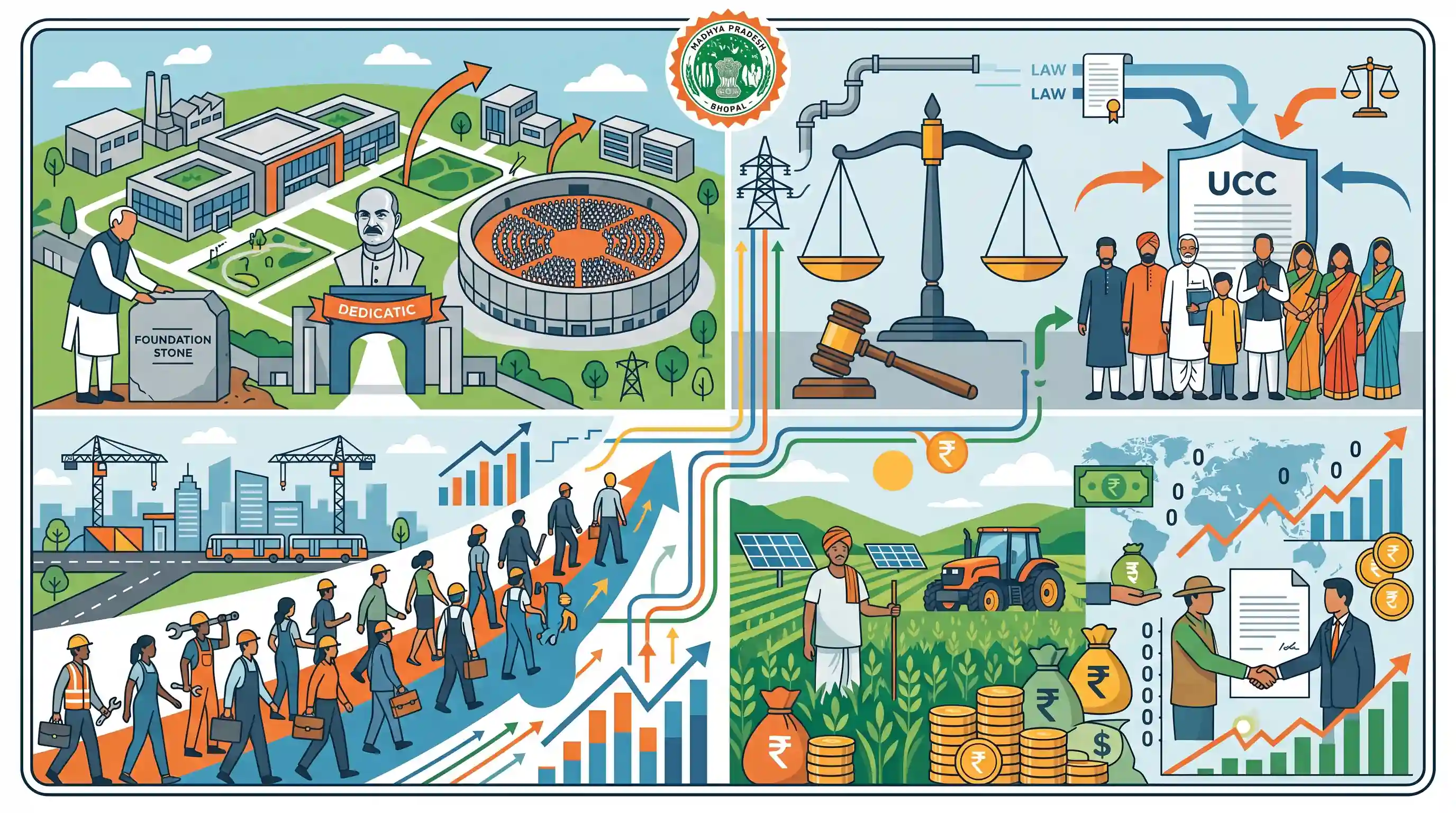
Madhya Pradesh Chief Minister Mohan Yadav laid the foundation stone for the Satgarhi Smart Industrial Park and Convention Centre in Bhopal. Named after Dr. Syama Prasad Mookerjee to mark his 125th birth anniversary, the park is designed to generate over 15,000 jobs. The site will feature MP's largest convention centre with a capacity of 10,000 seats. Concurrently, the CM declared that the state government will proceed with implementing the Uniform Civil Code (UCC) and highlighted that MoUs worth Rs 86,000 crore have been signed under 'Krishak Kalyan Varsh' since January 2026.
Key Points
- Madhya Pradesh Chief Minister Mohan Yadav laid the foundation stone of the Satgarhi Smart Industrial Park in Bhopal, which is projected to generate over 15,000 jobs.
- The industrial park has been named after Dr. Syama Prasad Mookerjee, India's first Industry Minister and founder of the Bharatiya Jana Sangh (founded October 21, 1951), on the occasion of his 125th birth anniversary.
- The project will house the largest convention centre in Madhya Pradesh, with a seating capacity of 10,000, being developed over a 25-acre area.
- Strategically located in Satgarhi, the site is 25 km from Raja Bhoj Airport, 15 km from Rani Kamalapati Railway Station, and adjacent to the proposed Western Bypass of Bhopal.
- CM Yadav announced that the state government is proceeding with plans to implement the Uniform Civil Code (UCC) in Madhya Pradesh.
- Additionally, under the state's 'Krishak Kalyan Varsh', Madhya Pradesh has signed MoUs worth Rs 86,000 crore with investors since January 2026.
Important Terms
Uniform Civil Code

A proposed common legal framework that replaces diverse religion-based personal laws with a single set of rules governing civil matters like marriage, divorce, inheritance, and adoption for all citizens equally.
UPSC context
GS Paper II (Polity & Governance); tests constitutional provisions (Article 44), personal laws, gender justice, and social reform.
Dr. Syama Prasad Mookerjee
An eminent educationist, barrister, and politician who served as independent India’s first Minister for Industry and Supply, and famously founded the nationalist political party Bharatiya Jana Sangh.
UPSC context
GS Paper I (Modern Indian History / Personalities); tests contributions of key leaders to post-independence politics and nation-building.
Bharatiya Jana Sangh
A right-wing nationalist political party founded in 1951 by Dr. Syama Prasad Mookerjee, advocating cultural nationalism and integration, which served as the political predecessor to the Bharatiya Janata Party.
UPSC context
GS Paper I & II (Post-Independence History & Political Science); tests the evolution of political parties and ideologies in India.
Krishak Kalyan Varsh
A comprehensive year-long agricultural initiative launched in 2026 by Madhya Pradesh, designed to reduce cultivation costs, increase farmer income, promote sustainable farming, and expand dairy production.
UPSC context
GS Paper III (Agriculture & Economy); tests state-level farmer welfare programs, crop diversification, and sustainable farming policies.
Prelims Trap
Uttarakhand was the first state in India to have a Uniform Civil Code in force.
Goa has continuously maintained its Portuguese Civil Code of 1867. Uttarakhand is only the first state in post-independence India to enact its own UCC legislation.
Static Concepts Connected
What were Dr. Syama Prasad Mookerjee’s key political contributions?
- Provincial Roles: Served as Calcutta University's youngest Vice-Chancellor and later as Finance Minister of Bengal Province (1941-42) under the Fazlul Haq coalition.
- Cabinet Minister: Appointed as independent India's first Minister for Industry and Supply in Jawaharlal Nehru's interim cabinet.
- Resignation & BJS: Resigned in 1950 in opposition to the Nehru-Liaquat Pact, later founding the Bharatiya Jana Sangh in October 1951.
What is the constitutional basis of the Uniform Civil Code?
- Article 44 DPSP: Enshrined as a non-justiciable directive under Article 44 of the Directive Principles of State Policy (DPSP) in Part IV.
- Concurrent List Power: Personal laws fall under Entry 5 of the Concurrent List, allowing both Centre and States to legislate on marriage, succession, and adoption.
Cross-Topic Patterns
MICE Infrastructure & Urban Economy
Bhopal's convention center mirrors national projects like Bharat Mandapam, positioning tier-2 cities as global business hubs to decentralize service-sector growth.
State UCC & Constitutional Uniformity
State-specific civil codes highlight a unique federal trend where states exercise Concurrent List powers to enact family laws, potentially fragmenting national legal uniformity.

Expect a statement-based Prelims question on post-independence figures, linking Dr. S.P. Mookerjee's Cabinet resignation to the 1950 Delhi Pact.
Linked PYQs · 1
Linked PYQs · 1
- 2022MPPSC_PRELIMSGS1
Where was the Global Investors Summit - 2023 held in Madhya Pradesh?
