Madhya Pradesh Bans Analog Paneer and Eases Employee Exam Rules
Source:the-statesman ↗
Why It Matters
Highlights the state government's proactive measures in tackling food adulteration (Food Safety and Public Health) and reforming administrative rules for the welfare of lower-rung government employees. Important for MP-specific current affairs and governance topics in MPPSC.
Summary
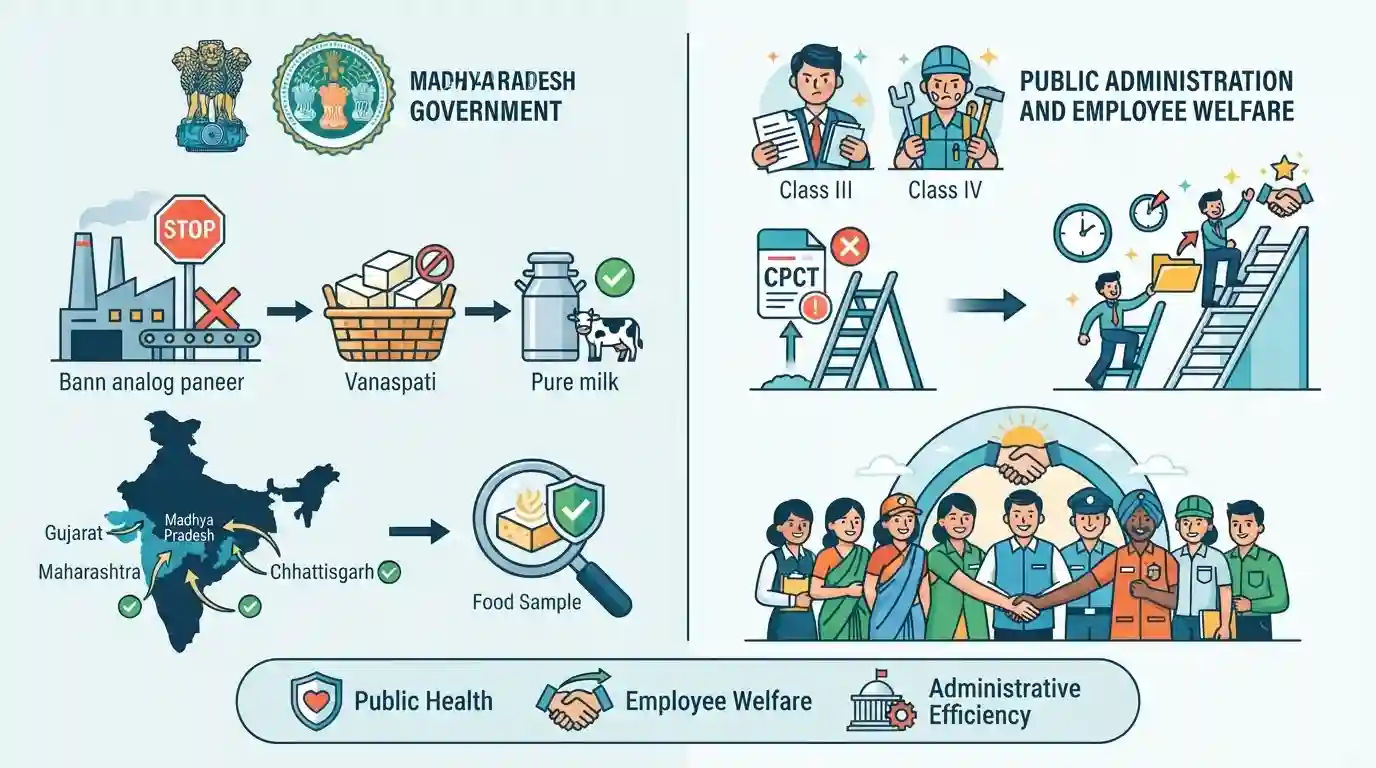
Madhya Pradesh Chief Minister Dr Mohan Yadav has issued a strict directive banning the production and sale of analog paneer, which is made using vanaspati instead of milk. This move prioritizes food safety and aligns Madhya Pradesh with states like Maharashtra, Gujarat, and Chhattisgarh that have already restricted the adulterated product. Additionally, Dr Yadav announced that the requirement to pass the Computer Proficiency Certification Test (CPCT) will no longer impede the career progression and promotions of Class III and Class IV government employees in the state. The directives emphasize the government's dual focus on public health and employee welfare.
Key Points
- Madhya Pradesh Chief Minister Dr Mohan Yadav has ordered a complete ban on the production and sale of analog paneer across the state.
- Analog paneer is an adulterated product manufactured using vanaspati instead of milk, posing public health risks.
- Madhya Pradesh joins states like Maharashtra, Gujarat, and Chhattisgarh in taking strict action against analog paneer.
- In a separate administrative directive, the CM mandated that the Computer Proficiency Certification Test (CPCT) exam should not hinder the promotion of Class III and Class IV state government employees.
- Strict campaigns against food adulteration will be run continuously to ensure the availability of pure food items in the state.
Important Terms
Analog Paneer

A synthetic imitation of paneer made using non-dairy fats like vanaspati or palm oil, starch, and occasionally harmful chemicals, instead of pure milk. Recently banned in Madhya Pradesh and other states.
UPSC context
GS Paper 2 (Health) & GS Paper 3 (Food Safety). Highlights food adulteration challenges, regulatory frameworks, and public health risks.
Computer Proficiency Certification Test (CPCT)
A standardized, computer-based exam in Madhya Pradesh that assesses IT knowledge and typing skills. It serves as an eligibility or promotion criterion for state government clerical and data-entry personnel.
UPSC context
GS Paper 2 (Governance & Public Administration). Relevant to civil service reforms, state capacity building, and digital literacy in governance.
Vanaspati
A fully or partially hydrogenated vegetable oil, often palm oil, used as a cheap substitute for dairy fat. Its unauthorized use to produce imitation dairy products constitutes illegal food adulteration.
UPSC context
GS Paper 3 (Food Processing). Tests knowledge of food adulterants, trans-fats, and the enforcement of food safety standards.
Prelims Trap
"FSSAI completely prohibits the manufacturing and sale of all dairy analogues in India."
FSSAI does not ban dairy analogues; it legally prohibits selling them under pure dairy terms (like "paneer") without explicit labelling as "non-dairy analogues" to prevent consumer deception.
Static Concepts Connected
What are trans fats and what is FSSAI's regulatory stance on them?
- Formation: Artificial trans fats are created by adding hydrogen to liquid vegetable oils (hydrogenation) to make them solid at room temperature (e.g., Vanaspati).
- Health Impact: They raise 'bad' cholesterol (LDL) and lower 'good' cholesterol (HDL), significantly increasing the risk of cardiovascular diseases.
- Regulatory Cap: FSSAI capped industrial trans fats to a maximum of 2% by mass of total oils/fats in all food products, effective January 1, 2022.
What is the statutory mandate and composition of the State Food Commission?
- Establishment: It is a statutory body constituted under Section 16 of the National Food Security Act (NFSA), 2013, to monitor the implementation of the Act.
- Structure: It consists of a Chairperson, five members, and a Member-Secretary.
- Mandatory Representation: The Act mandates that the Commission must include at least two women, one Scheduled Caste (SC) member, and one Scheduled Tribe (ST) member.
Cross-Topic Patterns
Food Adulteration + WHO REPLACE Campaign
Analog paneer relies on hydrogenated oils (vanaspati), linking state food adulteration drives directly to India's WHO commitments under the REPLACE campaign to eliminate trans fats and curb cardiovascular NCDs.
NFSA + Commission Affirmative Action
The State Food Commission's strict statutory quotas for SC/ST and women mirror the representation design in Panchayati Raj Institutions, making it a prime target for comparative polity questions.

FSSAI labelling rules for dairy analogues and the 2% industrial trans-fat cap are prime targets for a multi-statement science/polity MCQ.
Linked PYQs · 2
Linked PYQs · 2
- 2023MPPSC_PRELIMSGS1
The Food Preservation Commission is a statutory body established under which of the following Acts?
- 2020MPPSC_PRELIMSGS1
Under which law, the State Food commission is established?
