MP reviews rain situation and assures crop and property compensation
Source:dd-news ↗
Why It Matters
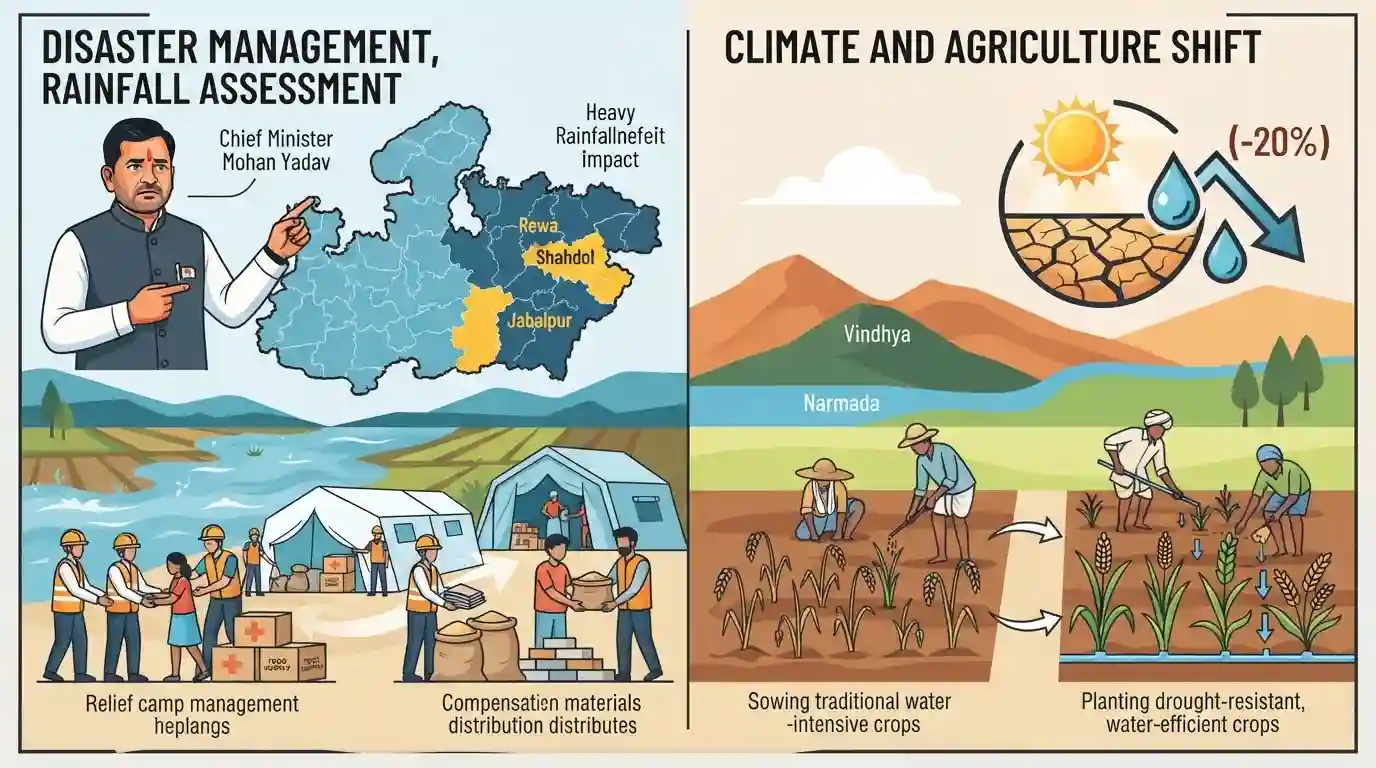
It highlights the dual climatic challenges Madhya Pradesh faces—localized extreme rainfall causing flooding in eastern districts and a broader 20% rainfall deficit across the state—necessitating dynamic disaster response and a shift toward climate-resilient agriculture and water-efficient cropping patterns.
Summary
Madhya Pradesh Chief Minister Mohan Yadav assessed the heavy rainfall impact in the Rewa, Shahdol, and Jabalpur divisions, promising complete compensation for damages while praising the administration's relief camp management. Concurrently, citing a 20% state-wide rainfall deficit, he directed the Agriculture Department to encourage farmers to adopt water-efficient crops for the post-monsoon cycle to mitigate the effects of changing weather patterns.
Key Points
- MP Chief Minister Mohan Yadav reviewed heavy rainfall and relief camp operations across Rewa, Shahdol, and Jabalpur divisions, assuring full compensation for loss of life, livestock, and collapsed houses.
- Despite localized heavy rain, Madhya Pradesh is experiencing a 20% overall rainfall deficit, prompting the CM to instruct the Agriculture Department to promote water-efficient crops for the upcoming post-rain cycle.
- The India Meteorological Department (IMD) recorded 8 cm of rainfall in Gohparu (Shahdol district), which was the highest in the state, and issued forecasts for further rain in eastern and western MP.
Important Terms
Agriculture Department (Madhya Pradesh)

The state department overseeing farm welfare and crop planning. It advises farmers on adapting to weather patterns, such as switching to low-water crops during a rainfall deficit.
UPSC context
MPPSC Paper 3 (Agriculture): Tests knowledge of state agricultural administration, cropping patterns, and farmer welfare policies.
India Meteorological Department (IMD)
The central agency under the Ministry of Earth Sciences responsible for meteorological observations, weather forecasting, and tracking extreme weather events or rainfall deficits across states.
UPSC context
MPPSC Paper 1 & 3: Crucial for Geography and Disaster Management regarding climate forecasting and early warning frameworks.
Water-Efficient Crops
Crops requiring minimal irrigation, such as millets, pulses, and oilseeds. MP promotes these during the post-monsoon cycle to ensure agricultural productivity despite statewide rainfall deficits.
UPSC context
MPPSC Paper 3 (Agriculture): Essential for topics on climate-resilient agriculture, cropping patterns, and water management in MP.
Rewa, Shahdol, and Jabalpur Divisions
Administrative zones in eastern Madhya Pradesh. Though they usually receive significant rainfall, they recently experienced heavy damage requiring state intervention, highlighting the region's vulnerability to extreme weather.
UPSC context
MPPSC Paper 1 (Geography of MP): Tests familiarity with state administrative divisions, regional topography, and climate zones.
Post-Monsoon Cycle (Rabi Season)
The agricultural season following the monsoon. Due to weather anomalies like a 20% rainfall deficit, adopting climate-resilient practices during this period is critical for Madhya Pradesh's farm output.
UPSC context
MPPSC Paper 3 (Agriculture): Important for understanding the state's cropping seasons, agricultural planning, and adaptation strategies.
Prelims Trap
"Madhya Pradesh receives its monsoon rainfall exclusively from the Arabian Sea branch due to its central location."
MP receives rainfall from BOTH branches. The convergence of both branches in eastern/south-eastern MP (Jabalpur, Shahdol) is exactly why it receives the state's highest rainfall.
Static Concepts Connected
How is monsoon rainfall geographically distributed across Madhya Pradesh?
- South-Eastern MP: Regions like Pachmarhi, Shahdol, and Mandla receive the maximum rainfall (120-150 cm) due to both monsoon branches.
- North-Western MP: Districts like Bhind and Morena receive the lowest rainfall (under 75 cm) as they lie in the rain shadow/tail-end of monsoon winds.
- Dual Branches: The state receives rainfall from both the Arabian Sea and the Bay of Bengal branches of the Southwest Monsoon.
What is the structure and funding of the State Disaster Response Fund (SDRF)?
- Primary Purpose: It is the primary fund available with State Governments for immediate response to notified disasters (like floods, droughts).
- Funding Ratio: The Central Government contributes 75% for general category states like MP, while the State contributes 25%.
- Nodal Authority: It is administered by the State Executive Committee (SEC), which is headed by the state's Chief Secretary.
Cross-Topic Patterns
Rainfall deficit and Millet promotion
The shift towards water-efficient crops links MP's changing climate vulnerabilities directly with the state's Sri Anna (Millet) promotion campaigns, a highly probable area for the agriculture syllabus.
SDRF and Center-State finances
Crop and livestock compensation triggers the State Disaster Response Fund (SDRF), making the 75:25 fiscal burden-sharing a potential overlap question bridging Disaster Management and Centre-State relations.

Expect a multi-statement question contrasting MP's overall rainfall deficit with the specific geographical distribution of maximum rainfall.
Linked PYQs · 3
Linked PYQs · 3
- 2024MPPSC_PRELIMSGS1
The south-eastern part of Madhya Pradesh receives maximum rainfall from :
- 2025MPPSC_PRELIMSGS1
Read the following statements regarding the climate of Madhya Pradesh and select the correct answer from the codes given below: 1. Most of the rainfall in the state is received from the monsoon. 2. Wind speed during winters is faster than in summer and rainy seasons. 3. Distance from sea also affects the distribution of monsoon rains in the state. 4. Summer temperature in Pachmarhi is related to the altitude above sea level. Codes:
- 2024MPPSC_PRELIMSGS1
UNNATI (Agri-GISl project of Madhya Pradesh Government is for :
