Jal Ganga Abhiyan and Water Conservation Progress in Madhya Pradesh
Source:indianmasterminds ↗
Why It Matters
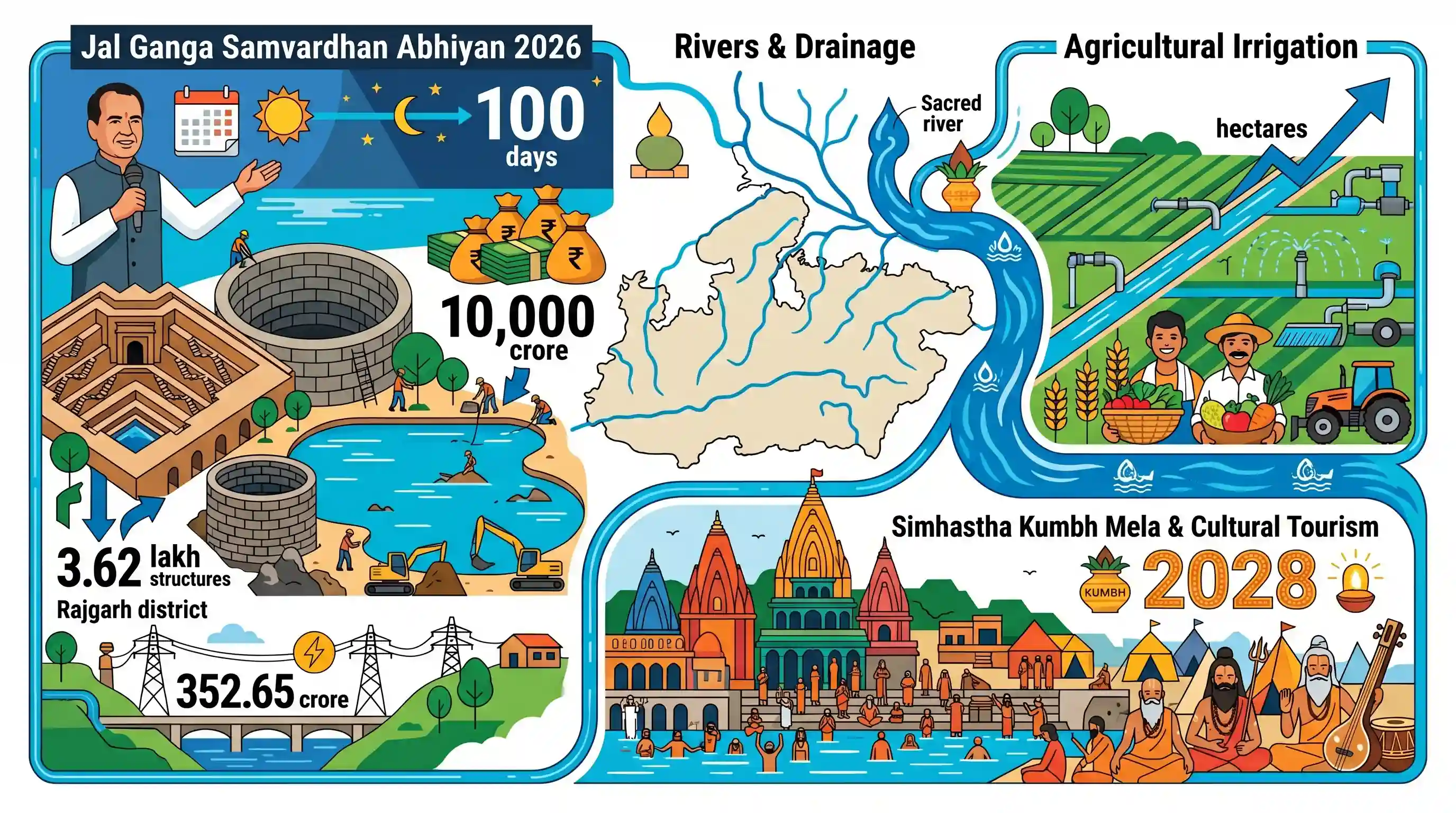
This article highlights critical state-level milestones directly relevant to the MPPSC Prelims syllabus, including water conservation metrics, agricultural irrigation expansion (from 44 to 65 lakh hectares), geographical linkages of northern-flowing MP rivers to the Ganga basin, and infrastructural planning for cultural congregations like Simhastha 2028.
Summary
Madhya Pradesh Chief Minister Dr. Mohan Yadav concluded the 100-day 'Jal Ganga Samvardhan Abhiyan 2026' (March 19 - June 30, 2026) in Rajgarh district. Under this massive ₹10,000 crore water conservation drive, approximately 3.62 lakh water structures, including wells, stepwells, and lakes, were restored or developed. The campaign takes its name from the fact that major state rivers like Chambal, Shipra, Kalisindh, and Parvati drain into the Yamuna-Ganga system. On this occasion, development works worth ₹352.65 crore were announced for Rajgarh, and key updates on the state's expanding irrigation potential (now 65 lakh hectares) and preparations for Simhastha 2028 in Ujjain were shared.
Key Points
- The 'Jal Ganga Samvardhan Abhiyan 2026' was a 100-day state-wide water conservation campaign that ran from March 19 to June 30, 2026, aimed at restoring traditional water structures.
- Nearly 3.62 lakh water structures (including wells, stepwells, ponds, rivers, and Amrit Sarovars) were developed, restored, or revived under this initiative, involving an estimated cost of ₹10,000 crore.
- The campaign is named 'Jal Ganga' because key rivers of Madhya Pradesh—such as Parvati, Chambal, Kalisindh, and Shipra—eventually flow northward to join the Yamuna and ultimately merge into the Ganga River system.
- Madhya Pradesh's total irrigated area has significantly expanded, growing from 44 lakh hectares in 2023 to 65 lakh hectares by 2026, boosting local agriculture and employment. In Rajgarh district alone, irrigated land expanded from 50,000 to nearly 2.5 lakh hectares in three years.
- A package of development projects worth ₹352.65 crore was unveiled for Rajgarh district, which includes municipal road works under the Dwarka Yojana and the construction of the Bhainswamata Lok (₹20 crore sanctioned for the first phase).
- Infrastructure preparations are being accelerated for Simhastha 2028 (Kumbh Mela) in Ujjain, which is expected to attract nearly 40 crore pilgrims, including major road connectivity projects linking Bhopal, Rajgarh, Ujjain, and Mandsaur.
Important Terms
Jal Ganga Samvardhan Abhiyan 2026

A 100-day water conservation campaign in Madhya Pradesh (March-June 2026) that revived 3.62 lakh traditional water bodies using public participation and an investment of ₹10,000 crore.
UPSC context
GS Paper III: Environment & Water Resources. Tests understanding of community-driven watershed management and ecological restoration models.
Dwarka Nagar Yojana
An urban development scheme in Madhya Pradesh introduced in the 2026-27 budget, allocating ₹5,000 crore over three years to upgrade urban local bodies, roads, housing, and infrastructure.
UPSC context
GS Paper II & III: Urbanization and Municipal Governance. Tests knowledge of state-funded urban infrastructure and municipal restructuring initiatives.
Mission Amrit Sarovar
A national water conservation initiative launched in 2022 that aimed to develop or rejuvenate 75 water bodies (ponds/sarovars) in each district of India to tackle the rural water crisis.
UPSC context
GS Paper III: Water Management and Rural Development. Tests understanding of decentralized central-state schemes for ecological resilience and sustainable irrigation.
Ladli Behna Yojana
A Madhya Pradesh state welfare scheme launched in 2023 providing direct benefit transfers (hiked to ₹1,500/month) to low-income married women to promote financial autonomy and nutrition.
UPSC context
GS Paper II: Social Justice and Welfare Schemes. Tests knowledge of gender-budgeting and direct cash transfers for vulnerable groups.
PM Kisan Samman Nidhi
A central sector scheme launched in 2019 providing direct income support of ₹6,000 annually in three equal installments to eligible landholding farmer families across India.
UPSC context
GS Paper III: Agricultural Subsidies and Farm Welfare. Tests analysis of direct income support mechanisms versus traditional input subsidies.
Madhya Pradesh Jan Abhiyan Parishad
A state government-backed organization in Madhya Pradesh promoting public participation (Jan Bhagidari) by establishing grassroots committees to execute, monitor, and disseminate welfare schemes.
UPSC context
GS Paper II: Civil Society, Governance, and Self-Help Groups. Tests institutional models designed to bridge government planning and citizen participation.
Prelims Trap
All major rivers originating in or flowing through Madhya Pradesh drain northwards into the Yamuna-Ganga river system.
While the Chambal, Betwa, Kalisindh, and Son drain into the Ganga-Yamuna system, major rivers like the Narmada, Tapi, and Mahi flow westwards into the Arabian Sea, meaning MP does not have a single-direction drainage system.
Static Concepts Connected
What are the major northward-flowing tributaries of the Yamuna and Ganga originating in the Central Highlands?
- Chambal River: Originates in the Vindhya Range near Mhow and flows north-northeast through MP and Rajasthan before joining the Yamuna in Uttar Pradesh.
- Sind, Betwa, and Ken: These rivers flow northwards from the Malwa Plateau and Bundelkhand uplands to join the Yamuna on its right bank.
- Son River: A major right-bank tributary of the Ganga that originates near the Amarkantak Plateau and flows north-northeast to join the Ganga directly near Patna.
What is the share of different irrigation sources in Indian agriculture?
- Wells and Tubewells: Account for over 60% of net irrigated area nationally (and ~66% in MP), driven by individual farmer-led groundwater extraction.
- Canal Irrigation: The second-largest source (~20%), highly prevalent in the Northern Plains and canal networks of major deltaic regions.
- Tank Irrigation: Primarily concentrated in the hard-rock plateau terrain of Southern India (e.g., Andhra Pradesh, Tamil Nadu) where digging wells is difficult.
Cross-Topic Patterns
River rejuvenation and cultural tourism
Infrastructure drives like the Shipra riverfront development for Simhastha 2028 highlight how ecological restoration of river basins directly underpins India's multi-million pilgrim cultural tourism economy.
Interstate river basins + federalism
Rejuvenation of Yamuna-bound tributaries in Madhya Pradesh directly impacts dry-season flows in downstream Uttar Pradesh and Rajasthan, testing cooperative interstate water governance models.

UPSC may couple Central Indian river drainage (Yamuna vs West-flowing) with groundwater dependency trends in national irrigation.
Linked PYQs · 5
Linked PYQs · 5
- 2022MPPSC_PRELIMSGS1
Which of the following is a major source of irrigation in Madhya Pradesh?
- 2020MPPSC_PRELIMSGS1
Chambal Canal Irrigation Project is related with
- 2013MPPSC_PRELIMSGS1
On which riverside the temple 'Mahakaal' in ujjan is situated?
- 2014MPPSC_PRELIMSGS1
What is the approximate present irrigation potential, in lakh, of Madhya Pradesh?
- 2025MPPSC_PRELIMSGS1
Match List-I with List-II and select the correct answer using the codes given below the lists: | List-I (River) | List-II (Place/Town) | |---------------------|----------------------| | (i) Betwa | 1. Balaghat | | (ii) Tapti (Tapi) | 2. Ujjain | | (iii) Kshipra | 3. Multai | | (iv) Wainganga | 4. Orchha | Codes: (i) (ii) (iii) (iv)
