Madhya Pradesh Chief Minister Integrates Electric Vehicle into Convoy
Source:indianmasterminds ↗
Why It Matters
This development highlights the intersection of sustainable mobility, leadership-led climate initiatives, and national development goals. For state services exams like MPPSC, milestones representing 'state firsts' in clean energy and sustainable governance are highly crucial. It links directly to state-level policies on renewable energy and progress in Sustainable Development Goals (SDGs).
Summary
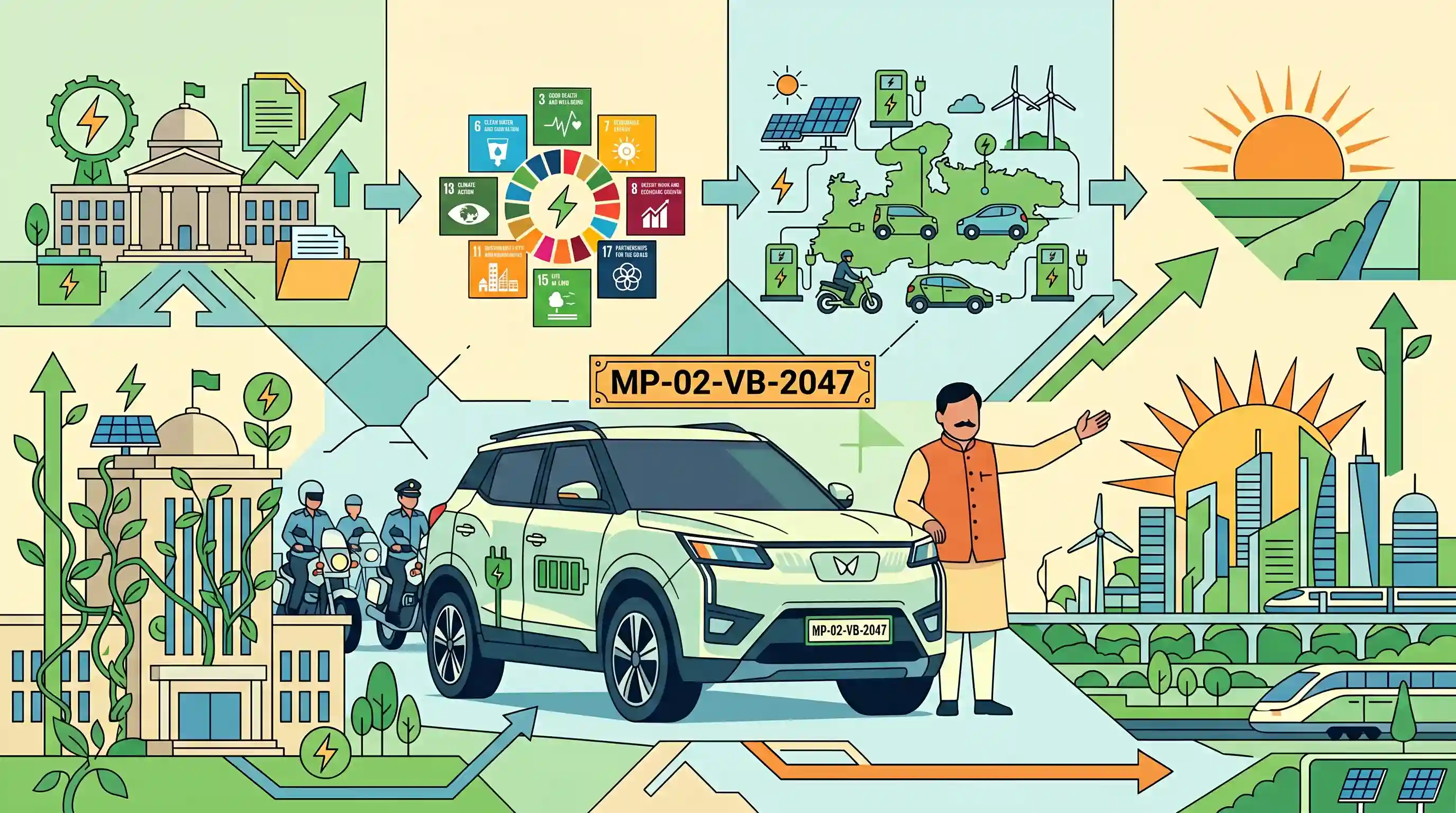
In a national first, Madhya Pradesh Chief Minister Dr. Mohan Yadav has integrated an electric vehicle, the Mahindra XEV 9e SUV, into his official convoy. Displaying the symbolic registration plate MP-02-VB-2047 ('Viksit Bharat 2047'), the move underlines MP's push towards clean energy transition, sustainable public administration, and PM Narendra Modi's vision of a developed India by 2047. The initiative is a symbolic milestone for green governance, climate action, and promoting electric mobility from the highest administrative offices in the state.
Key Points
- Madhya Pradesh Chief Minister Dr. Mohan Yadav has become the first Chief Minister in India to include an electric vehicle (EV) in his official convoy.
- The inducted vehicle is a Mahindra XEV 9e SUV, which is equipped with a range of 500 km on a single charge and high-tech features like a 360-degree camera.
- The vehicle features the registration number MP-02-VB-2047, where 'VB' stands for 'Viksit Bharat' (Developed India) and '2047' refers to the centenary year target of becoming a developed nation.
- The move is part of MP's green governance push, focusing on sustainable mobility, clean energy adoption, and reducing reliance on fossil fuels.
- This aligns with other cost-effective and simplicity-focused public administrative steps taken by CM Mohan Yadav, such as travelling via tourist buses or tempo travellers and reducing overall convoy size.
Important Terms
Viksit Bharat 2047

A government vision to transform India into a fully developed nation by the 100th anniversary of its independence in 2047, targeting economic prosperity, social advancement, and modern governance.
UPSC context
GS Paper III (Economic Development); tests long-term national growth visions, economic planning, and development targets.
Green Governance
An administrative approach that integrates environmental sustainability and ecological conservation into public policies, judicial directives, and executive decision-making processes.
UPSC context
GS Paper II (Governance) & GS Paper III (Environment); tests understanding of policy integration and administrative conservation strategies.
SDG India Index
A composite tool developed by NITI Aayog to measure, track, and rank Indian States and Union Territories on their progress toward the United Nations' Sustainable Development Goals.
UPSC context
GS Paper II (Governance) & GS Paper III (Sustainable Development); tests subnational progress tracking and cooperative federalism.
Electric Mobility
The shift from internal combustion engine vehicles to electric propulsion systems, aiming to reduce greenhouse gas emissions, urban air pollution, and oil import dependence.
UPSC context
GS Paper III (Infrastructure and Environment); tests knowledge of clean transportation policies and urban sustainable infrastructure.
Clean Energy Transition
The systemic structural shift of the energy sector from a fossil-fuel-dominated model to low-carbon, clean, and renewable energy sources to achieve net-zero commitments.
UPSC context
GS Paper III (Energy and Climate Change); tests renewable energy targets, decarbonization pathways, and net-zero strategies.
Prelims Trap
Madhya Pradesh is classified overall as an 'Achiever' state in the NITI Aayog SDG India Index due to its perfect sub-index scores.
While MP scored 100 in SDG 7 and 12, its composite score puts it in the 'Front Runner' category (65-99). A state is only an 'Achiever' if its overall composite score is 100.
Static Concepts Connected
What are the four performance categories in NITI Aayog's SDG India Index?
- Aspirant: Scores from 0 to 49, representing states/UTs in the beginning phase of SDG implementation.
- Performer: Scores from 50 to 64, showing moderate progress toward the goals.
- Front Runner: Scores from 65 to 99, denoting high performers leading the transition (e.g., MP's current composite status).
- Achiever: A perfect score of 100, meaning the state/UT has fully achieved all targeted milestones.
What ecological and technical advantages do floating solar plants (FSPVs) offer?
- Thermal Efficiency: Water acts as a natural coolant, lowering panel temperatures and increasing photovoltaic energy generation efficiency.
- Evaporation Mitigation: Shading the reservoir reduces evaporation water losses significantly, conserving precious freshwater resources.
- Algae Control: Shading restricts sunlight penetration into the reservoir, which limits harmful algal growth and preserves water quality.
Cross-Topic Patterns
Federal Competition + SDG Localization
NITI Aayog's competitive indices incentivize states to adopt green governance practices, turning global SDGs into localized, state-level policy targets.
Floating Solar + Land-Water Synergy
Deploying large-scale floating solar projects on reservoirs like Omkareshwar bypasses contentious land acquisition issues while simultaneously preventing water loss.

State-level EV mandates and NITI SDG Index categorization criteria will likely feature as a multi-statement Prelims question in 2026.
Linked PYQs · 3
Linked PYQs · 3
- 2021MPPSC_PRELIMSGS1
In which region of Madhya Pradesh Solar Floating Project of 600 MW capacity is proposed?
- 2025MPPSC_PRELIMSGS1
What was Madhya Pradesh's composite SDG (Sustainable Development Goals) score in the SDG India Index 3.0 in 2020?
- 2024MPPSC_PRELIMSGS1
What are the four pillars of E-Governance?
