Madhya Pradesh Police Promotions and Law Enforcement Initiatives
Source:indian-masterminds ↗
Why It Matters
It provides important case studies for state-level internal security modernization (SISF), criminal justice reform execution, and targeted affirmative action policies for marginalized PVTGs (Baiga, Sahariya, Bharia) in Madhya Pradesh.
Summary
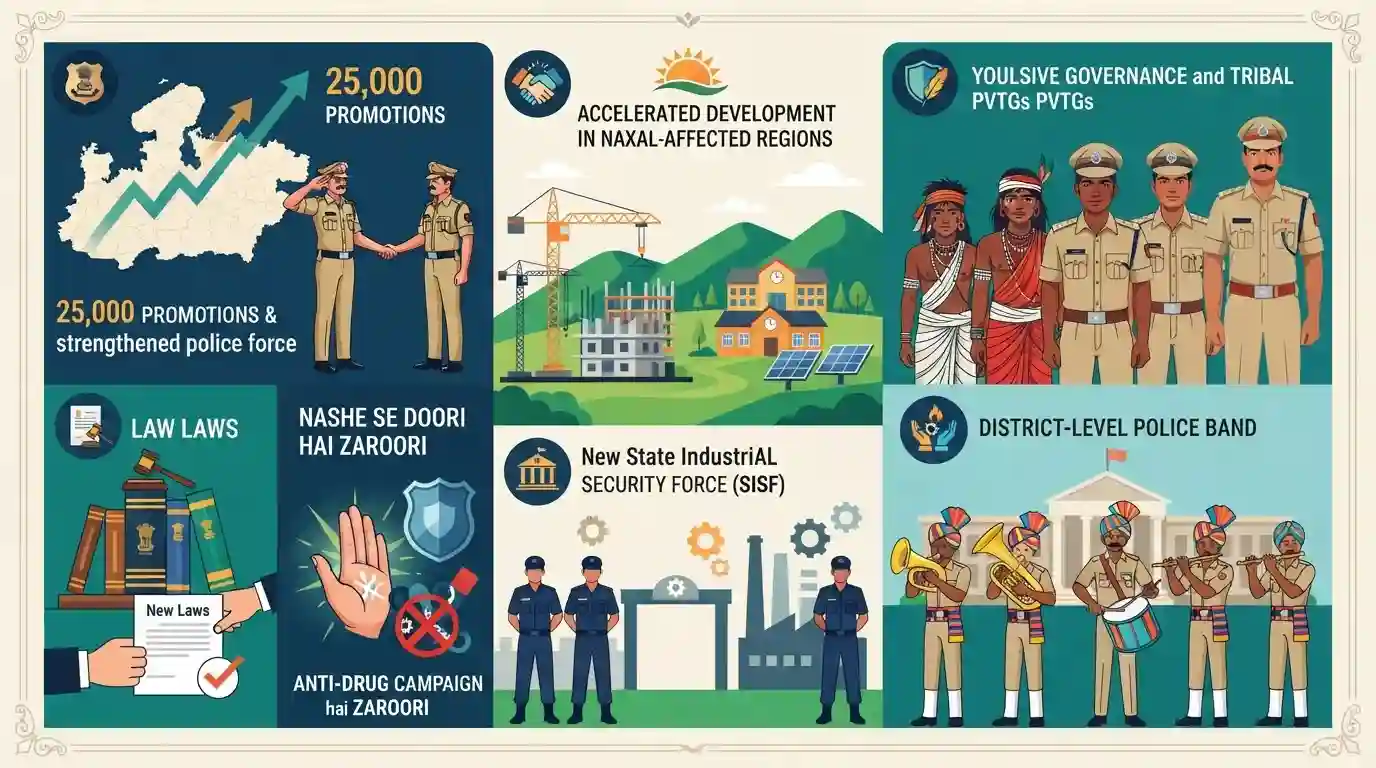
Madhya Pradesh Chief Minister Mohan Yadav announced 25,000 promotions within the state police force, underscoring a commitment to robust law enforcement and internal security. The government is focusing on the seamless implementation of the new central criminal justice laws and initiating anti-drug campaigns like "Nashe Se Doori Hai Zaroori". Furthermore, developmental drives in previously Naxal-affected areas are being accelerated. Emphasizing inclusive governance, the state is recruiting youths from Baiga, Sahariya, and Bharia Particularly Vulnerable Tribal Groups (PVTGs) into the police without written examinations, alongside forming a State Industrial Security Force (SISF) and establishing district-level police bands.
Key Points
- Madhya Pradesh executed a historic move by promoting 25,000 police personnel across various ranks to strengthen internal security and state policing capabilities.
- A State Industrial Security Force (SISF) is being established to provide localized security to industrial areas in MP.
- The state actively focuses on integrating the new Central Government criminal laws into daily law enforcement operations.
- To promote tribal welfare, youths from PVTGs (Baiga, Sahariya, and Bharia) are being directly recruited as police constables without a written exam across six districts.
- The government is maintaining strict vigilance in former Naxal-affected regions, combining security efforts with localized developmental activities.
Prelims Trap
State governments lack the constitutional power to modify state police recruitment rules or exempt groups from written examinations.
Under List II, state governments hold exclusive jurisdiction over police recruitment and can modify entry criteria (like written exams) for specific disadvantaged groups under Article 16(4).
Static Concepts Connected
What is the administrative background and criteria for identifying PVTGs in India?
- Origin: The Dhebar Commission established the 'Primitive Tribal Groups' (PTG) category in 1973, which was renamed PVTGs in 2006.
- Criteria: Pre-agricultural technology, low literacy rates, stagnant/declining population, and an extremely backward subsistence-level economy.
- Distribution: There are 75 identified PVTGs spread across 18 States and 1 UT, with Odisha hosting the highest number of these groups.
How is policing categorized under the Seventh Schedule of the Indian Constitution?
- State Subject: Both subjects are placed under Entry 2 and Entry 1 respectively of List II (State List), making states the primary authorities.
- Union Assistance: The Union can assist states during public order crises under Article 355, deploying Central Armed Police Forces (CAPFs) as needed.
- Concurrent Overlap: While the police machinery is under state control, criminal law and criminal procedure are under List III (Concurrent List).
Cross-Topic Patterns
Tribal mainstreaming as anti-LWE strategy
Integrating vulnerable tribes into local security forces addresses economic alienation, directly countering recruitment narratives of Left-Wing Extremists in critical forest corridors.
Federalism and criminal justice implementation
While criminal law is under the Concurrent List, operational execution relies entirely on state-controlled police forces, showcasing executive federalism in implementing new codes.

Multi-statement questions on PVTG criteria (Dhebar Commission) mapped alongside state-specific tribal security initiatives are likely in 2026.
Linked PYQs · 2
Linked PYQs · 2
- 2025MPPSC_PRELIMSGS1
Which one of the following is not one of the Particularly Vulnerable Tribal Group (PVTG) of Madhya Pradesh?
- 2022MPPSC_PRELIMSGS1
Which of the following tribes is often addressed as "Khutia Patel" with respect?
