Madhya Pradesh Clean Energy Capacity Exceeds 11000 MW
Source:the-statesman ↗
Why It Matters
MPPSC Prelims frequently tests candidates on specific renewable energy projects located within Madhya Pradesh (such as past questions on the Rewa and Omkareshwar solar parks). Updates on state installed capacities, new floating solar parks, and large-scale battery storage infrastructure (like in Morena) provide highly testable factual data.
Summary
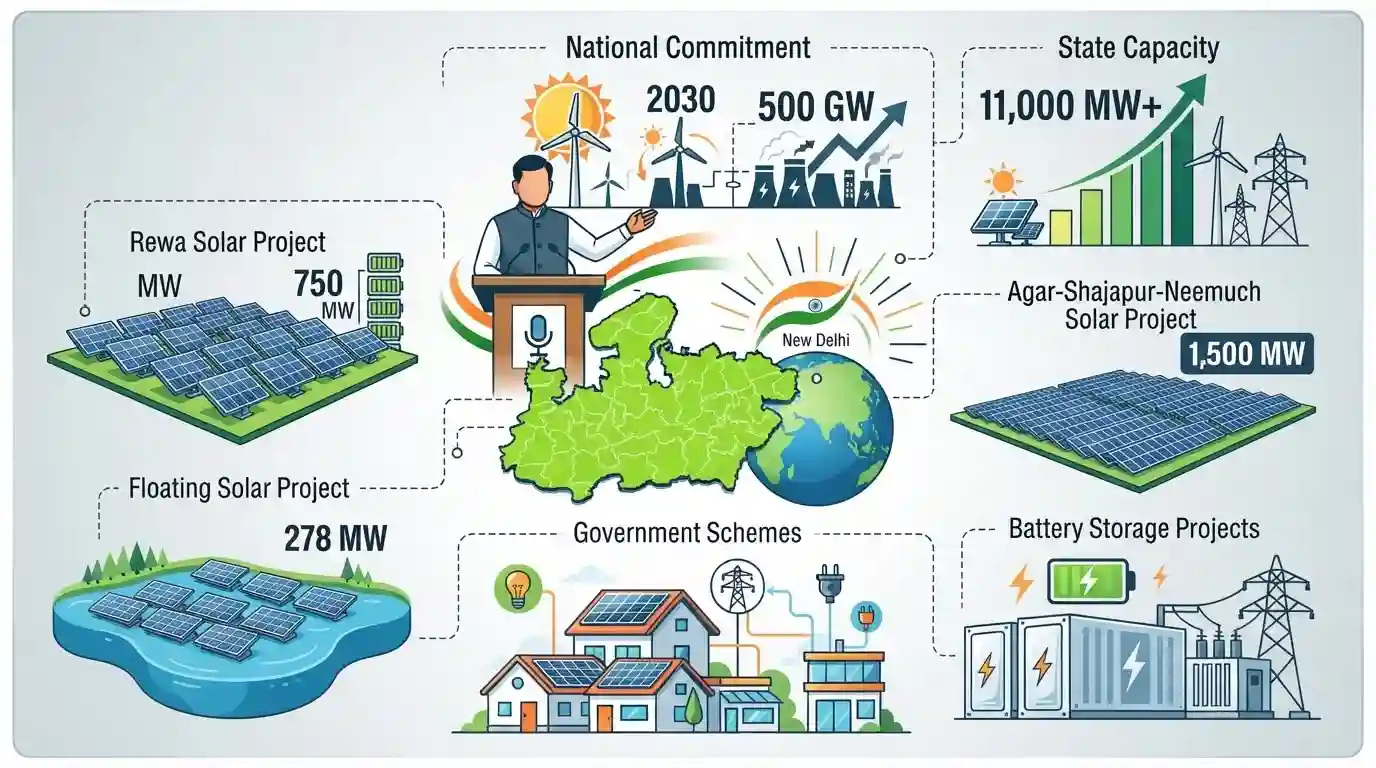
Madhya Pradesh Chief Minister Dr Mohan Yadav addressed the 7th International Renewable Energy Conference in New Delhi, reaffirming the state's commitment to India's goal of reaching 500 GW of non-fossil fuel energy by 2030. He highlighted the state's rapid growth in renewable energy capacity, which now exceeds 11,000 MW. Key milestones include the landmark 750 MW Rewa Solar Project, the 1,500 MW Agar-Shajapur-Neemuch Solar Project, a 278 MW Floating Solar Project, and advanced battery storage projects in Morena. He also emphasized the success of schemes like the PM Surya Ghar: Muft Bijli Yojana in promoting rooftop solar adoption across the state.
Key Points
- Madhya Pradesh is committed to contributing to India's target of achieving 500 GW of non-fossil fuel energy capacity by 2030.
- The state's renewable energy capacity has grown from 438 MW to over 11,000 MW in the past 12 years.
- Major state achievements include the 750 MW Rewa Ultra Mega Solar Project, the 1,500 MW Agar-Shajapur-Neemuch Solar Project, and a recently inaugurated 278 MW Floating Solar Project.
- MP is expanding battery energy storage systems, notably with a 440 MW Solar and 880 MWh Battery Energy Storage Project at Morena.
- Rooftop solar adoption is accelerating under the PM Surya Ghar: Muft Bijli Yojana, with 566 MW installed across 1.5 lakh households in MP.
Important Terms
PM Surya Ghar: Muft Bijli Yojana

A central sector scheme providing up to 300 units of free electricity monthly to one crore Indian households through rooftop solar installations.
UPSC context
GS Paper 3 (Infrastructure, Energy & Government Schemes). Tests decentralised renewable energy and solar adoption challenges.
Surya Mitra Krishi Feeder Scheme
A flagship initiative of the Madhya Pradesh government to solarise agricultural power feeders, providing reliable and affordable daytime electricity to farmers.
UPSC context
GS Paper 3 (Agriculture & Energy). Tests knowledge of agricultural feeder solarisation under KUSUM and rural power distribution.
Sustainable Development Goals
A set of 17 global goals adopted by the United Nations in 2015 to address urgent environmental, political, and economic challenges by 2030.
UPSC context
GS Paper 3 (Environment & Sustainable Development). Crucial for questions on clean energy commitments, climate action, and global targets.
Delhi Metro
A rapid transit system serving the National Capital Region of India, famously powered partly by off-site clean solar energy from Madhya Pradesh.
UPSC context
GS Paper 3 (Infrastructure). Illustrates the integration of renewable energy with mass urban transit systems for sustainable cities.
World Bank Group
A global financial partnership of five institutions providing loans and grants to developing nations to foster sustainable economic development.
UPSC context
GS Paper 2 (International Relations) & GS Paper 3 (Infrastructure Funding). Tests multilateral funding mechanisms for clean energy projects.
Harvard University
A prestigious Ivy League research university in the United States, whose business school has published case studies on Indian solar projects.
UPSC context
GS Paper 3 (Infrastructure/Energy Sector). Evaluates the global replicability, viability, and academic recognition of Indian infrastructure models.
Indian Railways
India's state-owned national railway system, which is actively procuring green solar power to meet its target of becoming a net-zero emitter.
UPSC context
GS Paper 3 (Infrastructure & Decarbonisation). Covers transition strategies of massive public utilities to green energy grids.
Prelims Trap
India's Panchamrit target is to achieve 500 GW of renewable energy capacity by 2030.
The Panchamrit pledge targets 500 GW of 'non-fossil fuel' energy capacity, which explicitly includes nuclear and large hydropower, whereas 'renewable energy' is a narrower classification that historically excluded nuclear power.
Static Concepts Connected
What are the key 'Panchamrit' climate targets announced by India?
- Non-fossil capacity: Reach 500 GW of non-fossil fuel energy capacity by the year 2030.
- Carbon emissions: Reduce the total projected carbon emissions by one billion tonnes from now onwards till 2030.
- Carbon intensity: Reduce the carbon intensity of India's economy by less than 45 percent by 2030, from 2005 levels.
- Net-Zero target: Achieve the target of Net-Zero emissions by the year 2070.
What is Grid Parity in the context of renewable energy?
- Definition: Occurs when alternative energy generates electricity at a levelized cost equal to or less than purchasing power from the traditional utility grid.
- Rewa milestone: Rewa Solar Project was the first in India to break grid parity, bidding tariffs lower than contemporary coal-fired power.
- Open-access innovation: Pioneered supplying solar power directly to an institutional buyer (Delhi Metro) across state boundaries using a robust risk-mitigation framework.
Cross-Topic Patterns
Floatovoltaics + Water-Energy Nexus
Floating solar installations like Omkareshwar reduce reservoir evaporation, conserving freshwater ecosystems while utilizing existing water body footprints to bypass complex land acquisition hurdles.
Discom Health + PM Surya Ghar
Rapid adoption of subsidized residential rooftop solar reduces high-paying domestic consumption from State Discoms, necessitating reforms in cross-subsidy structures and net-metering regulations.

Panchamrit 2030 targets vs actual capacity split (nuclear, hydro, RE) likely to be tested via analytical statements in 2026.
Linked PYQs · 3
Linked PYQs · 3
- 2020MPPSC_PRELIMSGS1
750 Megawatt (MW) Solar Power Plant is situated in which district of Madhya Pradesh?
- 2021MPPSC_PRELIMSGS1
In which region of Madhya Pradesh Solar Floating Project of 600 MW capacity is proposed?
- 2025MPPSC_PRELIMSGS1
Which of these states had the highest installed capacity of solar energy in India as on March 2023?
