Madhya Pradesh Directs Officials to Expand Farmers Welfare Schemes
Source:socialnews.xyz ↗
Why It Matters
MPPSC frequently tests candidates on specific agricultural schemes (e.g., Bhavantar Bhugtan Yojana), technology adoption in state agriculture (such as the UNNATI Agri-GIS project), and state-level events or conferences. This development highlights crucial policy goals for 2026, cooperative digitization, and Indore's role as a venue for agricultural symposiums.
Summary
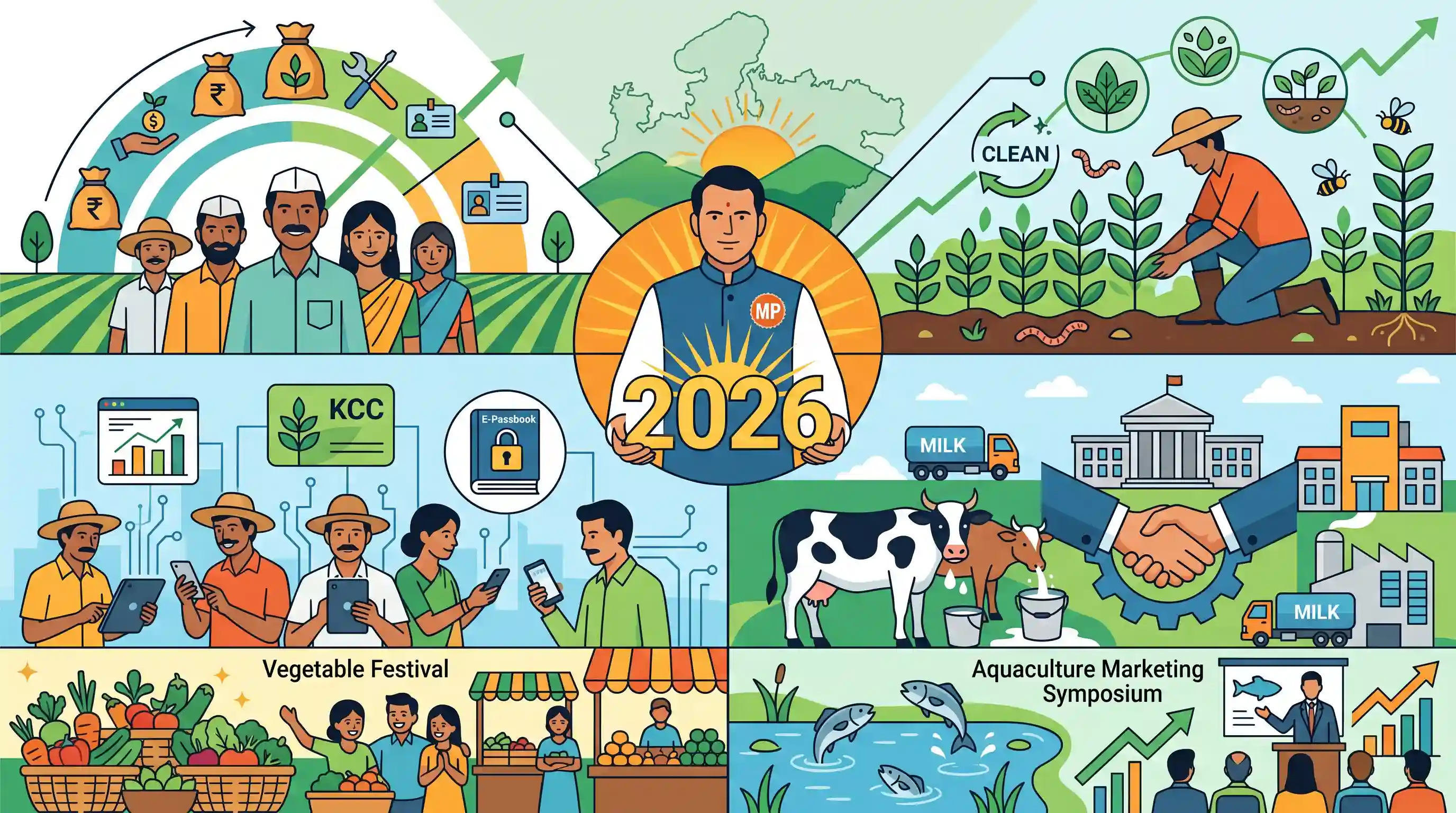
Madhya Pradesh Chief Minister Mohan Yadav reviewed the progress of the state's 'Farmers' Welfare Year-2026' (Krishak Kalyan Varsh-2026) campaign. Key directives issued include bringing more eligible farmers under welfare schemes, promoting natural/organic farming, expanding rural dairy infrastructure with high-breed cows through private partnerships, digitising cooperative societies (via an online KCC portal and e-passbook facility), and preparing for the Vegetable Festival and Aquaculture Marketing Symposium in Indore.
Key Points
- Madhya Pradesh Chief Minister Mohan Yadav reviewed the implementation of the state's 'Farmers' Welfare Year-2026' (Krishak Kalyan Varsh-2026) during a meeting at the Bhopal Mantralaya.
- The state government intends to run agricultural schemes in mission mode to lower farming costs, enhance farmers' income, and make agriculture more profitable.
- Special emphasis is being placed on promoting low-water-consuming crops, natural farming, and organic farming in Madhya Pradesh.
- To boost the dairy sector, the government plans to leverage private sector support to provide high-breed cows to farmers and expand rural dairy centres.
- In the digital cooperative sector, instructions were issued to complete the digitisation of cooperative society processes, launch an online Kisan Credit Card portal, and introduce an e-passbook facility.
- The CM reviewed arrangements for the upcoming 'Vegetable Festival and Aquaculture Marketing Symposium' scheduled to be held in Indore.
- Madhya Pradesh Agriculture Minister Aidal Singh Kanshana and senior bureaucrats briefed the CM on tech adoption, market linkages, and scheme delivery.
Important Terms
Krishak Kalyan Varsh-2026

A campaign launched by Madhya Pradesh in January 2026, coordinating 16 state departments to enhance farmers' incomes, promote digital and organic farming, and expand rural dairy and irrigation infrastructure.
UPSC context
GS Paper III: Agriculture. Tests knowledge of state-level decentralized planning, rural welfare initiatives, and multi-sectoral strategies for farmers' empowerment.
Kisan Credit Card (KCC) Scheme
A credit delivery mechanism introduced in 1998 to provide Indian farmers with timely, hassle-free access to short-term formal credit for cultivation, post-harvest expenses, and consumption needs.
UPSC context
GS Paper III: Agriculture and Financial Inclusion. Tests awareness of institutional credit mechanisms and digital reforms like online KCC portals.
AgriStack
A Digital Public Infrastructure framework that consolidates agricultural data, creating unique digital Farmer IDs linked with land records to streamline direct benefit transfers and smart farming advisories.
UPSC context
GS Paper III: E-technology in aid of farmers. Tests understanding of digital agriculture, data-driven policymaking, and rural digital infrastructure.
Cooperative Societies
Autonomous, member-owned, and democratically controlled voluntary associations of individuals who pool their resources to meet mutual socio-economic needs, operating on self-help principles.
UPSC context
GS Paper II: Polity & Constitution. Tests understanding of the 97th Constitutional Amendment, Part IXB, and rural cooperative governance.
Prelims Trap
Under the Bhavantar Bhugtan Yojana, the state government physically procures crops from farmers to maintain minimum support price levels.
The scheme does not involve physical procurement. It only pays the difference between the MSP and the model market price directly into the farmer's bank account.
Static Concepts Connected
How does Price Deficiency Payment differ from traditional MSP procurement?
- No Physical Procurement: Unlike traditional MSP procurement, the state does not buy or store commodities; it only compensates the price gap.
- Direct Benefit Transfer: Farmers sell their produce in open markets (mandis), and the price difference is paid directly to their bank accounts.
- Fiscal Efficiency: Reduces government expenditure related to logistics, transport, warehousing, and public distribution system storage.
What are the core components of the Kisan Credit Card (KCC) scheme?
- Broad Coverage: Extends credit to owner-cultivators, tenant farmers, sharecroppers, and self-help groups (SHGs) for agri-allied activities.
- Flexible Credit: Meets short-term credit requirements for crops, post-harvest expenses, consumption needs, and farm asset maintenance.
- Allied Sectors: Covers working capital requirements for animal husbandry, dairy, and fisheries sector activities.
Cross-Topic Patterns
Top-up fiscal federalism in agriculture
States supplementing central schemes (like MMKKY adding to PM-KISAN) demonstrate cooperative federalism, doubling financial impact by leveraging existing central database infrastructures.
Digital public infrastructure in agriculture
Integrating satellite-based GIS mapping with digitised cooperative land records streamlines agricultural credit delivery, minimises crop insurance disputes, and improves yield forecasting accuracy.

2026 Prelims may test agricultural reforms by contrasting physical MSP procurement with direct price-deficiency payment mechanisms.
Linked PYQs · 2
Linked PYQs · 2
- 2024MPPSC_PRELIMSGS1
UNNATI (Agri-GISl project of Madhya Pradesh Government is for :
- 2018MPPSC_PRELIMSGS1
Bhavantar Bhugtan Yojana of Madhya Pradesh is related to which sector?
