Madhya Pradesh Uniform Civil Code Draft Cabinet Clearance Plans
Source:newindianexpress ↗
Why It Matters
Madhya Pradesh's move toward implementing a Uniform Civil Code (UCC) is a major constitutional development. The exclusion of Scheduled Tribes, the regulation of live-in relationships, and the historical link of the cabinet's meeting place (Jagdishpur) to Bhopal State's founding history are highly relevant for the MPPSC Prelims across Polity, Demography, and State History sections.
Summary
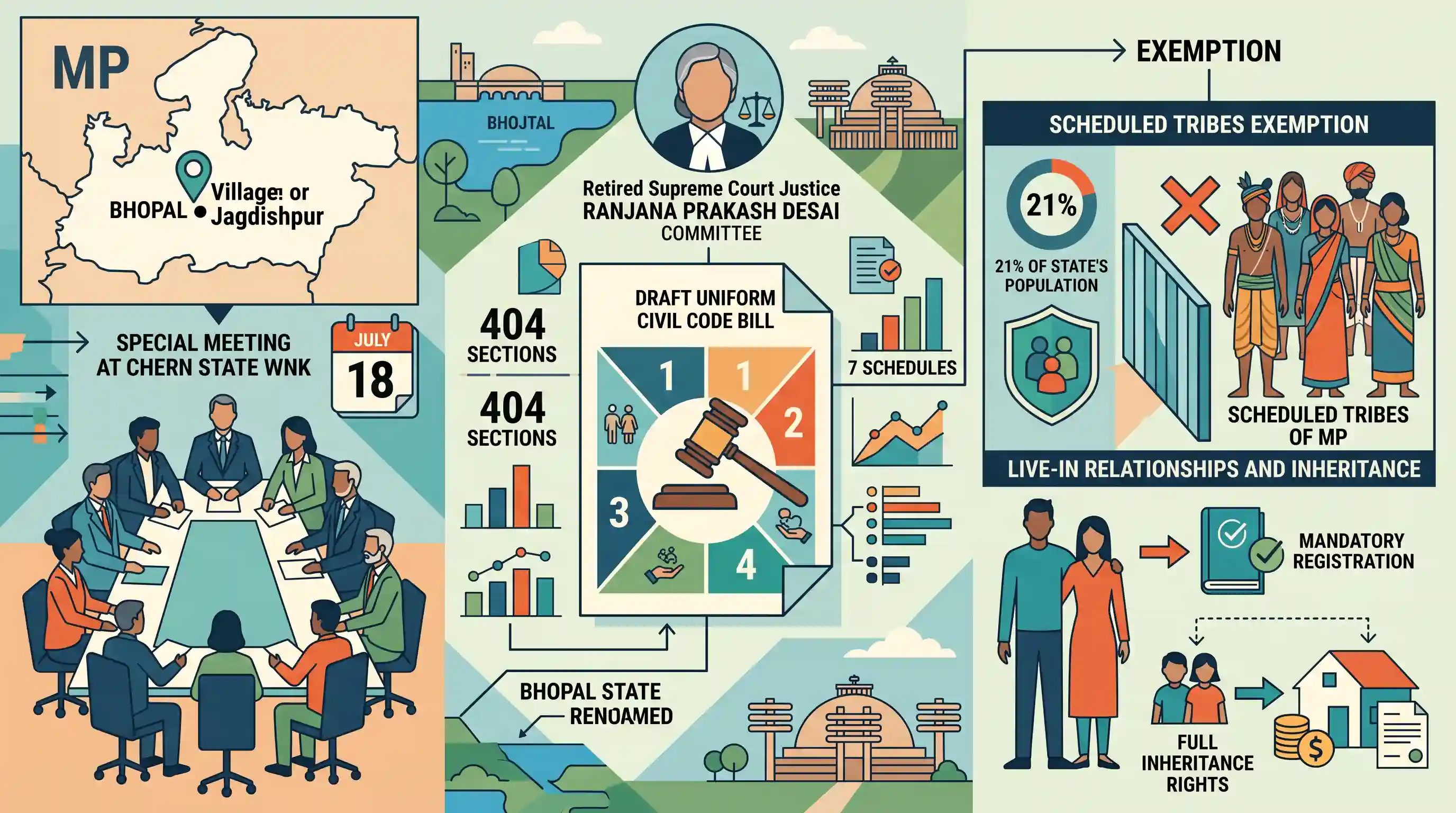
The Madhya Pradesh state cabinet is scheduled to clear the draft Uniform Civil Code (UCC) Bill on July 18, 2026, during a special meeting in Jagdishpur village near Bhopal. The draft, compiled by a high-level committee under Retired Supreme Court Justice Ranjana Prakash Desai, comprises 4 parts, 404 sections, and 7 schedules. Key recommendations include the complete exemption of Scheduled Tribes (accounting for 21% of the state's population) from the law's purview, mandatory registration of live-in relationships, and full inheritance rights for children born of such relationships.
Key Points
- Special Cabinet Meeting: The MP Cabinet will meet on July 18, 2026, in Jagdishpur village (on Bhopal's outskirts) to clear the draft Uniform Civil Code (UCC) Bill before presenting it in the Assembly's Monsoon Session (July 20–24).
- UCC Committee Chairperson: The high-level committee responsible for drafting the UCC is headed by retired Supreme Court Judge, Justice Ranjana Prakash Desai.
- Structure of the UCC Draft: The submitted draft comprises three volumes, with the draft Bill itself containing 4 parts, 404 sections, and 7 schedules. It underwent massive public consultations, receiving over 9.58 lakh responses.
- Exemptions for Scheduled Tribes: The committee has recommended keeping Scheduled Tribes (who make up approximately 21% of Madhya Pradesh's total population) completely outside the purview of the proposed UCC to safeguard their customary and traditional rights.
- Live-in Relationship Regulations: The draft mandates compulsory registration of live-in relationships and prescribes a structured registration process for separation. It also guarantees full inheritance rights for children born out of live-in relationships.
- Historical Context of Jagdishpur: The special cabinet meeting venue, Jagdishpur (formerly known as Islamnagar), was historically the seat of Bhopal's rulers and was captured/renamed by Dost Mohammad Khan, the founder of Bhopal State, before being renamed back to Jagdishpur recently.
Important Terms
Uniform Civil Code (UCC) Draft Bill

A legislative proposal to replace religion-specific personal laws with a unified, secular framework governing marriage, divorce, succession, and adoption for all citizens to ensure gender justice and equality [1.1.2, 2.1.2].
UPSC context
GS Paper II (Polity) — tests Article 44 (DPSP), secularism, federalism, gender justice, and state-level personal law reforms.
Constitution of India
The supreme law of India, establishing the country's political framework, structures, fundamental rights, and Directive Principles of State Policy that guide national and state governance [2.1.2, 2.2.4].
UPSC context
GS Paper II (Constitutional Framework) — fundamental topic testing constitutional values, federal structure, and legislative powers.
Madhya Pradesh Legislative Assembly
The unicameral legislative body of Madhya Pradesh, comprised of 230 directly elected members, responsible for enacting state laws, approving budgets, and holding the state executive accountable [2.3.1, 2.3.2].
UPSC context
GS Paper II (State Legislature) — tests the composition, powers, legislative processes, and functions of state assemblies.
Supreme Court of India
The apex judicial court under the Constitution, serving as the final interpreter of law, protector of fundamental rights, and the highest court of appeal [2.2.4, 2.2.6].
UPSC context
GS Paper II (Judiciary) — tests judicial review, appellate jurisdiction, and landmark constitutional judgments.
Madhya Pradesh Cabinet
The executive committee of the Madhya Pradesh government, headed by the Chief Minister, responsible for collective decision-making, policy formulation, and approving legislative drafts [1.2.4].
UPSC context
GS Paper II (State Executive) — tests executive powers, cabinet decision-making, and collective responsibility.
Indian National Congress
A major national political party in India, representing a key political ideology and acting as the main opposition in various legislative bodies, including state assemblies [1.2.2].
UPSC context
GS Paper II (Polity) — tests the role of opposition parties, multi-party democracy, and parliamentary oversight.
Prelims Trap
A state-level Uniform Civil Code must apply to all residents equally and cannot constitutionally exempt Scheduled Tribes.
Under Entry 5 of the Concurrent List, states have the legislative competence to enact personal laws; state UCCs can exclude Scheduled Tribes to protect customary rights.
Static Concepts Connected
What is the constitutional and legislative status of Article 44?
- DPSP Nature: Placed under Part IV of the Constitution, Article 44 is a non-justiciable directive guiding the State to secure a UCC for all citizens.
- Concurrent List: Personal laws (marriage, divorce, inheritance) fall under Entry 5 of the Concurrent List, giving both Centre and States power to legislate.
Who was Dost Mohammad Khan and what was his role in Bhopal's history?
- Founder of Bhopal: He was a Pashtun soldier who founded the princely state of Bhopal in the early 18th century (circa 1707-1723) during the Mughal decline.
- Capital at Jagdishpur: He established his early capital at Jagdishpur, renaming it Islamnagar, and constructed historic fortified palaces like Chaman Mahal.
Cross-Topic Patterns
Concurrent List and state-level civil codes
State-led UCCs highlight how personal laws under Concurrent List Entry 5 allow asymmetrical civil reforms across states, challenging the notion of a single, central national code.
Fifth Schedule vs. Article 44
Exempting Scheduled Tribes from state UCCs highlights the constitutional balance between codifying family law and preserving customary tribal autonomy under the Fifth and Sixth Schedules.

State-level UCC bills will likely trigger questions on Concurrent List competence and Fifth/Sixth Schedule exemptions for Scheduled Tribes.
Linked PYQs · 2
Linked PYQs · 2
- 2023MPPSC_PRELIMSGS1
The Directive Principles of State Policy are explained in Part IV of the Indian Constitution. This system has been taken from the Constitution of which country ?
- 2020MPPSC_PRELIMSGS1
Who was the original founder of Bhopal State?
