Madhya Pradesh Cabinet Approves CM Rise Schools Expansion
Source:freepressjournal ↗
Why It Matters
Knowledge of newly announced state schemes (like Mission Buniyaad) and significant industrial projects (India's first Telecom Manufacturing Zone in Gwalior) is vital for the MPPSC Prelims, which frequently tests candidates on specific geographical locations of industrial clusters and state welfare initiatives.
Summary
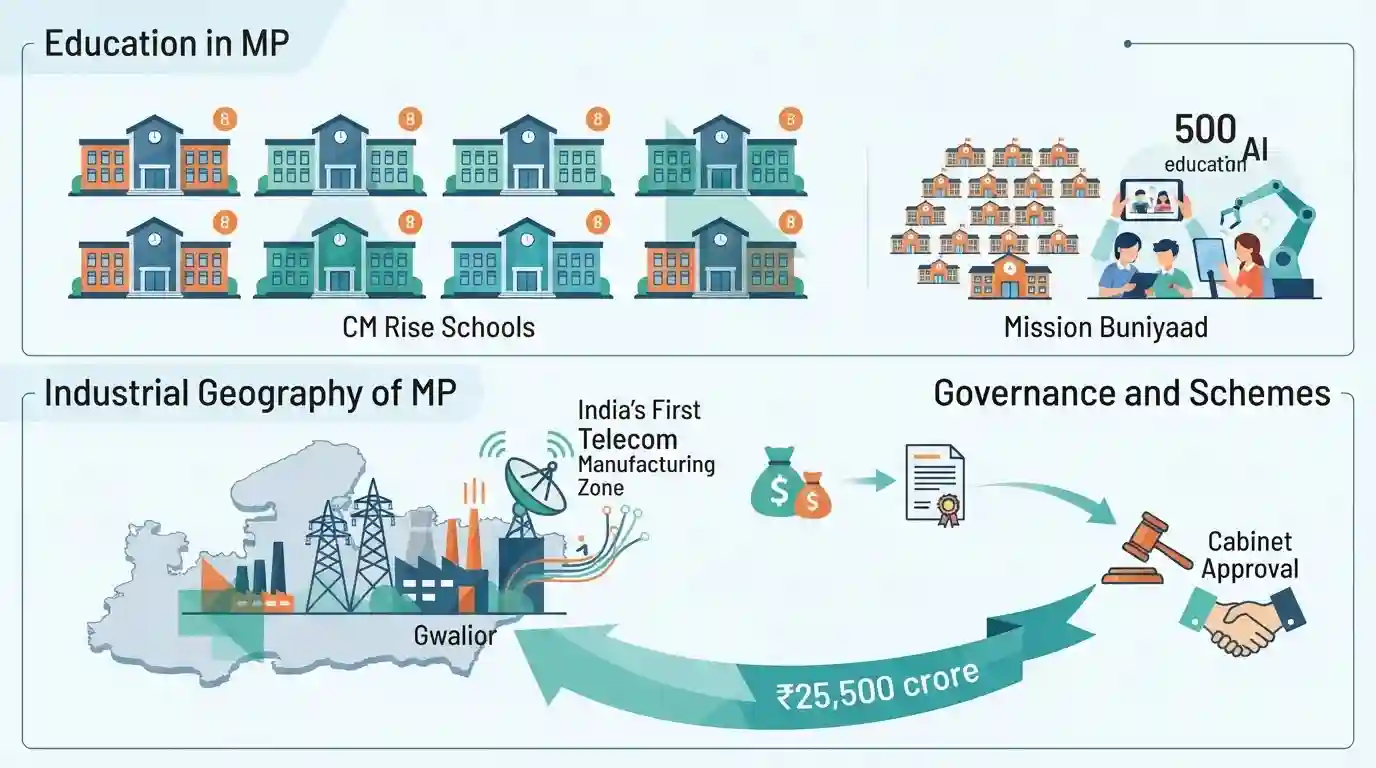
The Madhya Pradesh Cabinet recently approved a massive ₹25,500 crore investment to boost the state's education infrastructure by adding eight new CM Rise Schools and initiating the 'Mission Buniyaad' scheme to teach AI in 500 government schools. Further prioritizing industrial growth, the cabinet sanctioned the establishment of India's first Telecom Manufacturing Zone in Gwalior, reinforcing the city's status as an emerging manufacturing hub.
Key Points
- The Madhya Pradesh Cabinet, chaired by CM Mohan Yadav, approved ₹25,500 crore for establishing eight new CM Rise schools.
- India's first Telecom Manufacturing Zone will be set up in Gwalior, backed by an MoU between the state and central governments.
- The state launched 'Mission Buniyaad' to impart Artificial Intelligence (AI) education to students in 500 government schools across eight districts.
- The School Education Department announced the recruitment of 10,000 teachers.
- Schools achieving a 100% pass rate in board exams will be awarded a ₹5 lakh grant, while their principals will receive a ₹1 lakh honorarium.
Important Terms
Mission Buniyaad

An AI-based personalized learning initiative launched in Madhya Pradesh for students of classes 9 to 12. Initially rolled out in 500 government schools, it aims to integrate artificial intelligence into public education.
UPSC context
Relevant for GS Paper 2 (Education) and GS Paper 3 (IT). Highlights the integration of artificial intelligence in government schooling.
CM Rise Schools
A Madhya Pradesh government initiative to transform public schools into high-tech model institutions equipped with smart classes and modern infrastructure. These schools have recently been renamed to 'Sandipani Vidyalaya'.
UPSC context
Important for GS Paper 2 (Education). Illustrates state-level governance interventions aimed at modernizing public educational infrastructure and improving learning outcomes.
Telecom Manufacturing Zone
India’s first dedicated 350-acre industrial cluster for telecommunications equipment manufacturing, being established in Gwalior. Supported by the Central government, it aims to boost domestic electronics production and job creation.
UPSC context
Crucial for GS Paper 3 (Infrastructure). Tests awareness of Aatmanirbhar Bharat initiatives and the development of regional tech manufacturing hubs.
School Education Department
The state-level nodal agency in Madhya Pradesh responsible for administering public school infrastructure, managing teacher recruitments, and executing major educational welfare schemes like Mission Buniyaad and CM Rise Schools.
UPSC context
Relevant for GS Paper 2 (Governance). Demonstrates the role of administrative bodies in effectively executing grassroots developmental policies and educational reforms.
Prelims Trap
The Gwalior Telecom Manufacturing Zone SPV is 100% owned and funded by the Central Government.
The SPV equity is split 51% State and 49% Centre, even though the Phase-I core infrastructure is 100% funded by the Central Government.
Static Concepts Connected
How do Special Purpose Vehicles (SPVs) function in joint infrastructure projects?
- Legal Entity: It is incorporated under the Companies Act specifically for a single project to ring-fence financial risk from the parent entities.
- Equity Structure: Facilitates shared ownership and pooling of resources between the Centre, State governments, or private players (PPP).
- Operational Autonomy: Ensures faster decision-making, specialized management, and project execution independent of routine bureaucratic delays.
What are the primary schemes driving domestic telecom equipment manufacturing?
- PLI for Telecom: Offers 4-7% financial incentives on incremental sales to boost the local production of networking and telecom products.
- EMC 2.0 Scheme: Provides financial assistance to develop world-class, plug-and-play infrastructure and common facilities to attract electronics and telecom manufacturers.
- TTDF Initiative: The Telecom Technology Development Fund supports R&D and commercialization of indigenous telecom technologies, especially for rural connectivity.
Cross-Topic Patterns
Telecom zones & Cyber Sovereignty
Localizing telecom hardware manufacturing (like in Gwalior) is crucial for securing critical information infrastructure against foreign supply-chain compromises and cyber espionage.
State AI schemes & NEP 2020
MP's Mission Buniyaad operationalizes the National Education Policy (NEP) 2020’s mandate to integrate artificial intelligence and computational thinking directly into secondary school curricula.

Expect a 2026 prelims matching-pairs question linking emerging specialized industrial zones (like Gwalior's TMZ) with their states.
Linked PYQs · 3
Linked PYQs · 3
- 2023MPPSC_PRELIMSGS1
Which city in Madhya Pradesh has a cluster dedicated to the production of transformers and allied products?
- 2019MPPSC_PRELIMSGS1
In which district of Madhya Pradesh Industrial Development Center Bannore is situated?
- 2024MPPSC_PRELIMSGS1
UNNATI (Agri-GISl project of Madhya Pradesh Government is for :
