MP Kavach Yojana Launched for Cooperative Loan Relief
Source:indian-cooperative ↗
Why It Matters
MPPSC Prelims consistently features direct questions on the objectives and target beneficiaries of state-specific schemes (e.g., Ladli Behna, UNNATI). 'Kavach Yojana' is a highly probable question area regarding state initiatives in the agriculture and cooperative sectors.
Summary
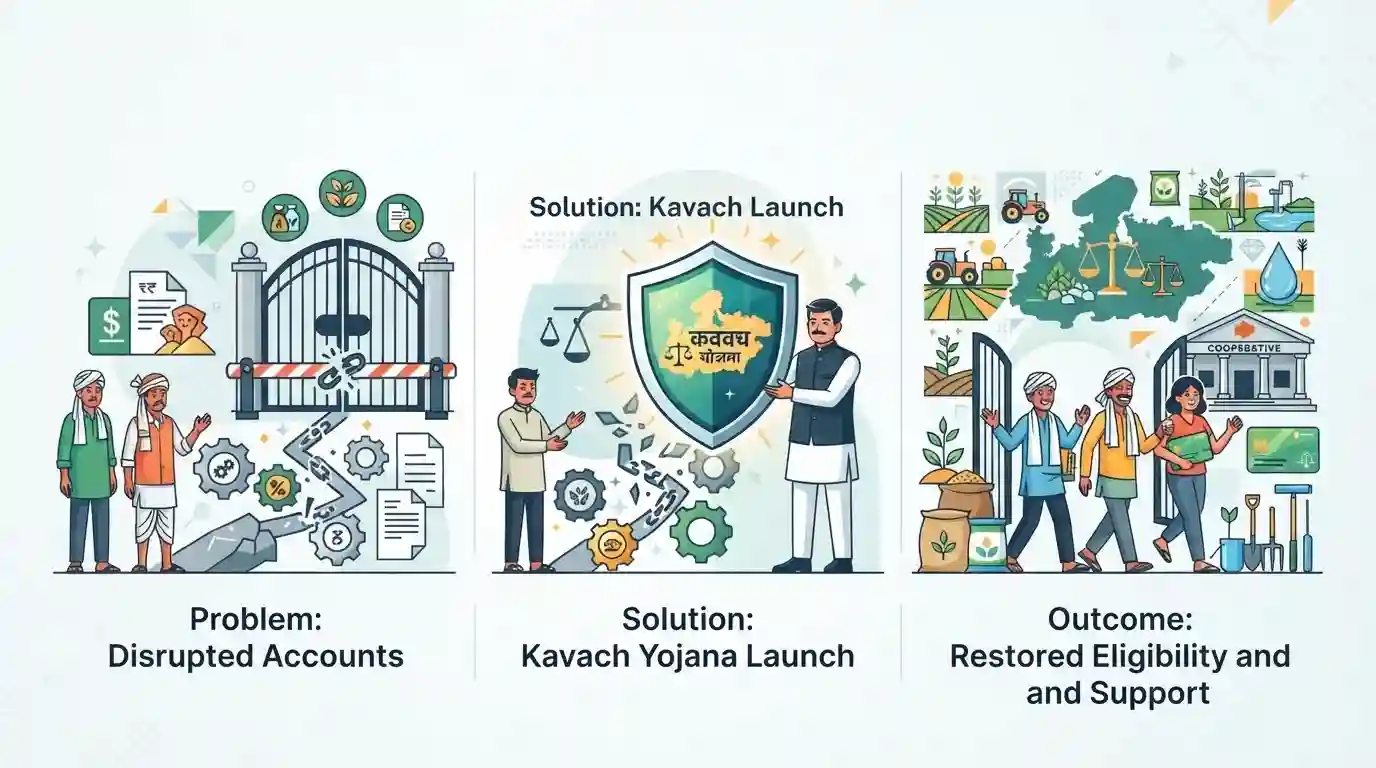
The Madhya Pradesh Cabinet has launched the 'Kavach Yojana' through the Cooperation Department to assist farmers whose cooperative loan accounts were disrupted by administrative or financial irregularities. Announced by Cooperative Minister Rakesh Singh, the scheme provides relief to these farmers, restoring their eligibility to benefit from government welfare and agricultural programs. The initiative aims to protect farmers' interests, ensure transparency, and reinforce confidence in the state's cooperative credit system.
Key Points
- The Madhya Pradesh Cabinet has approved the \'Kavach Yojana\', an initiative by the state\'s Cooperation Department.
- The scheme aims to provide relief to farmers adversely affected by administrative or financial irregularities in cooperative loan accounts.
- Eligible farmers will regain access to various government welfare and agricultural schemes from which they were previously excluded due to disputed loan records.
- The initiative seeks to restore farmers\' eligibility for institutional benefits, safeguard their interests, and rebuild trust in the cooperative credit system.
Important Terms
Kavach Yojana

A Madhya Pradesh state welfare scheme launched to assist farmers with irregular cooperative loan accounts, restoring their eligibility to receive government benefits and fresh institutional credit.
UPSC context
GS Paper II (Government Schemes) & GS Paper III (Agriculture); tests knowledge of state-level welfare initiatives and farm credit relief.
Primary Agricultural Credit Societies
Grassroots-level cooperative credit institutions operating at the village level, representing the lowest tier of the short-term cooperative credit structure in India and directly providing loans to rural borrowers.
UPSC context
GS Paper III (Agricultural Economy); tests understanding of grassroots rural credit structures, cooperative banking, and financial inclusion.
Cooperative Credit System
A structured financial framework in India designed to provide agricultural and rural credit, consisting of a multi-tier hierarchy of cooperative banks and grassroots-level credit societies.
UPSC context
GS Paper III (Agriculture & Banking); tests understanding of institutional credit models, rural credit architecture, and banking frameworks in India.
District Central Cooperative Banks
The intermediate tier of the short-term rural cooperative credit structure in India, operating at the district level to finance PACS and act as a link with State Cooperative Banks.
UPSC context
GS Paper III (Rural Credit Architecture); tests knowledge of the structural hierarchy and credit routing within India's cooperative banking sector.
Ministry of Cooperation
A Union ministry established in 2021 to provide a separate administrative, legal, and policy framework for strengthening the cooperative movement in India under the vision 'Sahkar se Samriddhi'.
UPSC context
GS Paper II & III (Economy & Governance); tests understanding of legislative, administrative, and policy reforms in India's cooperative sector.
Prelims Trap
"Kavach Yojana is an indigenous automatic train protection system."
UPSC often exploits overlapping nomenclature. While Railway 'Kavach' is an ATP system, MP's 'Kavach Yojana' restores farmers' cooperative loan eligibility lost to bank administrative errors.
Static Concepts Connected
What is India's Short-Term Cooperative Credit Structure (STCCS)?
- Three-tier system: A federal structure comprising State Cooperative Banks (StCBs), District Central Cooperative Banks (DCCBs), and Primary Agricultural Credit Societies (PACS) at the village level.
- Core mandate: Primarily disburses short-term crop loans (often via Kisan Credit Cards) and working capital to rural farmers.
- Supervision: Regulated by the RBI under the Banking Regulation Act, but NABARD is vested with the power to conduct statutory inspections of StCBs and DCCBs.
Cross-Topic Patterns
PACS Computerization & Transparency
The MP scheme highlights structural administrative flaws rather than farmer defaults. This ties directly into the Centre's ongoing ₹2,516 crore push for the nationwide computerization of PACS to plug transparency gaps.
Dual Control of Cooperative Banks
Illustrates regulatory overlap. While 'Incorporation and Management' of cooperative societies is a State List subject, the 'Banking' functions of DCCBs and StCBs fall under the RBI's domain.

Expect 2026 Prelims to test the 3-tier cooperative credit structure (PACS/DCCBs) and RBI/NABARD's dual regulatory control over them.
Linked PYQs · 3
Linked PYQs · 3
- 2024MPPSC_PRELIMSGS1
UNNATI (Agri-GISl project of Madhya Pradesh Government is for :
- 2025MPPSC_PRELIMSGS1
The objective of "Mukhyamantri Ladli Behna Yojana" implemented in entire Madhya Pradesh, in addition to economic self-reliance is:
- 2019MPPSC_PRELIMSGS1
In Madhya Pradesh the amount of financial help given to the marriageable girls of poor families under "Mukhya Mantri Kanyadan Yojna" was increased in the year 2019 to
