MP Cabinet Approves State Data Centre and Health Outlays
Source:aninews ↗
Why It Matters
MPPSC Prelims consistently features direct factual questions regarding the objectives and target demographics of Madhya Pradesh state schemes (such as Ladli Behna or UNNATI). The newly launched Kavach Scheme specifically targets cooperative society farmers and formal credit, making it highly probable for upcoming agriculture or state-economy objective questions.
Summary
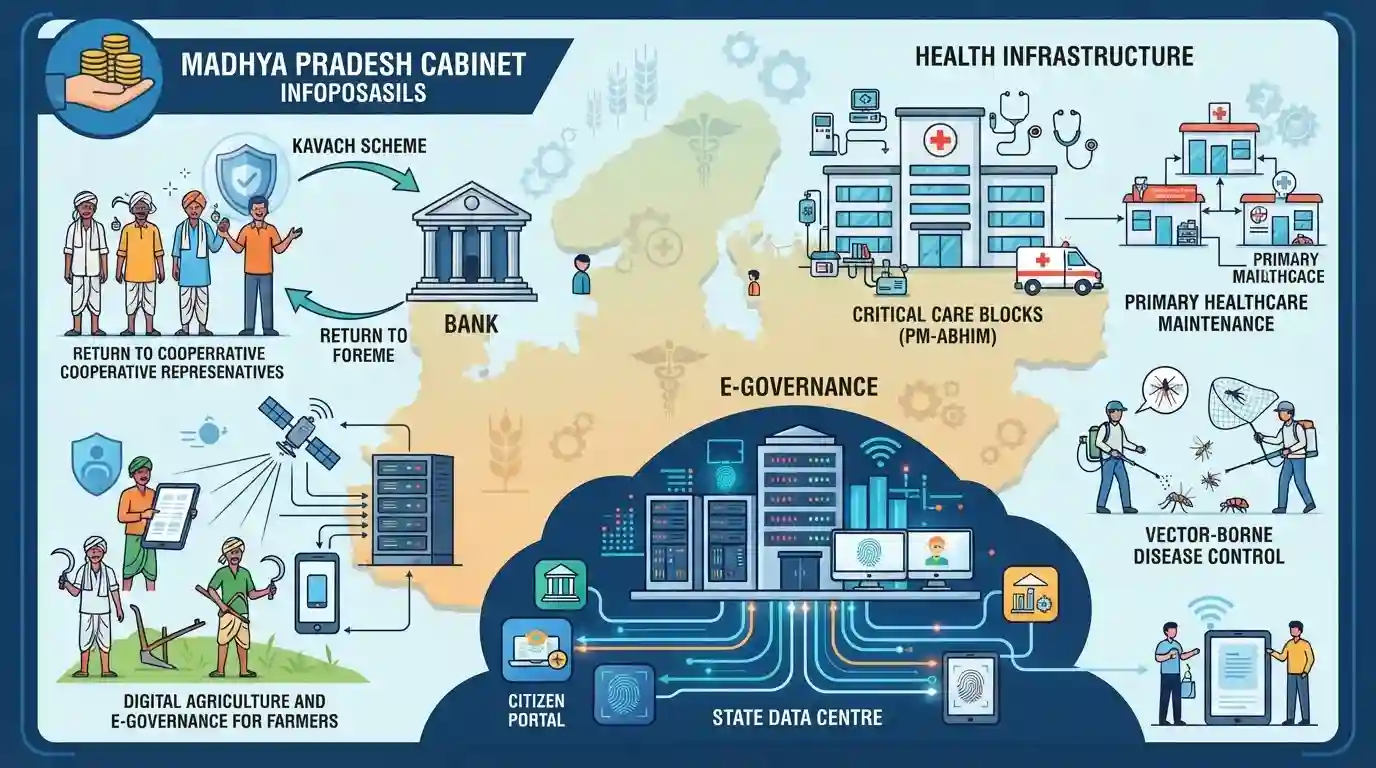
The Madhya Pradesh Cabinet has sanctioned comprehensive proposals worth Rs 32,070 crore focusing extensively on farmers, state health infrastructure, digital governance, and sports. A major highlight is the implementation of the 'Kavach Scheme' to aid cooperative society farmers whose loan accounts are under investigation by facilitating their return to formal credit structures. Furthermore, heavy allocations were made for primary healthcare maintenance, the PM-ABHIM mission for establishing Critical Care Blocks, vector-borne disease control, and a new State Data Centre for robust e-governance.
Key Points
- The Madhya Pradesh Cabinet, chaired by CM Mohan Yadav, approved a massive Rs 32,070 crore package encompassing agriculture, health, sports, and IT initiatives.
- The newly cleared 'Kavach Scheme' will provide relief to over 5,000 farmers whose cooperative society loan accounts are under probe, reintegrating them into the formal credit system using a Rs 75 crore fund.
- Significant health investments include Rs 11,812.02 crore for primary healthcare (2026-2031) and Rs 2,448.79 crore under PM-ABHIM to establish Critical Care Blocks and Integrated Public Health Laboratories.
- A Rs 1,099.58 crore State Data Centre will be set up by the Science and Technology department to enhance digital governance and centralize administrative data.
- The Cabinet also approved Rs 2,460.57 crore for sports infrastructure and a Fourth Time-Bound Promotional Pay Scale for Assistant Teachers in the Tribal Affairs Department.
Important Terms
Kavach Scheme

A Madhya Pradesh government initiative to restore formal credit access to cooperative society farmers whose loan accounts are stalled due to pending irregularity investigations, enabling them to receive fresh loans and government welfare benefits.
UPSC context
Relevant for GS Paper 2 (Welfare Schemes) and GS Paper 3 (Agriculture). Tests knowledge of state-level interventions for farmer distress and rural credit.
Pradhan Mantri Ayushman Bharat Health Infrastructure Mission (PM-ABHIM)
A pan-India central scheme launched to build a resilient, accessible, and self-reliant public health infrastructure. It focuses on establishing critical care blocks, integrated public health labs, and IT-enabled disease surveillance networks across districts.
UPSC context
Crucial for GS Paper 2 (Health). Tests understanding of India's pandemic-preparedness, healthcare capacity building, and progression towards Universal Health Coverage.
Apex Bank
The highest-level institution in a state's three-tier short-term cooperative credit structure. It acts as a balancing center for District Central Cooperative Banks (DCCBs) and channels agricultural refinancing from NABARD to the grassroots level.
UPSC context
Important for GS Paper 3 (Indian Economy). Tests knowledge of India's rural banking architecture, financial inclusion, and the cooperative credit hierarchy.
District Central Cooperative Banks (DCCBs)
The intermediary tier in the short-term cooperative credit structure, operating at the district level. DCCBs mobilize public resources and provide credit to village-level Primary Agricultural Credit Societies (PACS), bridging them to the Apex Bank.
UPSC context
Relevant for GS Paper 3 (Banking/Agriculture). Tests understanding of institutional credit delivery mechanisms for farmers and rural development.
Prelims Trap
"The Kavach Scheme, recently approved, is a state-level implementation of the indigenous automatic train protection network."
While the Union government's 'Kavach' is an Automatic Train Protection system, MP's 'Kavach Scheme' is entirely different—focused on agricultural credit reintegration.
Static Concepts Connected
What are the core pillars of the PM-ABHIM initiative?
- Critical Care Blocks: Establishing specialized 50-100 bed critical care units in district hospitals for populations exceeding 5 lakh.
- Disease Surveillance: Setting up Integrated Public Health Labs (IPHLs) in all districts for comprehensive diagnostics and testing.
- Institutional Capacity: Expanding the National Centre for Disease Control (NCDC) and setting up regional health research institutes.
What is the structural hierarchy of short-term cooperative rural credit?
- State Level: State Cooperative Banks (StCBs) act as the apex body, channeling NABARD refinance down to lower tiers.
- District Level: District Central Cooperative Banks (DCCBs) function as the intermediate link, governing grassroots societies.
- Village Level: Primary Agricultural Credit Societies (PACS) deal directly with farmers, providing short-term crop loans and inputs.
Cross-Topic Patterns
Cooperative Banking & RBI Oversight
Assisting farmers whose cooperative loan accounts are under probe highlights ongoing governance issues in grassroots cooperatives, echoing RBI's recent moves to bring cooperative banks under stricter regulatory oversight.
SDCs and Digital Public Infrastructure
State Data Centres (SDCs) form the physical backbone of the National e-Governance Plan (NeGP), connecting state-level capacity building with India's broader ambitions for localized Digital Public Infrastructure (DPI).

A 2026 Prelims question will likely exploit the dual use of 'Kavach'—mixing MP’s agricultural credit scheme with the Railways' ATP system.
Linked PYQs · 2
Linked PYQs · 2
- 2024MPPSC_PRELIMSGS1
UNNATI (Agri-GISl project of Madhya Pradesh Government is for :
- 2025MPPSC_PRELIMSGS1
The objective of "Mukhyamantri Ladli Behna Yojana" implemented in entire Madhya Pradesh, in addition to economic self-reliance is:
