Madhya Pradesh Cabinet Infrastructure and Irrigation Approvals
Source:aninews ↗
Why It Matters
These decisions reflect major budgetary allocations and policy shifts in Madhya Pradesh, specifically targeting agricultural support, regional micro-irrigation systems (such as the Kundaliya project in Rajgarh and Agar-Malwa), and structural changes in welfare programs like the Take-Home Ration scheme, which are highly relevant for the MPPSC Prelims and Mains.
Summary
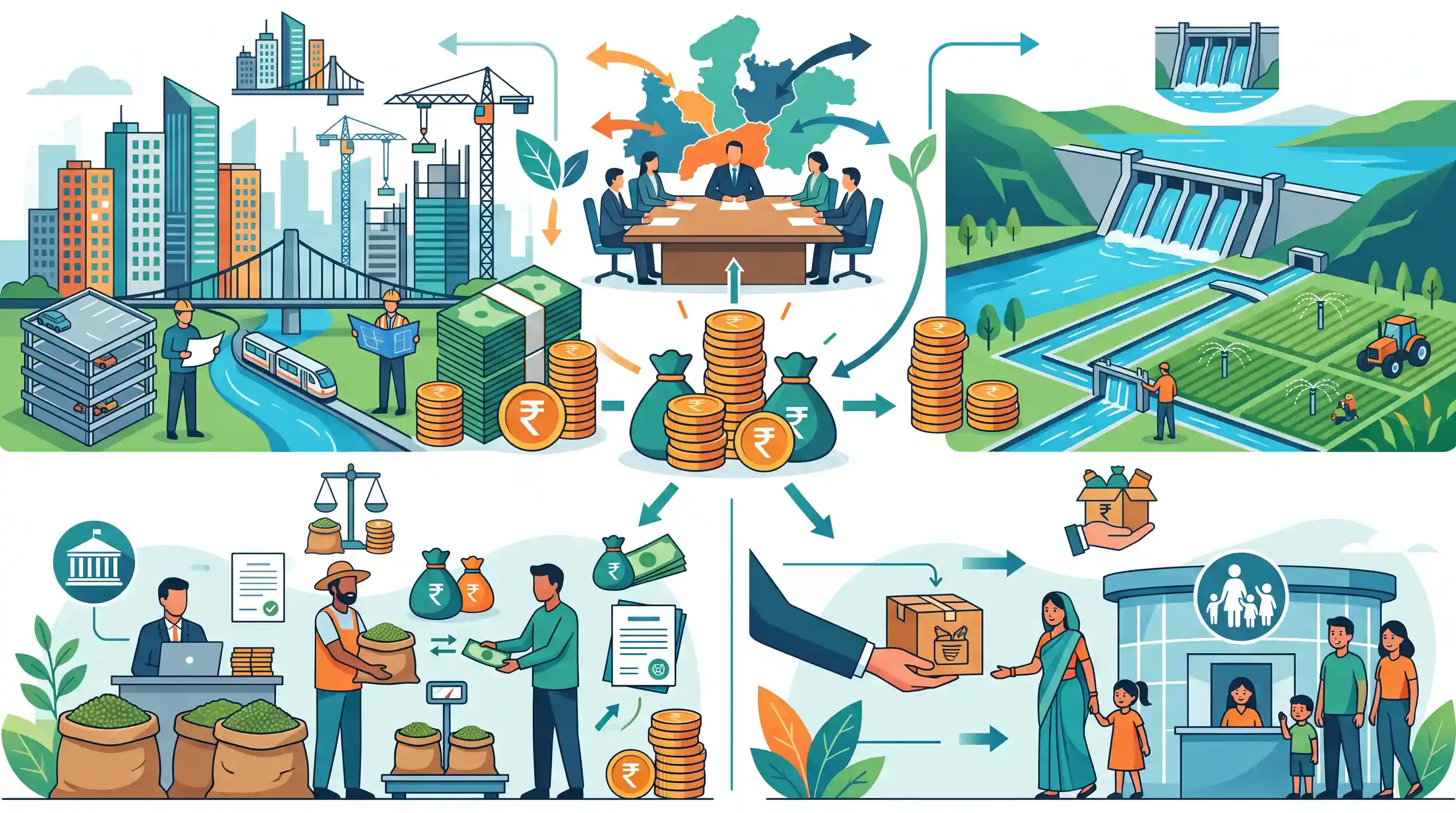
The Madhya Pradesh Cabinet approved proposals worth Rs 10,800 crore for infrastructure, urban development, irrigation, and public welfare. Key decisions include Rs 8,445 crore for urban infrastructure, Rs 1,587 crore in interest-free guarantees for moong procurement under the Price Support Scheme, and Rs 245.45 crore for the Kundaliya Major Irrigation Project. Additionally, the responsibility for Take-Home Ration (THR) was transferred to the Women and Child Development Department.
Key Points
- The Madhya Pradesh Cabinet, under CM Mohan Yadav, approved proposals worth Rs 10,800 crore to bolster infrastructure, urban development, irrigation, and public welfare.
- Rs 8,445 crore is allocated for urban infrastructure development over the next five years to accelerate city transformations.
- An interest-free government guarantee of Rs 1,587 crore is approved for procurement of moong under the Price Support Scheme (PSS) for Rabi Marketing Season 2024-25, including Rs 396 crore for PNB and Rs 1,191 crore for SBI.
- The Cabinet sanctioned Rs 245.45 crore for the Kundaliya Major Irrigation Project in Rajgarh district to secure 1.39 lakh hectares of irrigation potential across Rajgarh and Agar-Malwa districts during the 16th Finance Commission period (2026-27 to 2030-31).
- Responsibility for the production and supply of Take-Home Ration (THR) was transferred from MP Rajya Ajeevika Forum to the Women and Child Development Department, with Self-Help Groups (SHGs) taking over as an interim arrangement.
- The Commercial Tax Department received Rs 521.04 crore for the continued operation of three establishment schemes from 2026-27 to 2030-31.
Important Terms
Price Support Scheme

A market intervention scheme under PM-AASHA where designated central agencies physically procure pulses, oilseeds, and copra at the Minimum Support Price (MSP) during harvest gluts to prevent distress sales.
UPSC context
GS Paper 3 (Agriculture/Subsidies and MSP); tests mechanisms for price stability and farmers' welfare.
Take-Home Ration
A supplementary nutrition initiative under Mission Poshan 2.0/ICDS that provides raw or pre-packaged nutritious food directly to children, pregnant women, and lactating mothers for home consumption.
UPSC context
GS Paper 2 (Issues relating to Health, Hunger, and Nutrition); tests government efforts in addressing malnutrition.
Kundaliya Major Irrigation Project
A major multipurpose dam project constructed on the Kalisindh River in Madhya Pradesh, acting as an integral part of the proposed Parbati-Kalisindh-Chambal river-interlinking project to boost regional irrigation.
UPSC context
GS Paper 1 (Geography/Water resources) & GS Paper 3 (Irrigation/Infrastructure); tests river-linking and water resource management.
Women and Child Development Department
A governmental administrative division tasked with formulating, executing, and monitoring policies, laws, and welfare programs aimed at the empowerment, health, and safety of women and children.
UPSC context
GS Paper 2 (Welfare schemes for vulnerable sections); tests administrative machinery and execution of social security programs.
Prelims Trap
The Price Support Scheme (PSS) under PM-AASHA operates solely via direct cash transfers of price differences without physical crop procurement.
This describes the Price Deficiency Payment Scheme (PDPS). PSS requires actual physical procurement of the commodity (pulses, oilseeds, copra) by central agencies like NAFED and FCI.
Static Concepts Connected
What is the Price Support Scheme (PSS) under PM-AASHA?
- Commodity Scope: Covers pulses, oilseeds, and copra where market prices fall below the Minimum Support Price (MSP).
- Nodal Agencies: Central agencies like NAFED and Food Corporation of India (FCI) physically procure these commodities.
- Financial Loss Settlement: The Central Government meets the losses incurred by procuring agencies up to prescribed limits.
What is the geographic status of the Kalisindh River and Chambal Basin?
- River Path: Originates in the Vindhya Range (Dewas, MP) and flows north to join the Chambal River in Rajasthan.
- Basin Significance: Part of the Yamuna-Ganga sub-basin, serving as a vital water source for the semi-arid Malwa region.
- Pressurized Piped Irrigation: Reduces evaporation and seepage losses, maintaining high water-use efficiency (up to 85%) in clay soils.
Cross-Topic Patterns
Micro-irrigation + Water-Use Efficiency
Transitioning from open canals to pressurized piped micro-irrigation networks minimizes transit evaporation losses, directly aiding India's national groundwater conservation and climate-resilient agriculture targets.
SHGs + Decentralized Nutrition Delivery
Leveraging local Self-Help Groups (SHGs) for manufacturing Take-Home Ration (THR) represents a decentralization trend that bypasses commercial contractors to improve local nutritional outcomes.

Distinction between PM-AASHA components (PSS vs PDPS) and the integration of micro-irrigation in river basins likely to be targeted in 2026.
Linked PYQs · 3
Linked PYQs · 3
- 2022MPPSC_PRELIMSGS1
Which of the following is a major source of irrigation in Madhya Pradesh?
- 2024MPPSC_PRELIMSGS1
In which of the following irrigation projects do four states have partnership?
- 2024MPPSC_PRELIMSGS1
UNNATI (Agri-GISl project of Madhya Pradesh Government is for :
