Madhya Pradesh Cabinet Approves Mandi Fee Revision and Metro Funding
Source:indianmasterminds ↗
Why It Matters
These cabinet decisions are highly significant for MPPSC Prelims as they detail critical state-level infrastructure projects (Bhopal Metro), agricultural market reforms (cotton mandi fees, MARKFED procurement), and e-governance infrastructure, which are core areas of the MPPSC GS syllabus.
Summary
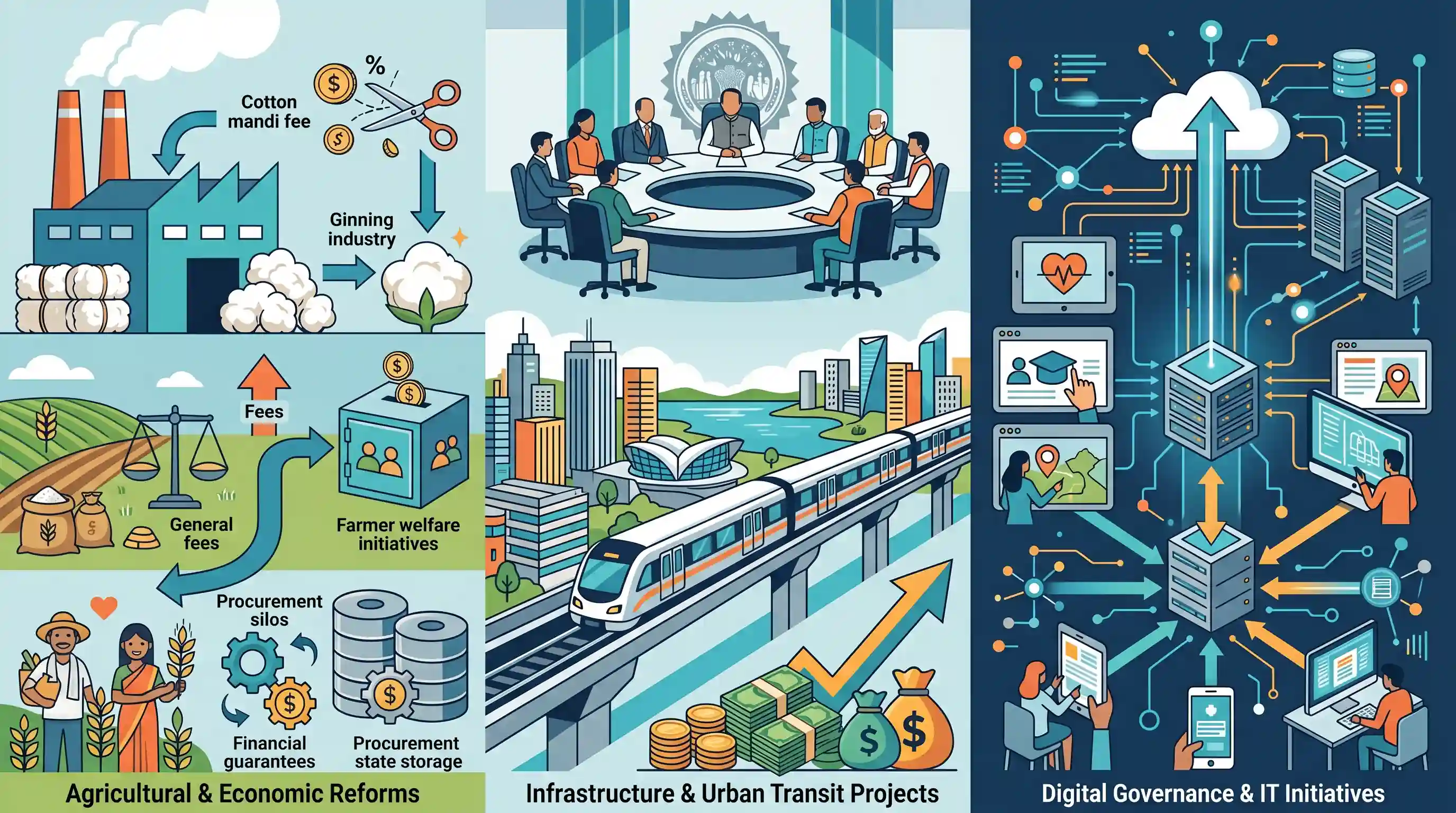
In June 2026, the Madhya Pradesh Cabinet, chaired by Chief Minister Dr. Mohan Yadav, cleared a series of key economic, agricultural, and administrative reforms. Key measures include cutting the cotton mandi fee to 0.5% to boost the state's ginning industry, increasing the general mandi fee to fund farmer welfare initiatives, and approving a revised cost of ₹10,033.62 crore for the Bhopal Metro Rail. In addition, major funding was cleared for strengthening digital governance under MPSEDC and providing critical financial guarantees for agricultural procurement through MARKFED and the MP State Civil Supplies Corporation.
Key Points
- Cotton mandi fee reduced from 1% to 0.5% to support 158 ginning mills in MP (combined capacity of 13 lakh metric tons) and prevent industrial flight to neighboring states.
- General mandi fee raised from ₹1 to ₹1.50, with the incremental ₹0.50 earmarked for a farmer welfare fund, generating an additional ₹500 crore for rural roads, cold storage, and agricultural infrastructure.
- Bhopal Metro Rail Project cost revised from ₹6,941.40 crore to ₹10,033.62 crore (additional support of ₹3,532.22 crore approved) to accelerate urban transit development.
- Approved ₹235.63 crore for IT Cadre and Consultancy Services (incorporating AI, blockchain, and cybersecurity) and ₹55.43 crore for IT Training and Governance Plan to strengthen MPSEDC and introduce E-Governance Excellence Awards.
- Sanctioned interest-free government guarantee of ₹8,600 crore for grain procurement (wheat, rice, coarse grains) in 2026-27 by MARKFED and Civil Supplies Corporation, plus a separate ₹29,500 crore guarantee for Civil Supplies Corporation.
Important Terms
MARKFED

The apex cooperative marketing federation in Madhya Pradesh (est. 1956) responsible for agricultural procurement, distributing high-quality fertilizers (DAP, NPK, urea), and stabilizing rural supply chains.
UPSC context
GS Paper III (Agriculture & Cooperatives), testing agricultural marketing, minimum support price procurement, and cooperative models.
MP State Civil Supplies Corporation
A public sector undertaking in Madhya Pradesh (est. 1974) responsible for decentralized procurement of food grains and managing the targeted Public Distribution System (PDS) to ensure state food security.
UPSC context
GS Paper III (Food Security & Public Distribution System), evaluating mechanisms of state procurement, storage, and civil supplies distribution.
MPSEDC
The Madhya Pradesh State Electronics Development Corporation, a nodal agency under the Department of Science and Technology promoting IT infrastructure, cybersecurity, and e-governance across state departments.
UPSC context
GS Paper II (E-governance), testing the role of nodal state bodies in implementing digital service delivery and public administrative transparency.
Bhopal Metro Rail Project
A state-of-the-art mass rapid transit system in Bhopal, Madhya Pradesh, developed by MPMRCL to provide low-carbon, climate-resilient, and efficient public urban transport.
UPSC context
GS Paper III (Infrastructure & Urbanization), testing strategies for smart urban transit, green infrastructure financing, and regional connectivity.
IT Cadre and Consultancy Services
A Madhya Pradesh state initiative deploying specialized IT professionals within government line departments to provide in-house tech consultancy, capacity-building, and assist with emerging technologies.
UPSC context
GS Paper II (Bureaucracy & Capacity Building), testing modern administrative reforms, in-house technical specialization, and technological governance frameworks.
IT Training and Governance Plan
An administrative roadmap in Madhya Pradesh funding regular capacity-building workshops for government officials, promoting e-governance, cyber safety, and technological innovation.
UPSC context
GS Paper II (E-governance), exploring human resource development in digital governance, institutional capacity-building, and tech-driven administrative transparency.
Prelims Trap
Under the Decentralized Procurement (DCP) scheme, the Food Corporation of India (FCI) directly undertakes the physical procurement of foodgrains in all participating states.
In DCP states, state government agencies (not FCI) directly procure, store, and distribute foodgrains. FCI only steps in to take over surplus grains that exceed the state's internal allocation.
Static Concepts Connected
What is the Decentralized Procurement (DCP) Scheme for foodgrains?
- Core Objective: Introduced to promote local procurement, reduce transit costs, and expand MSP reach to non-traditional states.
- Operational Mandate: State agencies directly procure, store, and distribute grains under NFSA, rather than the Food Corporation of India.
- Financial Settlement: The Central Government monitors the process and reimburses the approved economic cost of procurement to the state.
How are APMC Mandi Fees governed under the Indian Constitution?
- Constitutional Jurisdiction: Agriculture and market yards fall under Entry 28 (Markets and fairs) of the State List (List II) of the Seventh Schedule.
- Regulatory Fee: Mandi fees are classified as regulatory fees, requiring a broad quid pro quo such as building rural market infrastructure.
Cross-Topic Patterns
APMC fees vs rural infrastructure financing
Mandi fees are increasingly earmarked for specific funds like 'Kisan Sadak Nidhi' to bypass general state treasury pools and directly finance rural physical connectivity.
Metro funding and external debt models
The 20:20:60 funding ratio of central-state equity to multilateral debt (EIB/ADB) highlights the growing dependence of state-level mass transit on sovereign-backed external loans.

Expect UPSC to test the structural mechanics of the Decentralized Procurement (DCP) Scheme versus centralized FCI operations in 2026.
Linked PYQs · 2
Linked PYQs · 2
- 2023MPPSC_PRELIMSGS1
In the year 2020-21, which of the following districts holds the first position in the production of cotton in Madhya Pradesh?
- 2024MPPSC_PRELIMSGS1
UNNATI (Agri-GISl project of Madhya Pradesh Government is for :
