Madhya Pradesh Assembly Passes Uniform Civil Code Legislation
Source:daily-pioneer ↗
Why It Matters
The passage of the UCC bill in Madhya Pradesh is a crucial development in Indian polity and state legislation. It touches upon vital constitutional topics like the Directive Principles of State Policy (Article 44), conflicts with Fundamental Rights (Article 29), the process of Presidential assent for state bills, and the protection of tribal customs, making it highly relevant for the MPPSC examination.
Summary
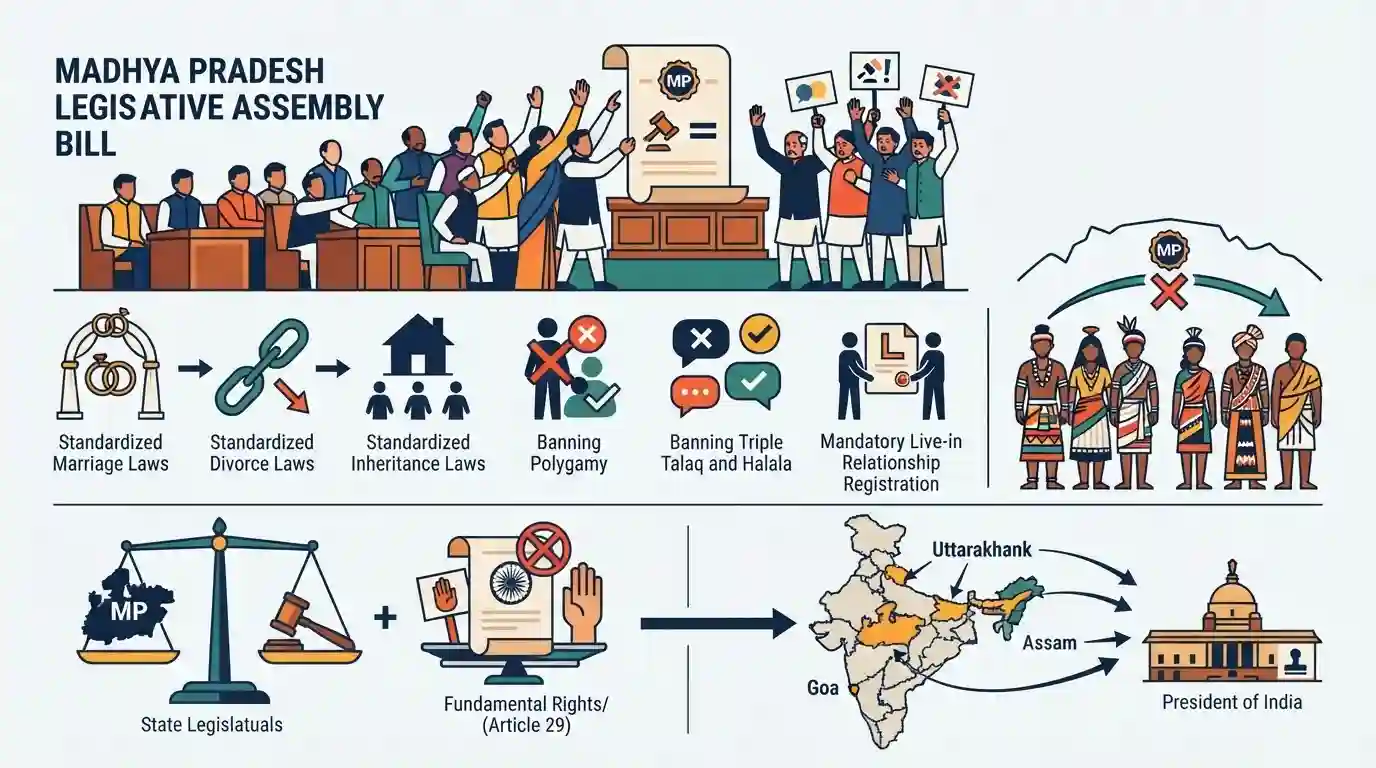
The Madhya Pradesh Legislative Assembly passed the 'Madhya Pradesh Uniform Civil Code 2026 Bill' amid strong protests from the opposition Congress party. The bill establishes standardized civil laws regulating marriage, divorce, and inheritance, effectively banning practices like polygamy, triple talaq, and halala, while making the registration of live-in relationships mandatory. Notably, tribal communities have been excluded from the bill's purview. Opposition members argued that the legislation violates Article 29 of the Constitution. With its passage, MP joins Goa, Uttarakhand, and Assam in advancing a UCC, and the bill will now be sent to the President of India for formal assent.
Key Points
- Madhya Pradesh became the fourth Indian state to pass a Uniform Civil Code (UCC) bill, following Goa, Uttarakhand, and Assam.
- The Madhya Pradesh Uniform Civil Code 2026 Bill criminalizes practices like triple talaq, halala, and polygamy.
- The legislation mandates the registration of live-in relationships, marriages, and divorces, and establishes equal inheritance rights for men and women.
- Tribal communities are completely excluded from the ambit of the MP UCC bill to preserve their customary practices.
- Congress MLAs opposed the bill, asserting that it infringes upon the cultural and educational rights guaranteed under Article 29 of the Indian Constitution.
- The bill, introduced by Chief Minister Mohan Yadav, has been passed by the assembly and now requires the President's assent.
Important Terms
Uniform Civil Code

A proposed common set of civil laws governing personal matters like marriage, divorce, inheritance, and adoption for all citizens, irrespective of their religion.
UPSC context
GS Paper II (Polity & Governance); tests understanding of secularism, Article 44 of the Constitution, and personal law reforms.
Madhya Pradesh Uniform Civil Code 2026 Bill
A state bill establishing standardized civil laws for marriage, divorce, inheritance, and mandatory live-in relationship registration in MP, while explicitly excluding Scheduled Tribes.
UPSC context
GS Paper II (State Legislature); tests knowledge of federalism, concurrent list powers, and state-level social reforms.
Constitution of India
The supreme law of the nation, laying down the framework defining fundamental political principles, procedures, powers of government institutions, and fundamental rights.
UPSC context
GS Paper II (Indian Constitution); crucial for understanding constitutionalism, federalism, judicial review, and individual liberties.
Madhya Pradesh Legislative Assembly
The unicameral legislative body of Madhya Pradesh, empowered under the Constitution to enact laws on matters within the State and Concurrent lists.
UPSC context
GS Paper II (State Legislature); tests knowledge of legislative procedures, lawmaking processes, and center-state legislative relations.
Prelims Trap
Only the Parliament can enact a Uniform Civil Code as personal laws fall exclusively under the Union List.
Personal laws fall under the Concurrent List (Entry 5). States can pass UCC legislations, but they require the President's assent under Article 254(2) to override central laws.
Static Concepts Connected
When does a State Bill require Presidential Assent?
- Concurrent List Repugnancy: Under Art 254(2), if a state law conflicts with a central law on a Concurrent subject, it must be reserved for the President's assent to prevail in that state.
- High Court Powers: Under Article 200, the Governor is constitutionally mandated to reserve any bill that would endanger or derogate the position of the State High Court.
- Discretionary Reservation: The Governor can use discretion to reserve bills dealing with compulsory acquisition of property (Article 31A) or issues of larger national importance.
What is the scope of Article 29 in the Indian Constitution?
- Any Section of Citizens: It protects the right to conserve the distinct language, script, or culture of 'any section of citizens', which includes both minorities and the majority communities.
- Absolute Nature: Unlike Article 19, the right to conserve one's culture under Article 29(1) is absolute and is not subject to 'reasonable restrictions' in the text of the Constitution.
Cross-Topic Patterns
State UCCs + Tribal Customary Exemptions
Both MP and Uttarakhand exempt Scheduled Tribes, reflecting a constitutional balancing act between Article 44 (UCC) and the preservation of tribal customary laws under the Fifth and Sixth Schedules.
Live-in registration vs Article 21 Privacy
The mandatory registration of live-in relationships in state UCCs creates a direct tension with the fundamental right to privacy established in the K.S. Puttaswamy judgment (Article 21).

Expect a 2026 Prelims question testing state power to enact UCCs via the Concurrent List, paired with tribal exemptions under Article 342.
Linked PYQs · 2
Linked PYQs · 2
- 2023MPPSC_PRELIMSGS1
The Directive Principles of State Policy are explained in Part IV of the Indian Constitution. This system has been taken from the Constitution of which country ?
- 2025MPPSC_PRELIMSGS1
In which Article of the Indian Constitution is there a provision of reservation of seats for Scheduled Tribes in the State Assembly?
