Assembly Data Reveals Over 61000 Missing Girls in Madhya Pradesh
Source:the-guardian-chronicle ↗
Why It Matters
This data highlights critical demographic and social security challenges within Madhya Pradesh. Knowledge of state-specific initiatives (like Operation Muskaan and Operation Srijan) and the institutional framework (Anti-Human Trafficking Units) is essential for State Service Preliminary and Mains examinations focusing on social justice, law and order, and women's empowerment.
Summary
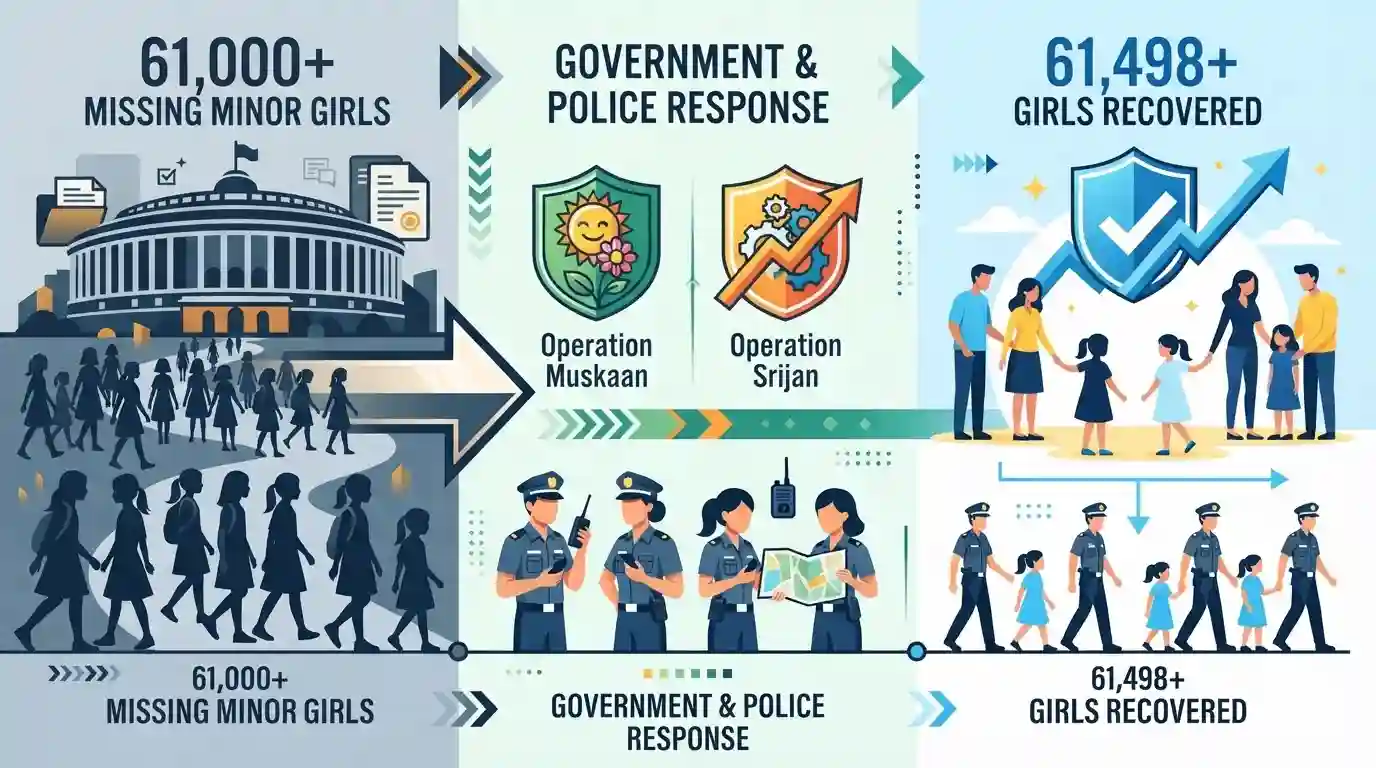
Recent data presented in the Madhya Pradesh Legislative Assembly reveals that over 61,000 minor girls went missing in the state between 2021 and 2025. Complying with Supreme Court directives, all missing minor girls are categorized as kidnapped. To combat this issue and improve rescue rates, the MP government has implemented dedicated operations such as 'Operation Muskaan' and 'Operation Srijan', alongside establishing Anti-Human Trafficking Units across 52 women's police stations. Despite the alarming statistics, the state police achieved a high recovery rate, tracing over 61,498 girls during the same period.
Key Points
- Over 61,000 minor girls were reported missing in Madhya Pradesh between 2021 and 2025, with an increasing yearly trend peaking at 13,146 cases in 2025.
- Following Supreme Court directives, the Madhya Pradesh police register all cases of missing minor girls under the 'kidnapped' category.
- The state government has achieved a high recovery rate, tracing 61,498 girls (including backlog cases) primarily within the state and from neighboring regions.
- The state operates specialized missions including 'Operation Muskaan' for rescuing all missing children, 'Operation Srijan' specifically focused on minor girls, and 'Operation Abhimanyu' for boys.
- Institutional safeguards include the establishment of an Anti-Human Trafficking Bureau at the state level and specialized units across 52 women's police stations.
Important Terms
Operation Muskaan

A Ministry of Home Affairs initiative implemented across Indian states to rescue, rehabilitate, and reunite missing, abducted, or trafficked children with their families.
UPSC context
GS Paper II (Social Justice) and GS Paper III (Internal Security); tests knowledge of child protection and anti-trafficking measures.
Operation Srijan
A targeted sub-campaign implemented under Operation Muskaan in Madhya Pradesh, specifically focusing on tracing and rescuing missing or abducted minor girls.
UPSC context
GS Paper II (Social Justice/Governance); tests understanding of state-level targeted interventions for vulnerable and missing children.
Operation Abhimanyu
An initiative by the Madhya Pradesh Police to raise public awareness, educate boys and men about women's safety, and track missing boys.
UPSC context
GS Paper II (Social Justice/Governance); tests strategies for gender sensitization, community policing, and child protection.
Anti-Human Trafficking Units
Specialized police units established across Indian districts to prevent trafficking, rescue victims, conduct thorough investigations, and coordinate rehabilitation efforts with other stakeholders.
UPSC context
GS Paper II (Governance) and GS Paper III (Internal Security); tests institutional mechanisms against organized crime and exploitation.
Anti-Human Trafficking Bureau
A state-level law enforcement body tasked with overseeing, monitoring, and strengthening coordination among various district-level Anti-Human Trafficking Units.
UPSC context
GS Paper II (Governance) and GS Paper III (Internal Security); tests knowledge of administrative mechanisms tackling organized crime.
Prelims Trap
Police must register a kidnapping FIR for missing minors only if there is prima facie evidence of trafficking.
The Supreme Court explicitly mandated an immediate FIR and a legal presumption of kidnapping or trafficking for ANY missing minor, bypassing the need for initial evidence.
Static Concepts Connected
What are the legal and institutional mandates for tracking missing children in India?
- Mandatory FIR: Under the SC's 2013 Bachpan Bachao Andolan judgment, authorities must immediately register an FIR for any missing minor, legally presuming kidnapping or trafficking.
- AHTU Funding: The Ministry of Home Affairs centrally funds the establishment and upgrade of AHTUs in all districts across States/UTs using the Nirbhaya Fund.
- Unified Portal: The TrackChild portal and Khoya-Paya app have been consolidated into the Mission Vatsalya Portal, which is fully interoperable with CCTNS.
Cross-Topic Patterns
Tech + Child Protection Integration
Linking the unified Mission Vatsalya Portal (TrackChild & Khoya-Paya) with MHA's CCTNS highlights how e-governance bridges social welfare and criminal justice systems.
Nirbhaya Fund's expanding scope
Originally envisioned for women's safety in public spaces, the non-lapsable Nirbhaya Fund is now critically utilized to centrally finance the creation of district-level Anti-Human Trafficking Units (AHTUs).

Mission Vatsalya + AHTU funding via Nirbhaya Fund + SC mandate on mandatory kidnapping FIRs will likely form a multi-statement Prelims Q.
Linked PYQs · 4
Linked PYQs · 4
- 2025MPPSC_PRELIMSGS1
The objective of "Mukhyamantri Ladli Behna Yojana" implemented in entire Madhya Pradesh, in addition to economic self-reliance is:
- 2022MPPSC_PRELIMSGS1
What amount will be given to eligible women under "Ladli Bahna Yojana" of the Madhya Pradesh Government?
- 2023MPPSC_PRELIMSGS1
The functions of the National Commission for Women are Specified in:
- 2023MPPSC_PRELIMSGS1
Which of the following is NOT a function of the National Human Rights Commission (NHRC)?
