Barwaha Dhamnod Four Lane Highway Project Approval
Source:indianmasterminds ↗
Why It Matters
Infrastructure development projects in MP, regional geography (Nimar, Khargone, Dhar districts), transport corridors (SH-38, connectivity to major National Highways), and religious tourism hubs (Maheshwar, Omkareshwar) are frequently asked topics in MPPSC Prelims State Service examinations.
Summary
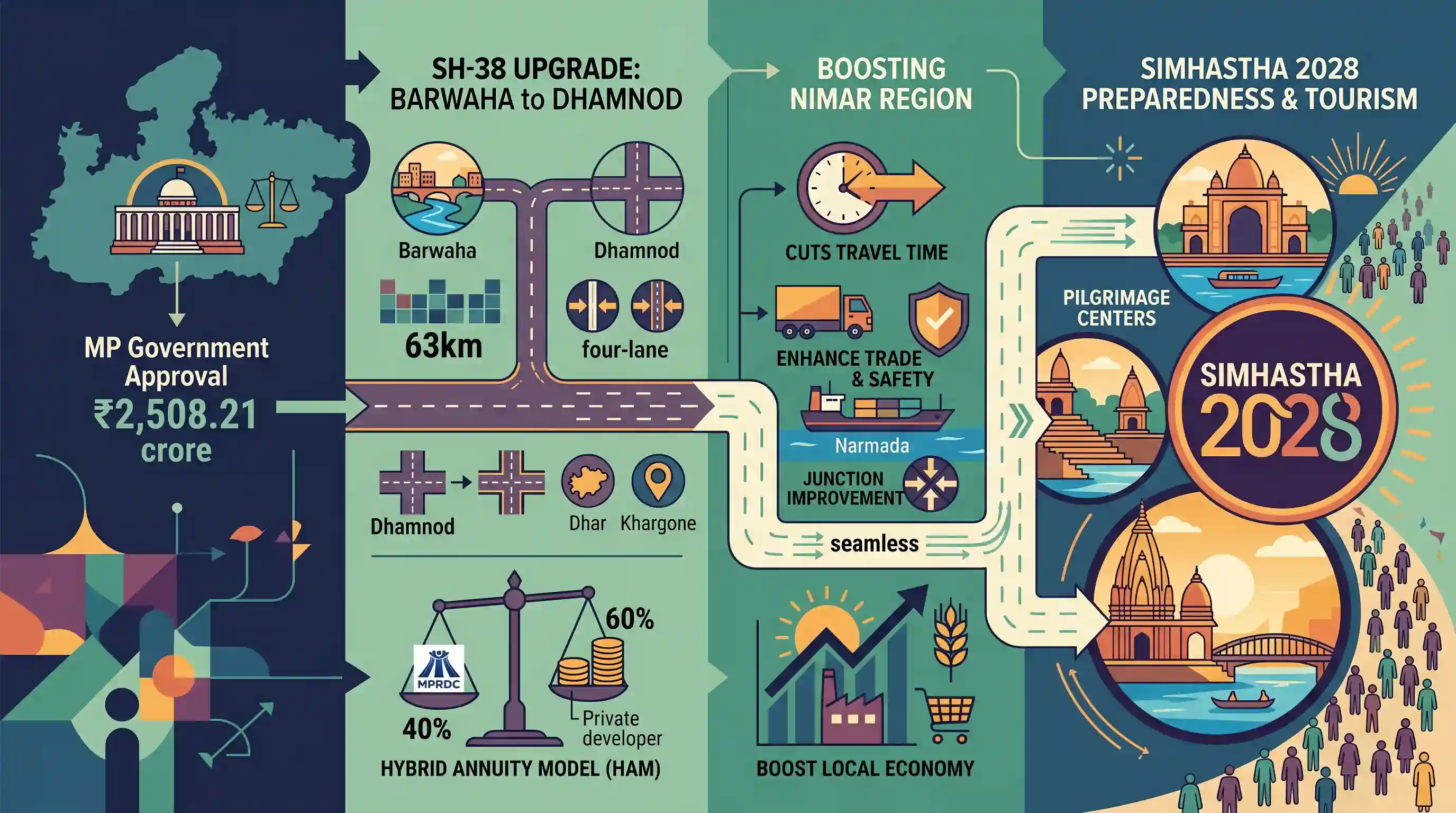
The Madhya Pradesh Government has approved the ₹2,508.21 crore upgrade of State Highway-38 (SH-38) connecting Barwaha and Dhamnod in the Nimar region. Developed under the Hybrid Annuity Model (HAM) by the MPRDC, the 63-km four-lane highway will span Dhar and Khargone districts. It aims to cut travel time, enhance trade and safety, boost the local Nimar economy, and offer seamless transit to major pilgrimage centers like Maheshwar, Mandleshwar, and Omkareshwar ahead of the Simhastha 2028.
Key Points
- The Madhya Pradesh Cabinet, chaired by Chief Minister Dr. Mohan Yadav, has approved the upgradation of the 63 km Barwaha-Dhamnod State Highway-38 (SH-38) from a two-lane to a four-lane highway.
- Estimated at a cost of ₹2,508.21 crore, the project will be developed under the Hybrid Annuity Model (HAM) by the Madhya Pradesh Road Development Corporation (MPRDC).
- The road runs through Dhar and Khargone districts—with a 5 km stretch from Dhamnod falling in Dhar, and the rest in Khargone. It connects Dhamnod (on the Mumbai-Agra corridor) to Barwaha (on the Indore-Ichhapur highway).
- The development is key to regional religious tourism, drastically improving connectivity to holy towns of Maheshwar, Mandleshwar, and Omkareshwar.
- The construction target is set for completion before the major Simhastha 2028 (Kumbh Mela in Ujjain) to ensure smooth pilgrim traffic.
Important Terms
Hybrid Annuity Model

A Public-Private Partnership (PPP) framework combining EPC and BOT models, where the government funds 40% of the project cost during construction, and the developer finances 60%, recovered later via periodic annuity payments.
UPSC context
GS Paper III (Indian Economy): Tests understanding of public-private partnership (PPP) frameworks and infrastructure investment models.
Simhastha 2028
A massive Hindu religious congregation (Kumbh Mela) held once every 12 years in Ujjain, Madhya Pradesh, on the banks of the Shipra River. The next edition is scheduled for March–May 2028.
UPSC context
GS Paper I (Art & Culture): Tests knowledge of major religious festivals, heritage sites, and cultural geography of India.
Madhya Pradesh Road Development Corporation
A wholly state-owned undertaking (established in 2004) responsible for the construction, maintenance, and management of State Highways, Major District Roads, and expressways in Madhya Pradesh.
UPSC context
GS Paper III (Infrastructure): Evaluates state-level institutional mechanisms in building highway networks and executing PPP projects.
State Highway-38
A 145-km-long state highway in western Madhya Pradesh connecting Dhar and Khargone districts. It acts as a crucial trade and tourism corridor linking religious sites like Maheshwar, Mandleshwar, and Omkareshwar.
UPSC context
GS Paper III (Infrastructure): Tests awareness of regional transit networks, corridor developments, and connectivity to pilgrimage zones.
Prelims Trap
Under the Hybrid Annuity Model (HAM), the private developer recovers its 60% investment directly by collecting toll/user fees from the users.
Under HAM, the private developer has zero toll collection rights. The government authority collects tolls and bears the entire revenue risk, paying the developer via annuities.
Static Concepts Connected
What is the Hybrid Annuity Model (HAM) and how does it share financial risks?
- Funding mix: Government provides 40% of the project cost in installments during construction; the developer finances the remaining 60%.
- Revenue collection: The government authority collects the toll, completely shielding the private developer from commercial traffic risk.
- Annuity payments: The developer is repaid its 60% share through fixed, inflation-adjusted semi-annual annuity payments over a specified operational period.
What are the key geographical and historical features of Omkareshwar and Maheshwar?
- Omkareshwar Mandhata: A river island on the Narmada River naturally shaped like the Hindu 'Om' symbol, hosting one of the 12 Jyotirlingas.
- Maheshwar Heritage: Capital of the 18th-century Holkar dynasty under Queen Ahilyabai Holkar, celebrated for Maheshwari handloom weaving and riverfront ghats.
- Kshipra River: Sacred river hosting the Simhastha (Kumbh) in Ujjain; it is a major tributary of the Chambal River.
Cross-Topic Patterns
PPPs & Fiscal Stress
The shift to HAM from BOT-Toll shields developers from risk but increases the government's long-term annuity liabilities, impacting capital expenditure space.
Cultural Heritage Tourism & Infrastructure
Multi-modal connectivity corridors around heritage sites like Omkareshwar boost local handicraft economies like Maheshwari handlooms and formalize regional tourism.

Multi-statement questions may target the structural risk-sharing differences between EPC, BOT, and HAM in public infrastructure funding.
Linked PYQs · 4
Linked PYQs · 4
- 2023MPPSC_PRELIMSGS1
Which of the following statements is not correct regarding the roadways of Madhya Pradesh according to Basic Road Statistics 2018-19?
- 2019MPPSC_PRELIMSGS1
Out of the following which National Highway does not pass through State of Madhya Pradesh ?
- 2014MPPSC_PRELIMSGS1
Nimar festival is organized every year in Madhya Pradesh at
- 2013MPPSC_PRELIMSGS1
On which riverside the temple 'Mahakaal' in ujjan is situated?
