Madhya Pradesh plans quota for Agniveers in uniformed services
Source:free-press-journal ↗
Why It Matters
This policy represents a crucial state-level governance reform integrating demobilized military personnel (Agniveers) into civil administrative and security structures. Understanding such reservation dynamics and administrative bodies (like the upcoming Police Recruitment Board) is highly pertinent for questions on public services and policy implementation in State Service Examinations.
Summary
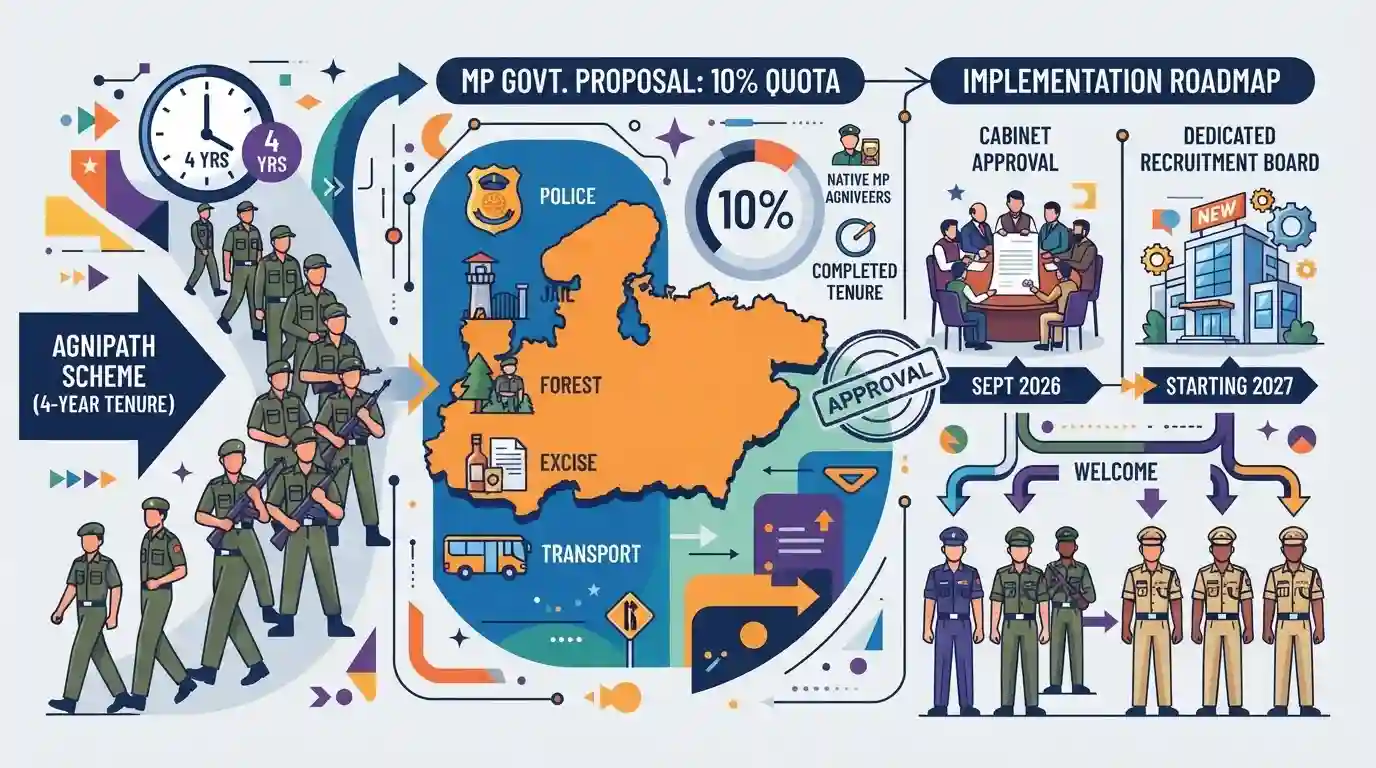
The Madhya Pradesh government has formulated a proposal to grant up to 10% reservation to native MP Agniveers in the state's uniformed services, including the Police, Jail, Forest, Excise, and Transport departments. Approved by the finance and home departments, the policy redistributes or creates specific quotas for Agniveers upon completing their four-year military tenure. It is slated for final Cabinet approval in September 2026, aligning with the expected completion of the first Agniveer batch's service and the creation of a dedicated MP Police Recruitment Board to manage state uniformed recruitment starting early 2027.
Key Points
- The Madhya Pradesh government is preparing to provide up to 10% reservation in state uniformed services for native Agniveers who complete their four-year tenure in the Indian Armed Forces.
- The targeted departments for this reservation include the Police, Jail, Forest, Excise, and Transport departments.
- For General Constable posts in the Police Department, the current reservation of 15% for Home Guards and 10% for Ex-Servicemen will be adjusted to 10% for Home Guards, 7.5% for Ex-Servicemen, and 7.5% for Agniveers, preserving the overall quota ratio.
- For Special Armed Force (SAF) and Excise Department constables, a brand-new 10% reservation for Agniveers will be established without altering existing quotas for other segments.
- For Guard posts in Jail and Forest Departments, the 30% quota for Home Guards will be reduced to 20%, with the remaining 10% allocated to Agniveers.
- The timeline aims for recruitment to begin in January-February (following the conclusion of the first Agniveer batch's tenure in Dec 2026–Jan 2027), which will be overseen by a newly proposed Police Recruitment Board for Madhya Pradesh.
- ACS Home Sanjay Shukla confirmed that the proposal has received finance and departmental approvals and is scheduled for final Cabinet approval in September 2026.
Important Terms
Agnipath Scheme

A central military recruitment scheme launched in June 2022 to induct youth into the Indian Armed Forces (Army, Navy, and Air Force) for a short-term tenure of four years.
UPSC context
MPPSC GS Paper II (Government Policies) & Paper III (Security Forces). Tests national defense reforms and military recruitment policies.
Agniveers
The youth recruited under the Agnipath Scheme for a four-year tenure in the Indian Armed Forces, who receive a lump-sum package and skill certificates upon discharge.
UPSC context
MPPSC GS Paper II (Welfare Schemes & Reservation Policy). Tests state welfare policies and rehabilitation of ex-military personnel.
Madhya Pradesh Police Recruitment Board
A state-level body created in Madhya Pradesh to handle standardized and transparent direct recruitment for all uniformed services, transitioning this responsibility away from the Employees Selection Board.
UPSC context
MPPSC GS Paper II (State Administration & Police Reforms). Tests administrative reforms and state governance.
Madhya Pradesh Home Department
The state administrative department in Madhya Pradesh responsible for public order, police forces, jail, and internal security, overseeing crucial safety policies and structural recruitment reforms.
UPSC context
MPPSC GS Paper II (State Governance & Administration). Tests departmental structures, internal security machinery, and state police recruitment policies.
Madhya Pradesh Finance Department
The key department of the Madhya Pradesh government tasked with handling state finances, budget formulation, and evaluating the fiscal feasibility of newly proposed public policies and recruitment boards.
UPSC context
MPPSC GS Paper II (Administrative Machinery) and GS Paper III (Public Finance). Tests fiscal management and departmental clearances.
Prelims Trap
The 10% Agniveer reservation applies universally to all demobilized Agniveers in India across all MP state departments without altering existing quotas.
The 10% reservation is strictly for native Agniveers of Madhya Pradesh, not all Indian Agniveers, and it is a horizontal reservation implemented partly by restructuring existing quotas.
Static Concepts Connected
What is the difference between Vertical and Horizontal Reservations?
- Vertical Reservation: Social reservations under Article 16(4) for SC, ST, and OBC that apply independently of each other.
- Horizontal Reservation: Interlocking reservations under Article 16(1) or 15(3) (e.g., for women, disabled, or ex-servicemen) that cut across vertical categories.
- Adjustment Rule: A horizontal reservation category candidate is adjusted within their respective vertical social category (UR/SC/ST/OBC).
What are the key exit provisions under the Agnipath Scheme?
- Retention Cap: Only up to 25% of the recruited Agniveers are retained in the regular cadre of the Armed Forces after 4 years.
- Seva Nidhi Package: The remaining 75% receive a one-time 'Seva Nidhi' package, which is exempt from Income Tax.
- Pension Status: Discharged Agniveers do not receive gratuity or pension benefits, making state-level post-release employment policies critical.
Cross-Topic Patterns
Demobilization & Internal Security
Absorbing disciplined, military-trained personnel directly into state police and special armed forces (SAF) enhances state-level tactical and internal security capabilities.
State Administrative Reforms
Establishing a dedicated Police Recruitment Board away from MPESB/Vyapam aligns with administrative reforms aimed at structural specialization and faster recruitment cycles.

MP's restructuring of quotas for Agniveers and the creation of a dedicated Police Recruitment Board likely to feature in State Polity.
