Madhya Pradesh Adopts PPP Model to Expand Medical Education
Source:medicalbuyer ↗
Why It Matters
Crucial for understanding Madhya Pradesh's policy framework on healthcare delivery, infrastructure development, and resource mobilization via PPP models, which frequently feature in state-level civil services examinations.
Summary
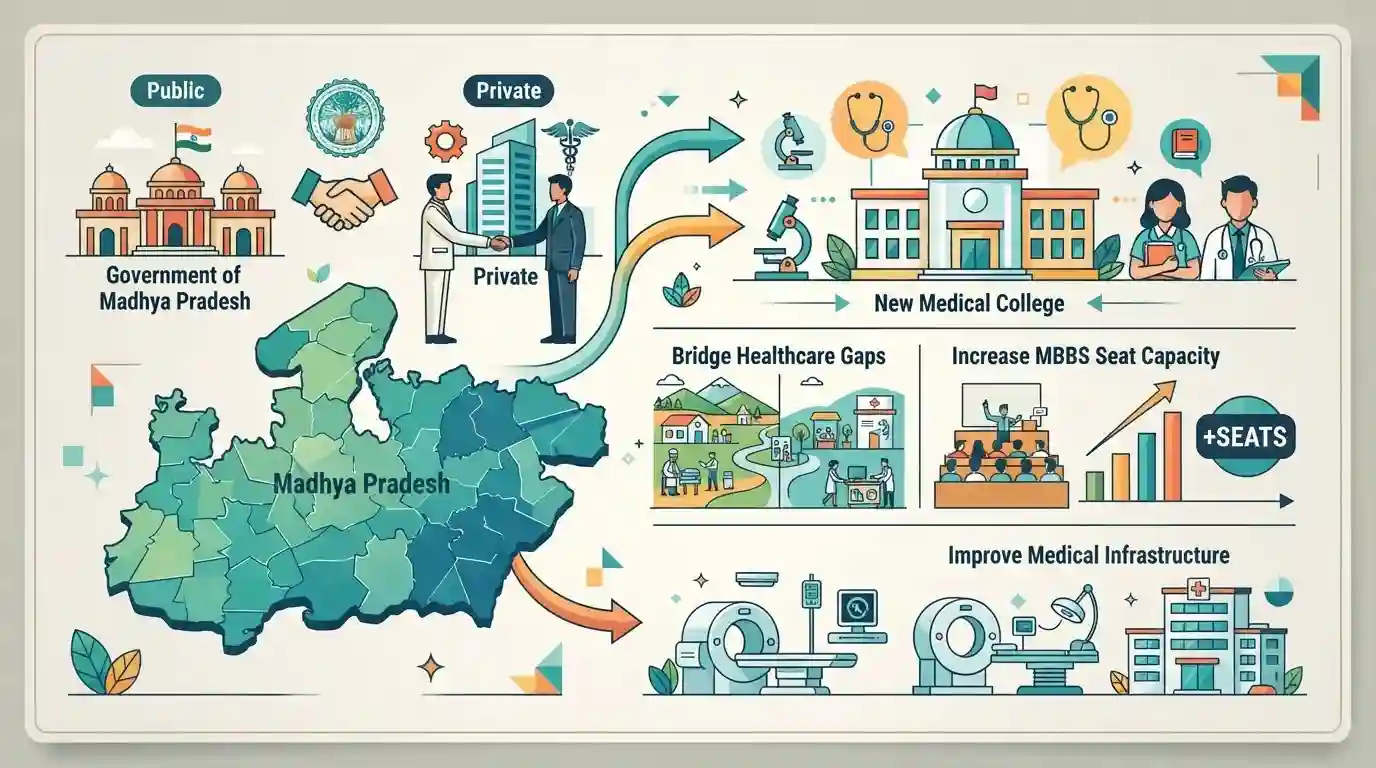
The Government of Madhya Pradesh has adopted a Public-Private Partnership (PPP) model to boost the expansion of medical colleges across the state, aiming to bridge healthcare gaps, increase MBBS seat capacity, and improve medical infrastructure through private sector collaboration.
Key Points
- Madhya Pradesh has adopted a Public-Private Partnership (PPP) approach to expand medical colleges and increase medical education infrastructure in the state.
- The initiative is aimed at addressing the shortage of medical professionals, enhancing healthcare accessibility, and improving public health delivery in under-served regions.
- Collaborating with private players allows the state to pool resources, accelerate infrastructure development, and upgrade medical training facilities.
Important Terms
Public-Private Partnership (PPP)

A collaborative funding and management framework between government bodies and private sector enterprises to build infrastructure, deliver public services, and leverage private capital and efficiency.
UPSC context
Important for MPPSC Paper II (Governance and Public Administration) and Paper III (Economy - Infrastructure, Public Private Partnerships).
Government of Madhya Pradesh
The apex administrative and political authority of the state of Madhya Pradesh, responsible for formulating policies, administering welfare schemes, and managing state infrastructure and governance.
UPSC context
Core to MPPSC Paper II (Madhya Pradesh Polity and Governance) and administrative structure of the state.
Prelims Trap
PPP model in medical colleges implies total privatization of healthcare services without government oversight.
Aspirants often assume PPP models in medical education imply complete privatization of healthcare delivery, whereas the framework maintains regulatory control and mandatory public health obligations.
Static Concepts Connected
What are the key models of Public-Private Partnerships (PPP) in infrastructure?
- BOO Model: Private partner builds, owns, and operates the facility for a defined period.
- BOT Model: Private partner builds, operates, and transfers the asset back to the government.
- DBFOT Model: Government builds the asset and leases it to a private operator for management.
Cross-Topic Patterns
PPP in Health + Fiscal Federalism
Public-Private Partnerships in health infrastructure intersect with the National Health Mission (NHM) and state budgetary allocations for capital expenditure in social sectors.
Medical Education Expansion + Regional Disparities
Expanding medical colleges under PPP models directly impacts doctor-population ratios, addressing regional imbalances highlighted in public health governance.

MPPSC questions often test specific governance models; expect matching questions on MP's PPP health initiatives and medical seat capacities.
Linked PYQs · 4
Linked PYQs · 4
- 2021MPPSC_PRELIMSGS1
The Madhya Pradesh Public Service Commission shall consist of maximum
- 2025MPPSC_PRELIMSGS1
What was Madhya Pradesh's composite SDG (Sustainable Development Goals) score in the SDG India Index 3.0 in 2020?
- 2025MPPSC_PRELIMSGS1
The objective of "Mukhyamantri Ladli Behna Yojana" implemented in entire Madhya Pradesh, in addition to economic self-reliance is:
- 2024MPPSC_PRELIMSGS1
UNNATI (Agri-GISl project of Madhya Pradesh Government is for :
