Nationwide Campaign Launched to Promote Swadeshi and Self Reliance
Source:Indian Express ↗
Why It Matters
Understanding campaigns for indigenous consumption connects historical independence strategies (Swadeshi) with modern economic paradigms (Atmanirbhar Bharat). It underscores the geopolitical significance of domestic manufacturing and self-reliance in safeguarding strategic autonomy.
Summary
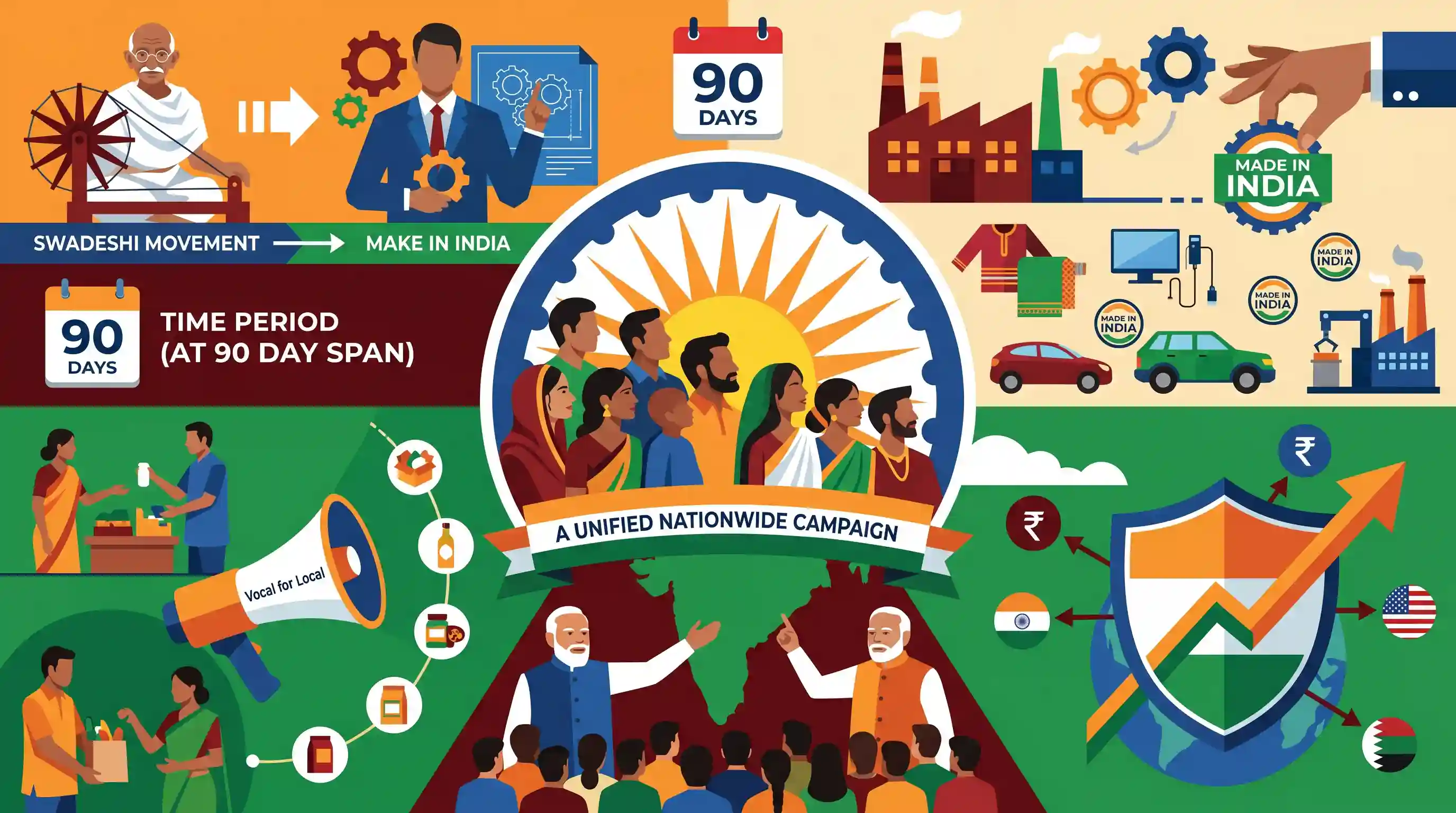
The article details the launch of the 'Atmanirbhar Bharat Sankalp Abhiyan', a 90-day nationwide campaign aimed at promoting indigenous goods and self-reliance. Led by Union Minister C R Paatil and Gujarat Chief Minister Bhupendra Patel, the initiative emphasizes the adoption of 'Swadeshi' and 'Vocal for Local' principles. Political leaders noted that true national sovereignty depends on economic independence, which shields India from international pressure. Spanning from the birth anniversary of Deendayal Upadhyay to that of Atal Bihari Vajpayee, the campaign connects the historical ethos of the Swadeshi Movement with modern economic strategies like 'Make in India'.
Key Points
- The 'Atmanirbhar Bharat Sankalp Abhiyan' is a 90-day nationwide campaign promoting the consumption of indigenous (Swadeshi) goods over imported alternatives.
- The initiative runs from September 25 (Deendayal Upadhyay's birth anniversary) to December 25 (Atal Bihari Vajpayee's birth anniversary).
- Leaders emphasized that economic independence and initiatives like 'Make in India' and 'Vocal for Local' are necessary to prevent foreign powers from exerting strategic or economic pressure on India.
- The campaign modernizes the historical principles of the Swadeshi Movement to build domestic manufacturing capacity and pride in local products.
Important Terms
Atmanirbhar Bharat Sankalp Abhiyan

A 90-day nationwide campaign (Sept 25 – Dec 25) launched in 2025 to promote indigenous goods, self-reliance, and public awareness of the 'Swadeshi' ethos.
UPSC context
GS Paper III (Economy); tests knowledge of government initiatives for industrial growth and domestic manufacturing.
Make in India
A flagship initiative launched in 2014 to transform India into a global manufacturing hub by encouraging domestic and foreign investment in 27 key sectors.
UPSC context
GS Paper III (Indian Economy); focuses on industrial policy, FDI, and employment generation in the manufacturing sector.
Vocal for Local
A policy call to prioritize and promote local products and brands to boost MSMEs, reduce import dependence, and strengthen the domestic supply chain.
UPSC context
GS Paper III (Economy); relevant for MSME promotion, rural development, and inclusive growth strategies.
Swadeshi Movement
Historically a 1905 anti-colonial movement; modernly used as a strategy for economic sovereignty by replacing foreign imports with domestic production.
UPSC context
GS Paper I (History) & III (Economy); tests the historical link between colonial-era resistance and modern economic self-reliance.
Economic Self-reliance
An economic strategy (Atmanirbharta) aimed at reducing external vulnerabilities by enhancing domestic production, technological independence, and resilience to global market shocks.
UPSC context
GS Paper III (Economy); fundamental concept for India's trade policy and industrial strategy post-pandemic.
Prelims Trap
Atmanirbhar Bharat is a return to complete import substitution and closed-economy policies.
Atmanirbhar Bharat does not mean autarky; it emphasizes building competitive domestic capacity to seamlessly integrate India into global supply chains as a resilient partner.
Static Concepts Connected
How does Atmanirbhar Bharat differ from pre-1991 Import Substitution?
- Autarky vs Integration: Pre-1991 policies aimed for closed-door self-sufficiency (autarky), whereas Atmanirbhar aims to integrate India efficiently into global value chains.
- FDI approach: Import substitution restricted foreign capital, while Atmanirbhar aggressively attracts Foreign Direct Investment (e.g., through PLI schemes) to boost domestic manufacturing capacity.
What were the economic pillars of the 1905 Swadeshi Movement?
- Boycott of foreign goods: Mass refusal to consume British imports, particularly Manchester cloth and Liverpool salt, enforced by picketing and social boycott.
- Indigenous enterprises: Establishment of native industries, such as P.C. Ray's Bengal Chemical Factory, alongside new swadeshi banks and insurance companies.
- Atmasakti (Self-reliance): Rabindranath Tagore's concept of self-reliance, emphasizing socio-economic regeneration, education, and dispute resolution at the village level.
Cross-Topic Patterns
Historical Swadeshi to High-Tech Autonomy
The 1905 khadi-based ethos translates directly to modern strategic autonomy concepts, bridging GS1 Modern History with GS3 Semiconductor and Defense Indigenization policies.
Welfare philosophies to Administrative Governance
The campaign spans Antyodaya Diwas to Good Governance Day, offering a bridge between foundational political welfare philosophies (Antyodaya) and modern administrative delivery (Good Governance).

Expect a GS1/GS3 Mains question comparing the 1905 Swadeshi movement's 'Atmasakti' with the modern global integration of Atmanirbhar Bharat.
Linked PYQs · 3
Linked PYQs · 3
- 2023MainsGS3
Faster economic growth requires increased share of the manufacturing sector in GDP, particularly of MSMEs. Comment on the present policies of the Government in this regard.
- 2025MainsGS3
India aims to become a semiconductor manufacturing hub. What are the challenges faced by the semiconductor industry in India? Mention the salient features of the India Semiconductor Mission.
- 2021MainsGS1
Bring out the constructive programmes of Mahatma Gandhi during Non-Cooperation Movement and Civil Disobedience Movement.
