Traditional Medicine: Integrating Siddha into Public Health Systems
Source:The Hindu ↗
Why It Matters
The debate over integrating traditional Indian Systems of Medicine (AYUSH) with modern allopathic practices is highly relevant for UPSC GS2 (Health/Governance). It highlights the tension between promoting accessible, culturally rooted medicine and ensuring rigorous, evidence-based scientific standards for tackling modern health challenges like non-communicable diseases.
Summary
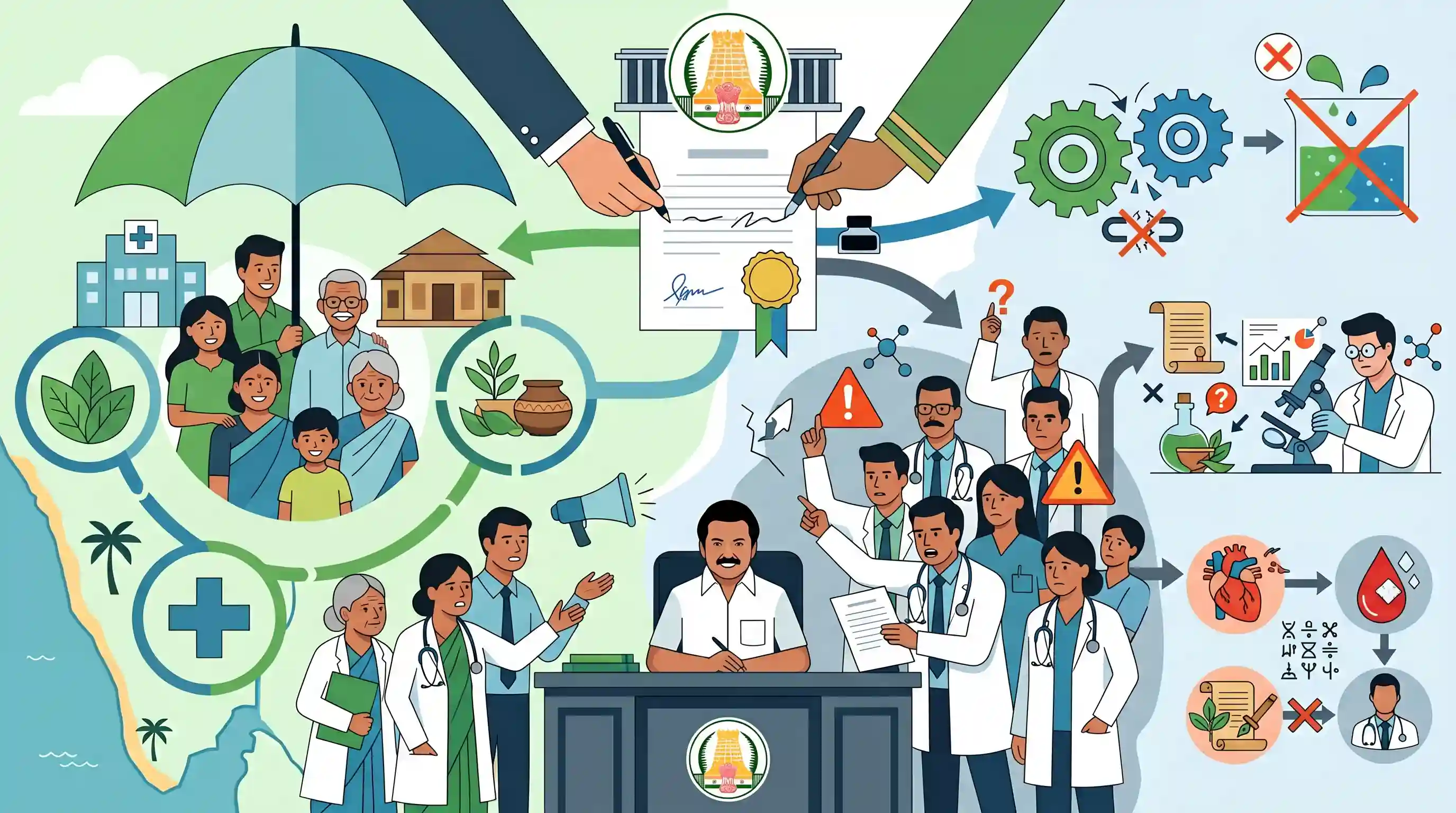
Tamil Nadu's initiative to integrate traditional Siddha practices into its public health system through a newly signed MoU has sparked strong opposition from modern medical associations. Critics label the move as "mixopathy," arguing it lacks scientific validation and could degrade healthcare standards across all systems of medicine. Medical professionals further emphasize that ancient practices offer no proven solutions for managing modern non-communicable diseases—such as diabetes and cardiovascular conditions—which are major mortality contributors in the state. While the government defends the collaboration as a step toward accessible and holistic healthcare, doctors are urging the Chief Minister to intervene and halt the integration.
Key Points
- Tamil Nadu's Directorate of Public Health signed an MoU with traditional medicine authorities to integrate Siddha practices into the public health system.
- Doctors' associations strongly oppose the move, labeling it "mixopathy" and arguing it will degrade the standards of both modern and traditional medicine.
- Medical professionals argue that traditional medicine lacks evidence-based solutions for non-communicable diseases (like diabetes and hypertension), which are the leading causes of mortality in the state.
- The state government defends the initiative as a progressive step to provide accessible, holistic, and culturally rooted healthcare to its citizens.
Important Terms
Mixopathy

A controversial term describing the integration or 'mixing' of traditional (AYUSH) and modern (allopathic) medical systems, often criticized by medical associations as unscientific.
UPSC context
Relevant to GS-II (Health Policy) and GS-IV (Medical Ethics); tests debates on integrative vs. evidence-based medicine.
National Institute of Siddha (NIS)
The apex national center of excellence for Siddha medicine in Chennai, focusing on research, postgraduate education, and validating traditional treatments through modern scientific standards.
UPSC context
Relevant to GS-II (Health) and GS-III (Indigenous Knowledge); tests awareness of institutional frameworks for traditional medicine.
Commissionerate of Indian Medicine and Homoeopathy (CIMH)
The Tamil Nadu government department responsible for the regulation, education, and clinical delivery of traditional medical systems like Siddha, Ayurveda, and Homoeopathy.
UPSC context
Relevant to GS-II (Government Policies); examines state-level administrative structures for promoting indigenous health systems.
Directorate of Public Health and Preventive Medicine (DPH&PM)
Tamil Nadu's lead health agency for preventive care, managing disease surveillance, maternal health, and the state's extensive network of Primary Health Centres (PHCs).
UPSC context
Relevant to GS-II (Social Justice/Health); tests knowledge of decentralized health delivery and preventive medicine infrastructure.
Service Doctors and Post Graduates Association (SDPGA)
A professional association for government-employed doctors in Tamil Nadu, acting as a pressure group for medical welfare and scientific healthcare standards.
UPSC context
Relevant to GS-II (Pressure Groups); illustrates how professional bodies influence health policy and governance.
Doctors' Association for Social Equality (DASE)
A social-justice-oriented medical forum in Tamil Nadu that advocates for equitable healthcare access, fair pay, and opposes the privatization of public health services.
UPSC context
Relevant to GS-II (Pressure Groups/Vulnerable Sections); highlights the role of civil society in medical policy.
Prelims Trap
"NHP 2017 officially permits cross-practice, allowing AYUSH doctors to prescribe modern allopathic medicines."
NHP 2017 promotes "co-location" of facilities and cross-referrals (pluralism), not "cross-practice". Prescribing allopathy without an MBBS remains illegal under the NMC Act.
Static Concepts Connected
What are the foundational principles and unique elements of the Siddha system?
- Origins: Originated in ancient Tamil civilization, traditionally attributed to 18 'Siddhars' (spiritual scientists or perfected beings).
- Basic Philosophy: Disease is viewed as an imbalance of three humours (tridoshas): Vatham (air), Pitham (fire), and Kapham (earth/water).
- Unique Therapeutics: Unlike Ayurveda's heavy herbal focus, Siddha uniquely relies on alchemy, extensively utilizing purified metals, minerals, and animal products in its formulations.
How does the National Health Policy (NHP) 2017 mandate the mainstreaming of AYUSH?
- Co-location: Co-locating AYUSH practitioners in Primary Health Centres (PHCs), CHCs, and district hospitals to expand patient choice.
- Preventive Care: Utilizing traditional systems specifically for wellness, yoga, and promotive healthcare at Health and Wellness Centres.
- Resource Optimization: Leveraging the vast pool of registered AYUSH practitioners to bridge acute human resource shortages in rural areas.
Cross-Topic Patterns
NCD transition challenges AYUSH limits
India's shift to 63% NCD-driven mortality tests AYUSH integration. While effective for wellness, traditional systems face scrutiny over lacking evidence-based acute management for diabetes and cardiovascular diseases.
Medical pluralism vs clinical ethics
The debate connects GS-II healthcare to GS-IV bioethics. Medical pluralism offers patient choice, but 'mixopathy' risks bypassing rigorous clinical trial standards mandated by the CDSCO.

Expect a GS-II question on balancing NHP 2017's AYUSH mainstreaming against the scientific and ethical concerns of 'mixopathy'.
Linked PYQs · 2
Linked PYQs · 2
- 2024MainsGS2
In a crucial domain like the public healthcare system the Indian State should play a vital role to contain the adverse impact of marketisation of the system. Suggest some measures through which the State can enhance the reach of public healthcare at the grassroots level.
- 2020MainsGS2
In order to enhance the prospects of social development, sound and adequate health care policies are needed particularly in the fields of geriatric and maternal health care. Discuss.
