Nagaland Signs MoU to Promote Jute and Natural Fibre Farming
Source:The Hindu ↗
Why It Matters
The promotion of natural fibres in non-traditional areas like Nagaland is highly relevant for UPSC GS3 as it bridges multiple themes: agricultural diversification, increasing farmers' income in the Northeast, and environmental sustainability by generating biodegradable substitutes for plastic.
Summary
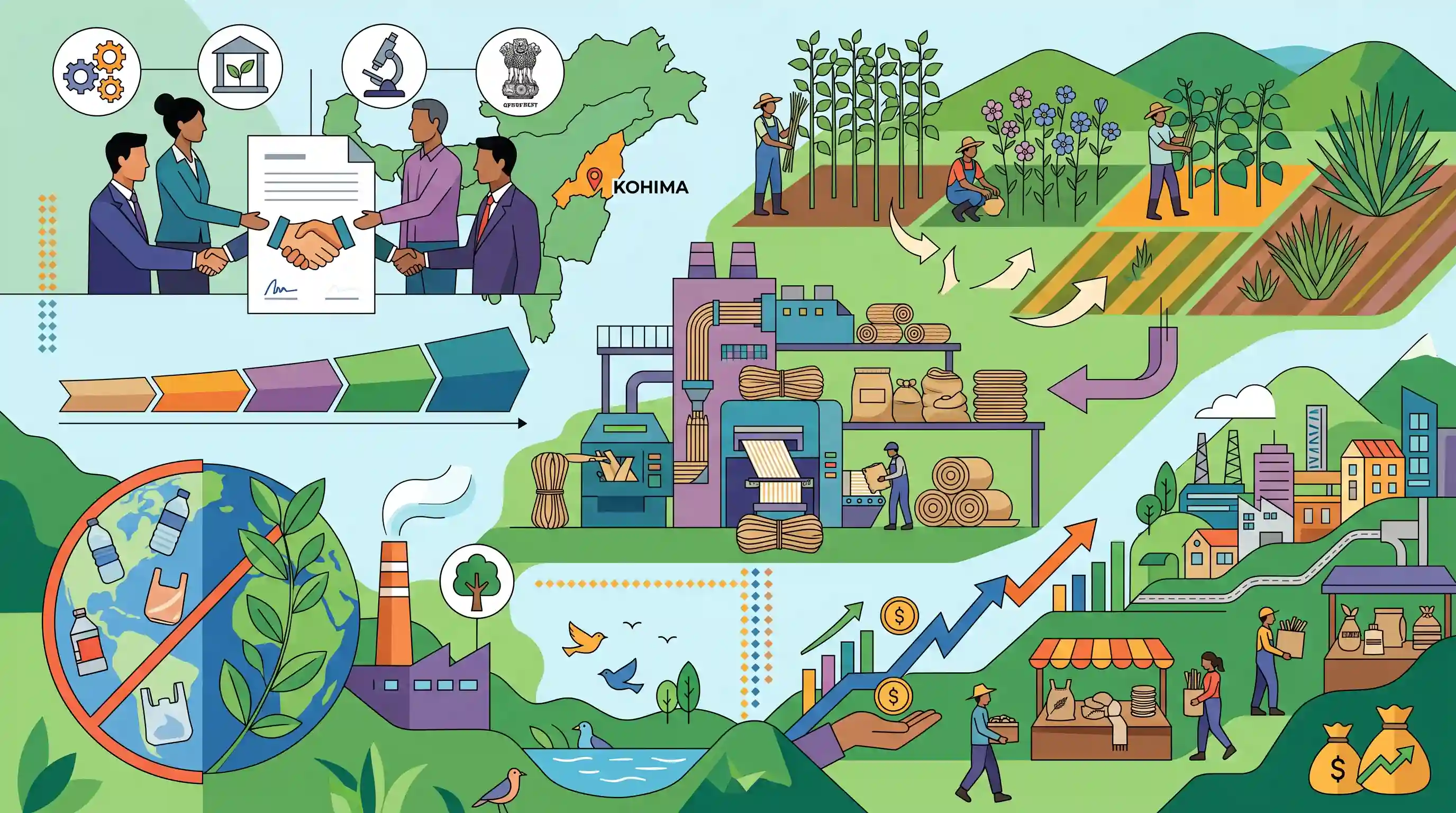
A landmark four-party Memorandum of Understanding (MoU) was signed in Kohima, Nagaland, to promote the cultivation of jute and new-age natural fibres. Involving the National Jute Board, Jute Corporation of India, ICAR-CRIJAF, and the Nagaland government, the five-year pact (2025-26 to 2030-31) focuses on agricultural diversification by introducing crops like flax, ramie, and sisal. The initiative aims to bolster the production of eco-friendly, biodegradable alternatives to plastics and timber while providing new cash-crop opportunities for farmers in Northeast India.
Key Points
- A four-party MoU was signed in Kohima to promote the cultivation of jute and new-age natural fibres like flax, ramie, and sisal in Nagaland.
- The agreement, spanning five years (2025-26 to 2030-31), aims to expand jute farming and implement better agronomy practices on a pilot scale in the state.
- The initiative seeks to develop eco-friendly, biodegradable substitutes for plastics and timber to mitigate environmental impacts.
- By expanding natural fibre cultivation to the Northeast, the project aims to drive agricultural diversification, open new industrial applications, and boost the rural cash-crop economy.
Important Terms
Nagaland Jute and Natural Fibre MoU

A 2025-2031 pact between the National Jute Board, JCI, ICAR-CRIJAF, and Nagaland to expand jute farming and introduce new-age fibres (flax, ramie, sisal) for sustainable livelihoods.
UPSC context
GS-III: Development of North East India; Agricultural Diversification. Tests strategies for shifting cropping patterns and promoting agro-based industries.
National Jute Board (NJB)
An apex statutory body under the Ministry of Textiles (Act of 2008) responsible for the promotion, modernization, and global competitiveness of India's jute sector.
UPSC context
GS-III: Economics/Agriculture. Tests institutional frameworks and statutory bodies governing key commercial crops and agro-industries.
Jute Corporation of India (JCI)
A Central Public Sector Undertaking (CPSU) that acts as the nodal agency for implementing Minimum Support Price (MSP) and price stabilization operations for jute farmers.
UPSC context
GS-III: Agriculture/Economy. Crucial for understanding MSP mechanisms, price support systems, and government intervention in agricultural markets.
ICAR-CRIJAF
A premier research institute under the ICAR that conducts R&D on crop improvement, sustainable production technologies, and value addition for jute and allied fibres.
UPSC context
GS-III: Science and Technology in Agriculture. Relevant for institutional roles in improving crop yields and developing eco-friendly industrial materials.
New-age Natural Fibres
Biodegradable natural fibres like flax, ramie, and sisal being promoted as sustainable alternatives to synthetic plastics and timber in industrial applications.
UPSC context
GS-III: Environment and Ecology. Tests knowledge of sustainable, biodegradable materials and eco-friendly substitutes for plastic pollution mitigation.
Jute-ICARE Scheme
A flagship scheme aimed at improving the productivity and quality of raw jute through better agronomic practices, microbial retting, and seed distribution.
UPSC context
GS-III: Agriculture/Government Schemes. Tests specific initiatives targeted at technology adoption and productivity enhancement in the textile sector.
Prelims Trap
"The Minimum Support Price (MSP) for raw jute is determined and declared by the Jute Corporation of India."
JCI is merely the central nodal procurement agency. The MSP for jute is determined by the CCEA based on recommendations from the CACP.
Static Concepts Connected
What are the ideal geographical conditions for jute cultivation?
- Temperature: Requires a hot and humid climate, typically ranging between 24°C and 35°C during the growing season.
- Rainfall: Needs heavy and well-distributed rainfall ranging from 120 cm to 150 cm to support continuous growth.
- Soil profile: Thrives best in well-drained, highly fertile alluvial soils, particularly those frequently replenished by annual river floods.
What is the difference between 'bast' and 'leaf' plant fibres?
- Bast Fibres: Extracted from the phloem (inner bark) of the plant's stem, usually via a microbial rotting process called retting. Examples: jute, flax, and ramie.
- Leaf Fibres: Obtained directly from the long, fleshy leaves of specific plants. Sisal (derived from the Agave plant) is a prime example.
Cross-Topic Patterns
NE India Cash Crop Push
Similar to the National Mission on Edible Oils - Oil Palm (NMEO-OP), introducing jute and ramie in Nagaland reflects a strategic shift to leverage NE India's climate for lucrative cash crops.
Alternatives to Single-Use Plastics
Cultivating biodegradable fibres like flax and sisal directly supports India's Single-Use Plastic ban and aligns with mandatory packaging norms under the Jute Packaging Materials Act, 1987.

Expect a multi-statement Prelims question on bast vs leaf fibres (flax/ramie/sisal) coupled with the statutory mandate of the NJB.
Linked PYQs · 5
Linked PYQs · 5
- 2020PrelimsGS1
"The crop is subtropical in nature. A hard frost is injurious to it. It requires at least 210 frost-free days and 50 to 100 centimeters of rainfall for its growth. A light well-drained soil capable of retaining moisture is ideally suited for the cultivation of the crop." Which one of the following is that crop?
- 2017MainsGS3
How do subsidies affect the cropping pattern, crop diversity and economy of farmers? What is the significance of crop insurance, minimum support price and food processing for small and marginal farmers?
- 2021MainsGS3
What are the present challenges before crop diversification? How do emerging technologies provide an opportunity for crop diversification?
- 2017MainsGS3
What are the major reasons for declining rice and wheat yield in the cropping system? How crop diversification is helpful to stabilise the yield of the crops in the system?
- 2025MainsGS3
Explain the factors influencing the decision of the farmers on the selection of high value crops in India.
