Judicial Cooperation MoU Between Supreme Courts of India and Nepal
Source:The Hindu ↗
Why It Matters
This article provides excellent examples for GS2 answers on 'Comparison of the Indian constitutional scheme with that of other countries' and 'India and its neighborhood relations'. It highlights judicial diplomacy and the mutual influence of constitutional jurisprudence (such as Basic Structure and LGBTQ rights) between India and Nepal.
Summary
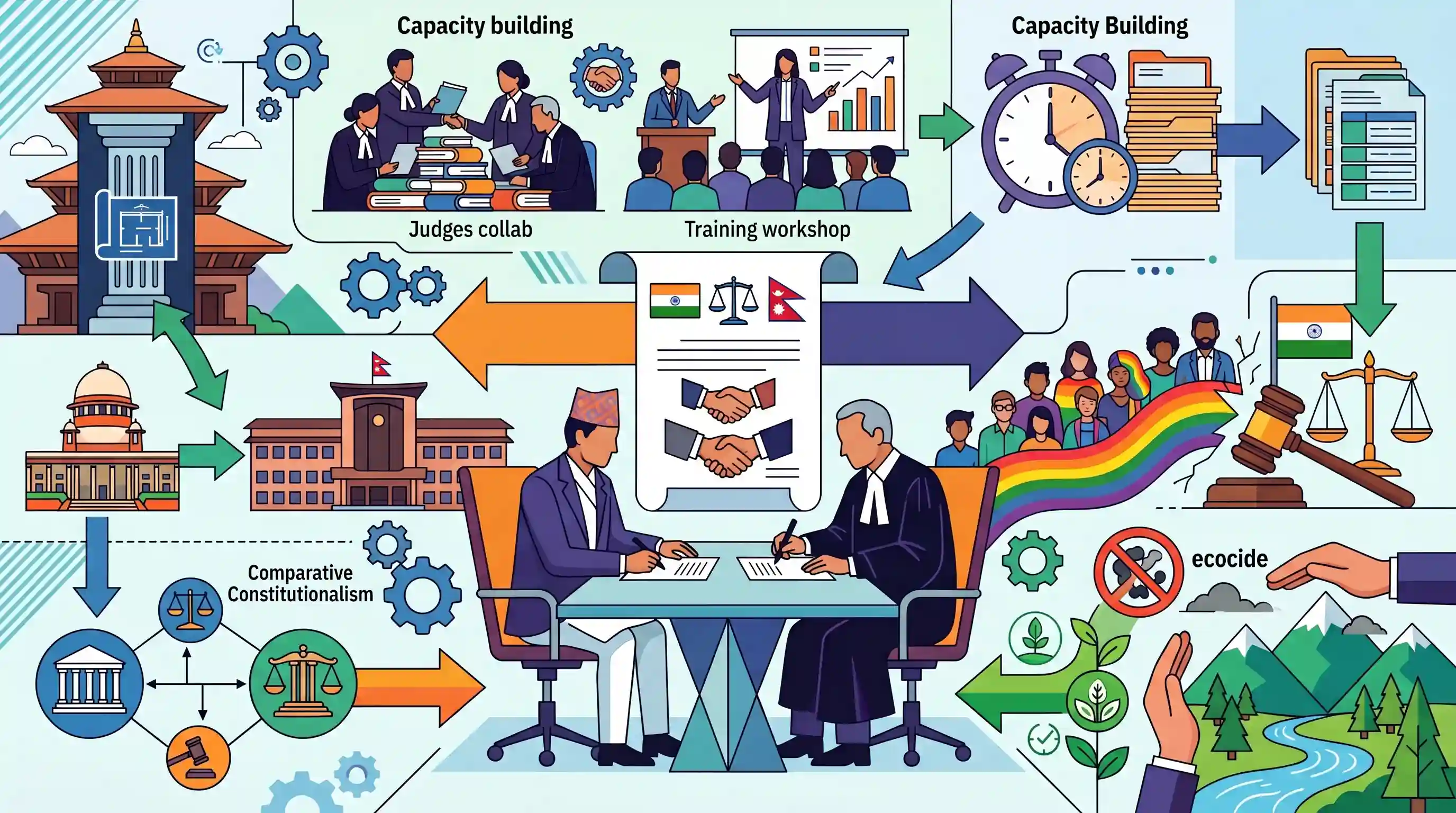
The Supreme Courts of India and Nepal signed a Memorandum of Understanding (MoU) to establish institutional mechanisms for judicial cooperation, focusing on capacity building, training, and resolving shared challenges like case pendency. During the signing, Chief Justice of India Sanjiv Khanna highlighted the cross-pollination of constitutional jurisprudence between the two countries. While Nepal has incorporated India's 'Basic Structure' doctrine into its legal framework, India’s apex court drew inspiration from the Nepal Supreme Court's progressive rulings on LGBTQ rights (influencing the decriminalisation of Section 377) and its interpretation of "ecocide" to protect the right to a clean environment.
Key Points
- The Supreme Courts of India and Nepal signed an MoU on April 7, 2025, to establish a formal framework for judicial cooperation.
- The MoU aims to facilitate joint research, training, and information sharing to address common issues such as judicial delays, digitisation, and access to justice.
- CJI Sanjiv Khanna highlighted reciprocal constitutional borrowing: Nepal has adopted India's 'Basic Structure' doctrine and constitutional morality concepts.
- India's Supreme Court, in turn, drew inspiration from the Nepal Supreme Court's progressive jurisprudence on decriminalising homosexuality and recognizing the concept of 'ecocide' under the right to a healthy environment.
Important Terms
Basic Structure Doctrine

A judicial principle established in the Kesavananda Bharati case (1973) stating that certain core features of the Constitution are beyond the amending power of Parliament.
UPSC context
GS Paper II: Constitution & Polity. Essential for understanding judicial review, Article 368, and the separation of powers.
Judicial Cooperation
A collaborative framework between national judiciaries to share legal information, conduct joint training, and adopt technological best practices to improve justice delivery and reduce case backlogs.
UPSC context
GS Paper II: International Relations. Relevant for bilateral ties, India's "Neighbourhood First" policy, and institutional diplomacy.
Section 377 of the Indian Penal Code
A colonial-era provision that criminalized "unnatural offences"; consensually decriminalized in India (2018) via Navtej Singh Johar v. Union of India, partially inspired by Nepal's earlier progressive rulings.
UPSC context
GS Paper I: Society & GS Paper II: Social Justice. Tests knowledge of fundamental rights (Articles 14, 15, 21).
Ecocide
The widespread destruction of the natural environment; recently recognized in Nepalese jurisprudence as a violation of the right to life and a healthy environment.
UPSC context
GS Paper III: Environment. Relates to environmental ethics, climate change litigation, and sustainable development.
Comparative Constitutionalism
The study of constitutional principles across different legal systems, facilitating "cross-pollination" where one country's judiciary adopts or adapts precedents from another.
UPSC context
GS Paper II: Constitution (Comparison of the Indian constitutional scheme with that of other countries).
Memorandum of Understanding (MoU)
A formal, non-legally binding agreement between two parties—such as the Supreme Courts of India and Nepal—outlining a shared plan for institutional collaboration.
UPSC context
GS Paper II: Governance. Pertains to institutional mechanisms and administrative cooperation.
Prelims Trap
"The Basic Structure doctrine remains an exclusively Indian legal concept unadopted by any other global jurisdiction."
False. While indigenous to India, the doctrine has been adopted by other jurisdictions, including Nepal, Bangladesh, and Kenya, illustrating the global export of Indian constitutionalism.
Static Concepts Connected
What is 'Comparative Constitutionalism' in the UPSC GS2 syllabus?
- Definition: The practice of courts studying and applying legal doctrines from foreign jurisdictions to interpret domestic laws, frequently used by the SC to expand fundamental rights.
- Persuasive Value: Foreign judgments are not binding on Indian courts but hold persuasive value, serving as a reference point in novel rights-based cases (e.g., privacy, decriminalisation of homosexuality).
How is the concept of 'Ecocide' evolving in domestic and international law?
- Core Definition: Unlawful or wanton acts committed with knowledge of a substantial likelihood of severe, widespread, or long-term damage to the environment.
- Indian Context: While not yet a statutory crime under Indian penal law, the SC is increasingly integrating its principles into the expanded right to life (Article 21).
Cross-Topic Patterns
Judicial Diplomacy in Neighborhood First
SC-level MoUs for capacity building (like with Nepal, Maldives, and Mauritius) demonstrate the Indian judiciary acting as a soft power tool in foreign policy.
Ecocide and Climate Rights under Art 21
Borrowing 'ecocide' aligns with the Indian Supreme Court's 2024 ruling recognizing the right against adverse climate change impacts as a fundamental right.

Expect a GS2 Mains question on how 'reverse constitutional borrowing' from Global South peers (e.g., Nepal) shapes India's Article 21.
Linked PYQs · 5
Linked PYQs · 5
- 2014MainsGS2
Starting from inventing the 'basic structure' doctrine, the judiciary has played a highly proactive role in ensuring that India develops into a thriving democracy. In light of the statement, evaluate the role played by judicial activism in achieving the ideals of democracy.
- 2021MainsGS2
‘Constitutional Morality’ is rooted in the Constitution itself and is founded on its essential facets. Explain the doctrine of ‘Constitutional Morality’ with the help of relevant judicial decisions.
- 2023MainsGS2
Explain the constitutional perspectives of Gender Justice with the help of relevant Constitutional Provisions and case laws.
- 2012MainsGS2
Discuss the contentious issues that have caused the prolonged constitutional logjam in Nepal.
- 2025MainsGS2
"Constitutional morality is the fulcrum which acts as an essential check upon the high functionaries and citizens alike...." In view of the above observation of the Supreme Court, explain the concept of constitutional morality and its application to ensure balance between judicial independence and judicial accountability in India.
