Advocates oppose impeachment motion against High Court judge
Source:The Hindu ↗
Why It Matters
The procedure for removing a judge of the higher judiciary is a constitutionally rigorous process meant to balance judicial accountability with judicial independence. Understanding the statutory framework (Judges (Inquiry) Act, 1968) and the constitutional provisions (Articles 124 and 217) is a core component of the GS2 Polity syllabus.
Summary
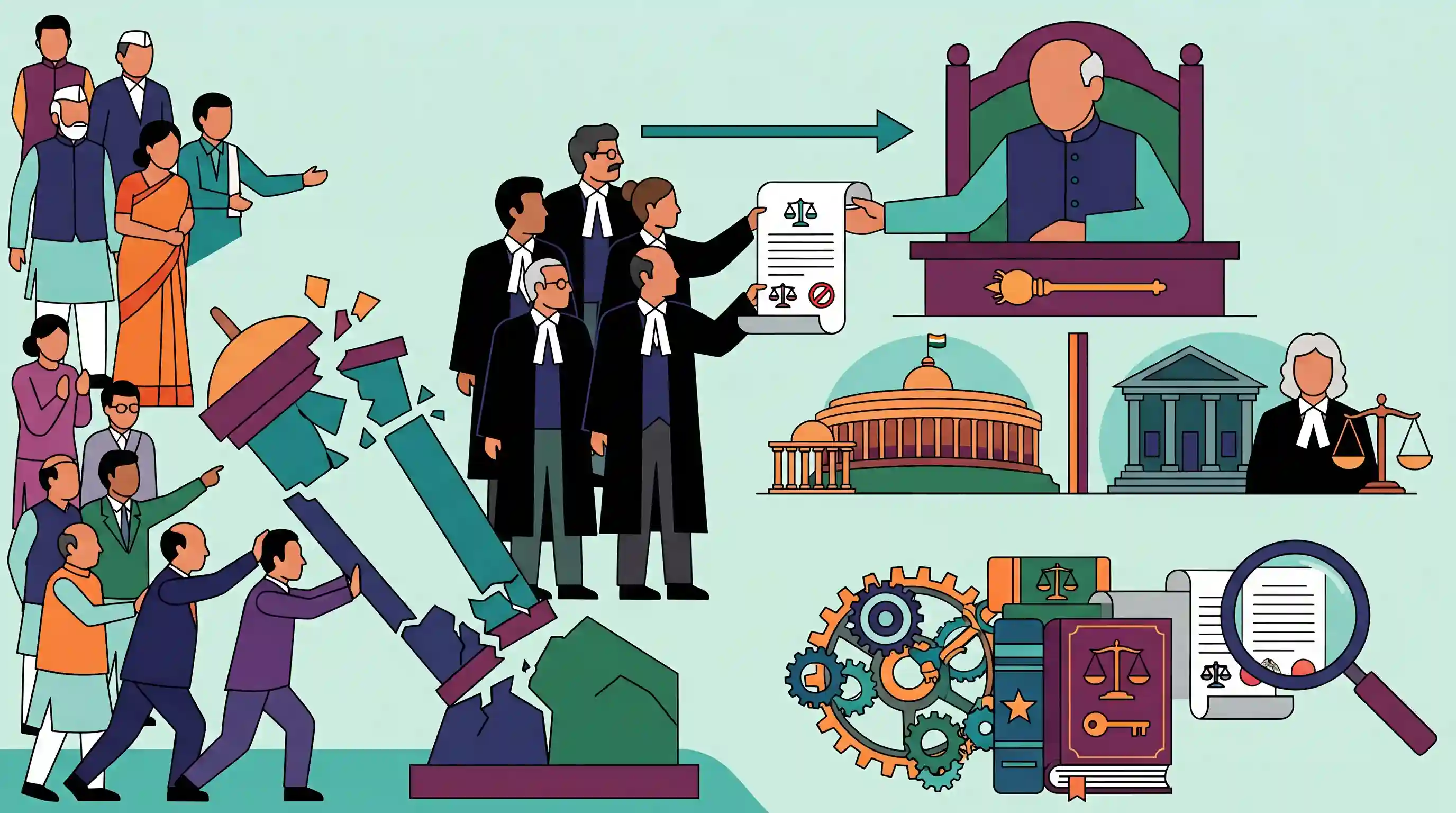
High Court advocates in Tamil Nadu have submitted a memorandum to the Lok Sabha Speaker opposing an impeachment motion against Madras High Court Judge G.R. Swaminathan. The advocates argue that the motion, initiated by certain MPs, is an attempt to destabilise the judiciary and threatens judicial independence. They assert that entertaining the motion would cross the boundary regarding the separation of powers between the legislature and the judiciary. The advocates urged the Speaker to apply the rigorous standards of Articles 124(4) and 217 of the Constitution and the Judges (Inquiry) Act, 1968, to reject the motion.
Key Points
- A section of MPs has moved a motion to impeach Justice G.R. Swaminathan of the Madras High Court.
- High Court advocates submitted a memorandum to the Lok Sabha Speaker requesting the rejection of the impeachment motion.
- The advocates argue the motion is an attempt to destabilise the judiciary and violates the separation of powers (the 'Lakshman Rekha' between legislature and judiciary).
- Removal of High Court judges is governed by Articles 217 and 124(4) of the Constitution alongside the Judges (Inquiry) Act, 1968, requiring 'proved misbehaviour or incapacity'.
- The Speaker of the Lok Sabha holds the statutory discretion to either admit or refuse the impeachment motion.
Important Terms
Judges (Inquiry) Act, 1968

The 1968 statute regulating the investigation and proof of "misbehaviour" or "incapacity" of Supreme Court and High Court judges as part of the constitutional removal process.
UPSC context
GS-II (Polity); tests understanding of judicial accountability versus independence and the legal steps required for removal.
Article 124(4)
The constitutional provision outlining that a Supreme Court judge can only be removed by a Presidential order following a special majority vote in both Houses of Parliament.
UPSC context
GS-II (Constitutional Framework); critical for questions on the security of tenure and checks on the higher judiciary.
Article 217
The article governing the appointment and removal of High Court judges, mandating that they be removed through the same procedure prescribed for Supreme Court judges.
UPSC context
GS-II (Polity); relevant for understanding the independence of the State-level higher judiciary and its constitutional safeguards.
Separation of Powers
A democratic doctrine dividing government into Legislative, Executive, and Judicial branches to prevent power concentration and ensure that one organ does not interfere in another's domain.
UPSC context
GS-II (Constitutional Framework); essential concept for analyzing conflicts between the judiciary and the legislature (e.g., impeachment).
Lok Sabha Speaker
The presiding officer of the Lok Sabha who acts as a gatekeeper in judicial impeachment, with discretionary power to admit or reject a motion for investigation.
UPSC context
GS-II (Parliament); tests the quasi-judicial powers of the Speaker and their role in maintaining institutional balance.
Judicial Independence
A fundamental constitutional principle ensuring that judges can perform their duties impartially, free from political pressure, secured by rigid appointment and removal procedures.
UPSC context
GS-II (Governance); a 'basic structure' element frequently tested regarding the judiciary's role as the Constitution's guardian.
Prelims Trap
"The Constitution of India details the procedure for impeachment and explicitly defines what constitutes 'proved misbehaviour'."
The Constitution only specifies the grounds (proved misbehaviour or incapacity) without defining them. The actual investigation procedure is entirely statutory (Judges (Inquiry) Act, 1968).
Static Concepts Connected
What is the statutory procedure to remove a High Court judge?
- Motion initiation: Requires signatures of 100 Lok Sabha members or 50 Rajya Sabha members to be submitted to the respective presiding officer.
- Discretionary admission: The Speaker of Lok Sabha or Chairman of Rajya Sabha has absolute statutory discretion to either admit or refuse the motion.
- Inquiry committee: If admitted, a three-member committee (Supreme Court judge, High Court Chief Justice, distinguished jurist) investigates the specific charges.
How do Articles 217 and 124(4) intersect for High Court judge removal?
- Article 217: Deals with the appointment and conditions of the office of a High Court Judge at the state level.
- Cross-reference: Article 217(1)(b) explicitly states that a High Court judge is removed in the exact same manner as a Supreme Court judge, pointing to Article 124(4).
- Special majority: Article 124(4) mandates a special majority (majority of total membership and two-thirds of members present and voting) in each House of Parliament.
Cross-Topic Patterns
Unitary bias in judicial structure
High Court judges adjudicate state-level matters, but their removal rests entirely with the Union Parliament. This highlights the integrated, unitary feature of the Indian judicial structure.
Speaker's quasi-judicial discretionary powers
The Speaker's unilateral power to reject an impeachment motion under the 1968 Act parallels their quasi-judicial authority under the Tenth Schedule (anti-defection), frequently sparking separation of powers debates.

Expect a multi-statement question in 2026 Prelims comparing the removal grounds and procedures of HC Judges, CAG, and CEC under Art 124(4).
Linked PYQs · 3
Linked PYQs · 3
- 2019PrelimsGS1
Consider the following statements: 1. The motion to impeach a Judge of the Supreme Court of India cannot be rejected by the Speaker of the Lok Sabha as per the Judges (Inquiry) Act, 1968. 2. The Constitution of India defines and gives details of what constitutes 'incapacity and proved misbehaviour' of the Judges of the Supreme Court of India. 3. The details of the process of impeachment of the Judges of the Supreme Court of India are given in the Judges (Inquiry) Act, 1968. 4. If the motion for the impeachment of a Judge is taken up for voting, the law requires the motion to be backed by each House of the Parliament and supported by a majority of total membership of that House and by not less than two-thirds of total members of that House present and voting. Which of the statements given above is/are correct?
- 2023MainsGS2
“Constitutionally guaranteed judicial independence is a prerequisite of democracy.” Comment.
- 2020MainsGS2
Judicial Legislation is antithetical to the doctrine of separation of powers as envisaged in the Indian Constitution. In this context justify the filing of large number of public interest petitions praying for issuing guidelines to executive authorities.
