Motherhood Penalty and Its Impact on Female Labor Force Participation
Source:Indian Express ↗
Why It Matters
Understanding the 'motherhood penalty' is crucial for addressing the structural barriers to women's economic empowerment. It directly connects to GS1 (Role of Women), GS2 (Social Justice/Vulnerable Sections), and GS3 (Inclusive Growth/Employment) by highlighting the need for gender-equitable policies and the formalization of the care economy.
Summary
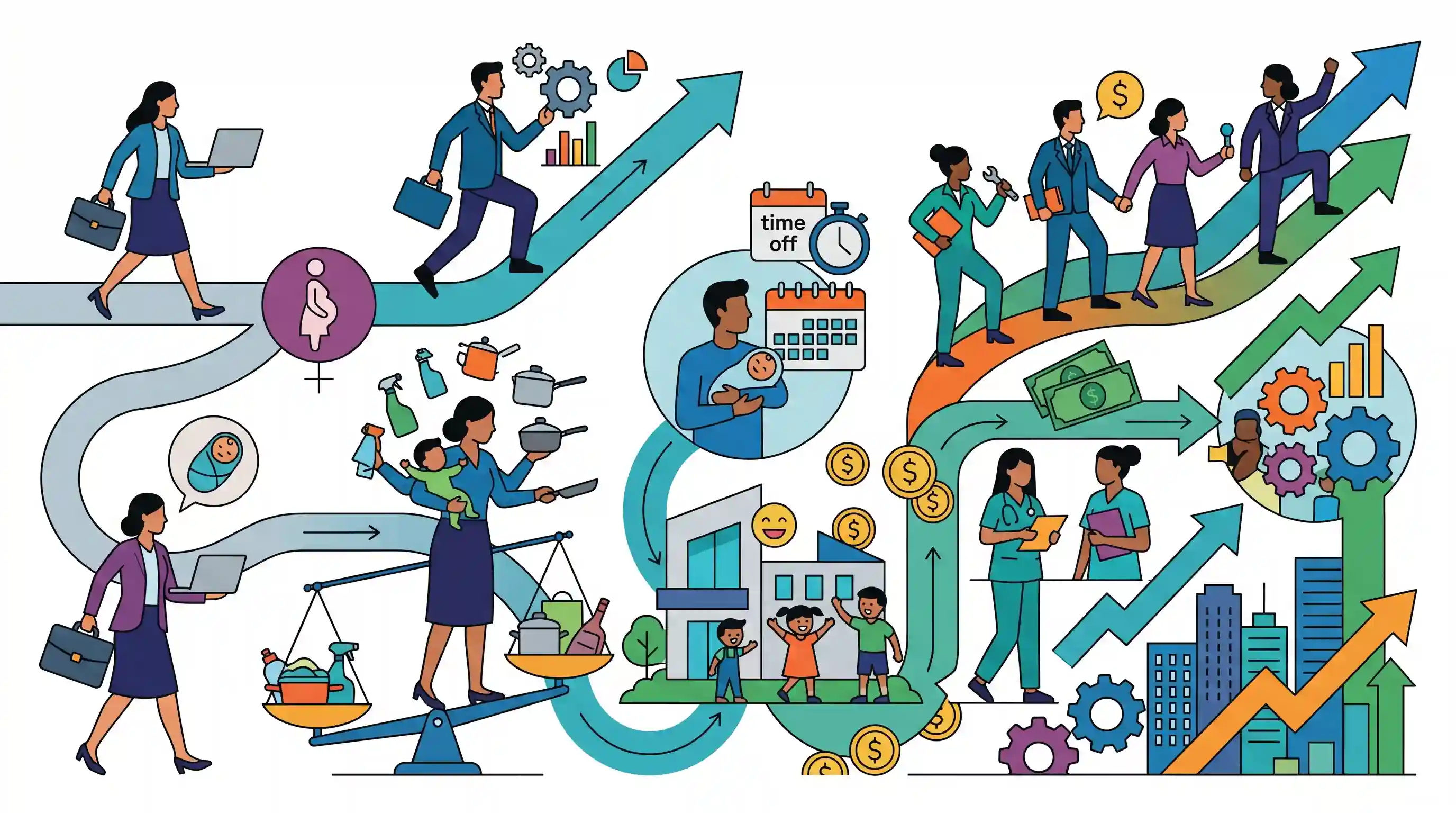
The article explores the 'motherhood penalty,' highlighting how childbirth and the subsequent burden of unpaid care work disproportionately derail women's careers and earnings compared to men. It argues that the lack of supportive care infrastructure and unequal domestic responsibilities severely constrain Female Labour Force Participation (FLFP). To foster inclusive growth and true gender equity, there is an urgent need for structural interventions, such as mandated paternity leaves, affordable childcare facilities, and broader societal recognition of the care economy.
Key Points
- The 'Motherhood Penalty' structurally disadvantages women in the workforce, leading to wage stagnation and reduced career mobility after childbirth.
- A disproportionate burden of unpaid care work and domestic chores forces many women to opt out of the formal labor market, lowering Female Labour Force Participation (FLFP).
- Current maternity policies often inadvertently increase the bias against hiring women if not matched with equitable paternity leaves.
- Addressing this requires formalizing the care economy, providing affordable institutional childcare, and promoting shared domestic responsibilities.
Important Terms
Motherhood Penalty

The systemic economic and professional disadvantages—such as lower wages and fewer promotions—that working women face after childbirth compared to childless women and men.
UPSC context
GS 1 & 2; critical for analyzing gender-based workplace discrimination and its impact on women’s economic empowerment.
Care Economy
The sector encompassing all paid and unpaid activities involving caregiving for children, the elderly, and the ill, which sustains human capital but is often excluded from GDP.
UPSC context
GS 3 (Economy); essential for discussing inclusive growth and the potential for job creation through social infrastructure investment.
Female Labour Force Participation (FLFP)
A metric representing the share of the female working-age population (15+) that is either employed or actively seeking work; India's rate recently rose to ~41.7%.
UPSC context
GS 3 (Employment); tests understanding of economic development trends and barriers to women’s entry into the formal workforce.
Maternity Benefit (Amendment) Act, 2017
Indian law extending paid maternity leave from 12 to 26 weeks and mandating crèche facilities in establishments with 50 or more employees.
UPSC context
GS 2 (Social Justice); relevant for questions on legislative support for women and welfare schemes for vulnerable sections.
Unpaid Care Work
Non-remunerated labor, like housework and caregiving, performed predominantly by women (who spend ~299 mins/day on it vs 97 mins for men in India).
UPSC context
GS 1 (Role of Women); central to discussing socio-cultural norms and the 'double burden' faced by working mothers.
Time Poverty
The lack of sufficient time for rest, education, or professional development due to an overwhelming burden of domestic and caregiving responsibilities.
UPSC context
GS 1 (Social Empowerment); used to evaluate how gendered divisions of labor impact a woman’s agency and productivity.
Prelims Trap
"The Maternity Benefit (Amendment) Act, 2017 mandates paid paternity leave alongside maternity leave."
The 2017 Act increased maternity leave to 26 weeks but contains zero provisions for statutory paternity leave, inadvertently fueling hiring bias against women.
Static Concepts Connected
What are the core mandates of the Maternity Benefit (Amendment) Act, 2017?
- Leave duration: Increased paid maternity leave from 12 to 26 weeks for the first two children.
- Creche facility: Strictly mandates establishments with 50 or more employees to provide and maintain a creche facility.
- Work from home: Enables employers to allow a nursing mother to work from home post-leave, if the nature of work permits.
Why is unpaid care work excluded from standard GDP calculations?
- Production boundary: The UN's System of National Accounts (SNA) excludes unpaid domestic services from its "production boundary" because they are difficult to value at market prices.
- Alternative measurement: Instead of GDP, India attempts to measure this invisible labor through the Time Use Survey (TUS) conducted by the NSO.
Cross-Topic Patterns
Care Economy & Demographic Dividend
High burden of unpaid care work depresses female labor force participation (FLFP), preventing India from fully realizing its demographic dividend despite a youth-heavy working-age population.
Nobel Prize & FLFP U-Curve
Claudia Goldin’s Nobel-winning research on the 'motherhood penalty' and the U-shaped FLFP curve provides a direct, high-value theoretical framework for GS-1 and GS-2 answers on women's issues.

Expect a GS1 or GS3 Mains question in 2026 linking the 'Care Economy' to India's FLFP stagnation, citing the Maternity Act's limitations.
Linked PYQs · 4
Linked PYQs · 4
- 2024MainsGS1
Distinguish between gender equality, gender equity and women's empowerment. Why is it important to take gender concerns into account in programme design and implementation?
- 2016MainsGS3
Women empowerment in India needs gender budgeting. What are the requirements and status of gender budgeting in the Indian context?
- 2021MainsGS1
Examine the role of 'Gig Economy' in the process of empowerment of women in India.
- 2020MainsGS2
In order to enhance the prospects of social development, sound and adequate health care policies are needed particularly in the fields of geriatric and maternal health care. Discuss.
