Artificial intelligence automation of white-collar work
Source:Indian Express ↗
Why It Matters
The automation of white-collar work by AI represents a critical juncture for economic policy, employment generation, and socio-economic stability. For UPSC aspirants, understanding this dynamic is essential for analyzing the future of the Indian economy, employment challenges, the need for education and skill development reforms, and the ethical dimensions of technology deployment.
Summary
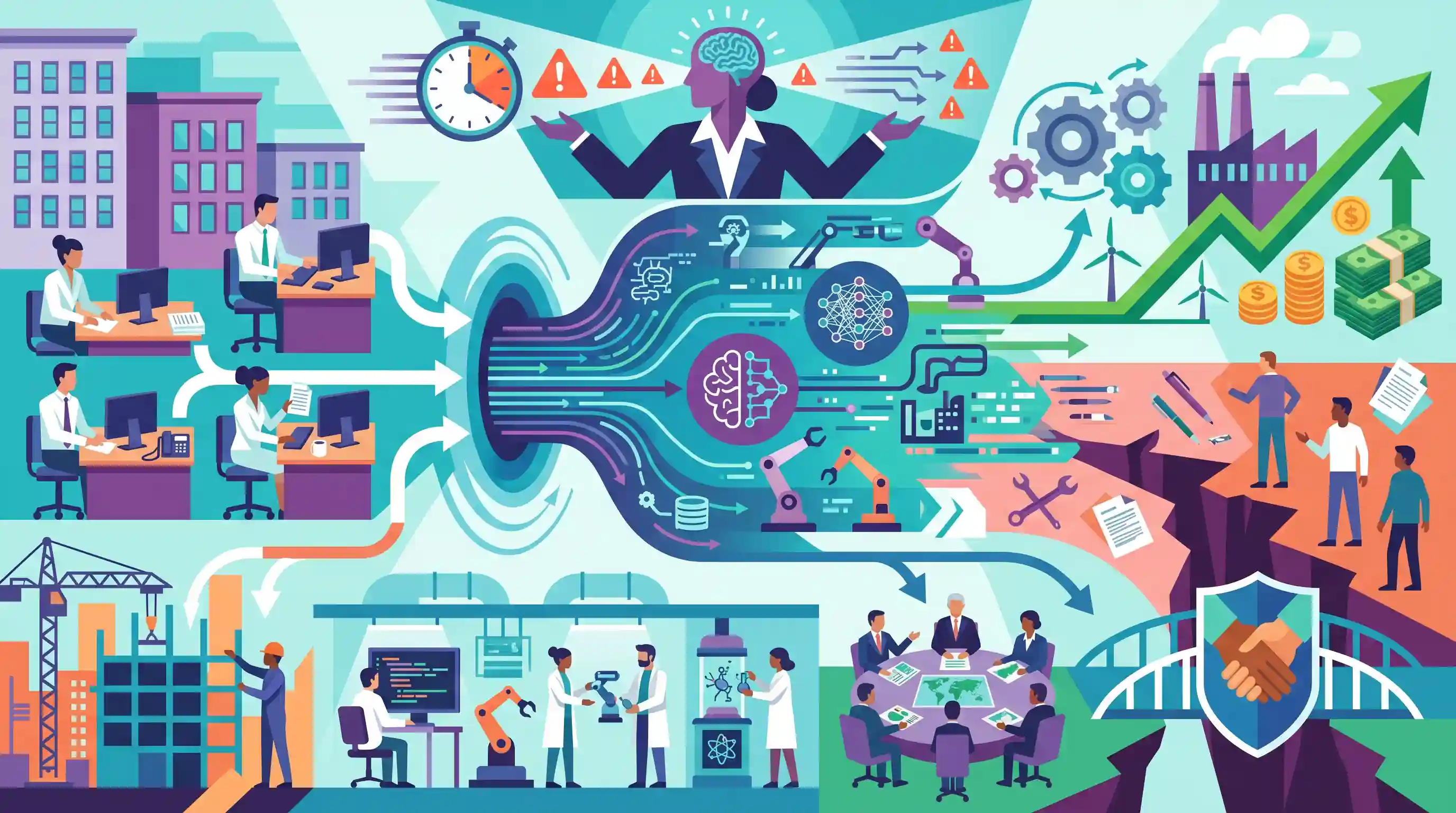
Microsoft's AI Chief has issued a stark warning regarding the future of work, predicting that most routine white-collar tasks will be fully automated within the next 18 months. This bold forecast underscores the unprecedented pace at which Artificial Intelligence, particularly Generative AI, is evolving and integrating into the professional sphere. The imminent automation of knowledge work signifies a profound structural shift in the global economy. While it promises massive gains in productivity and efficiency, it simultaneously raises critical concerns about widespread job displacement, economic inequality, and the redundancy of traditional skills. The situation highlights an urgent need for comprehensive policy responses aimed at large-scale reskilling of the workforce and the establishment of robust social safety nets to manage the socio-economic fallout of this technological revolution.
Key Points
- Microsoft's AI leadership predicts that the majority of routine white-collar tasks will be fully automated within an aggressive 18-month timeframe.
- The rapid advancement of Generative AI and Large Language Models (LLMs) is fundamentally disrupting traditional knowledge work.
- This accelerated timeline poses severe risks of large-scale job displacement across sectors previously thought immune to automation.
- The impending shift necessitates urgent global policy interventions focusing on workforce reskilling, upskilling, and potential social safety nets.
- The deployment of such transformative technology raises critical ethical debates regarding corporate responsibility, socio-economic inequality, and the future of human labor.
Important Terms
Generative AI (GenAI)

AI models (e.g., ChatGPT, Gemini) capable of creating original content like text, code, or images by learning patterns from vast training datasets.
UPSC context
GS Paper 3 (S&T): Tests awareness of emerging IT fields and their socio-economic impacts on India's service-led economy.
White-collar Automation
The use of AI and software to perform cognitive and administrative tasks (e.g., legal review, accounting) traditionally handled by professionals in office environments.
UPSC context
GS Paper 3 (Economy): Relevant for discussions on 'jobless growth' and the vulnerability of India's IT-BPM sector.
Structural Unemployment
Long-term unemployment arising from a mismatch between a worker's skills and the requirements of the labor market, often triggered by technological advancements like AI.
UPSC context
GS Paper 3 (Economy): Key concept for issues relating to planning, mobilization of resources, and employment.
Reskilling
The process of learning entirely new skill sets to transition into a different job role or industry as current roles become obsolete.
UPSC context
GS Paper 2 (Social Justice) & GS 3: Relates to HRD policies, Skill India, and labor market resilience.
Social Safety Nets
Government-led welfare programs (e.g., unemployment benefits, insurance) designed to protect vulnerable individuals from falling into poverty during economic shocks or transitions.
UPSC context
GS Paper 3 (Inclusive Growth): Essential for managing the socio-economic fallout of large-scale automation and displacement.
Fourth Industrial Revolution (Industry 4.0)
The current era of technological convergence (AI, robotics, IoT) that is fundamentally altering how humans live, work, and relate to one another.
UPSC context
GS Paper 3 (S&T/Economy): Framework for analyzing the speed and scope of technological disruption in global markets.
Prelims Trap
"AI-driven automation primarily leads to cyclical unemployment in the tech sector."
AI-induced job loss causes structural (or technological) unemployment due to a fundamental mismatch of skills, not cyclical unemployment, which is driven by temporary fluctuations in macroeconomic demand.
Static Concepts Connected
What distinguishes structural from frictional and cyclical unemployment?
- Structural: Caused by fundamental economic shifts, like AI automation, rendering existing worker skills obsolete and causing long-term market mismatches.
- Frictional: The temporary time lag or joblessness experienced when workers are transitioning between jobs or entering the labor market.
- Cyclical: Job losses directly tied to the boom-and-bust phases of a business cycle, driven by low aggregate demand.
What are the core foundational components of Universal Basic Income (UBI)?
- Universality: Provided to all resident citizens regardless of their income, wealth, or employment status, completely bypassing targeted selection.
- Unconditionality: Cash is transferred with absolutely no strings attached, requiring no proof of work, education, or behavioral conditions.
- Periodic Cash Transfer: Delivered directly to bank accounts as a recurring cash payment rather than in-kind transfers (food/goods) or a one-time grant.
Cross-Topic Patterns
AI vs. India's Demographic Dividend
Automation of BPO/IT services threatens India's service-led growth model, risking the transformation of our 'demographic dividend' into a 'demographic disaster' without urgent mass-upskilling policies.
Corporate Governance + Tech Ethics
The aggressive rollout of disruptive AI by mega-corporations highlights a critical GS4 theme: balancing pure profit maximization with corporate moral responsibility during massive socio-economic shifts.

Expect a GS3 Mains question linking GenAI's disruption of India's IT sector to the necessity of UBI or rapid upskilling by 2026.
Linked PYQs · 4
Linked PYQs · 4
- 2023MainsGS3
Introduce the concept of Artificial Intelligence (AI). How does Al help clinical diagnosis? Do you perceive any threat to privacy of the individual in the use of Al in healthcare?
- 2015MainsGS3
What are the areas of prohibitive labour that can be sustainably managed by robots ? Discuss the initiatives that can propel research in premier research institutes for substantive and gainful innovation.
- 2024MainsGS4
The application of Artificial Intelligence as a dependable source of input for administrative rational decision-making is a debatable issue. Critically examine the statement from the ethical point of view.
- 2022MainsGS3
Economic growth in the recent past has been led by increase in labour productivity." Explain this statement. Suggest the growth pattern that will lead to creation of more jobs without compromising labour productivity.
