Bihar Government Launches Monthly Panchayat Vikas Diwas Initiative
Source:deccan-herald ↗
Why It Matters
This article covers multiple core topics of the BPSC GS syllabus: local self-governance platforms (Panchayat Vikas Diwas), the socio-economic empowerment of rural women through JEEViKA, fiscal transfers to PRIs, and internal security/border relations with Nepal.
Summary
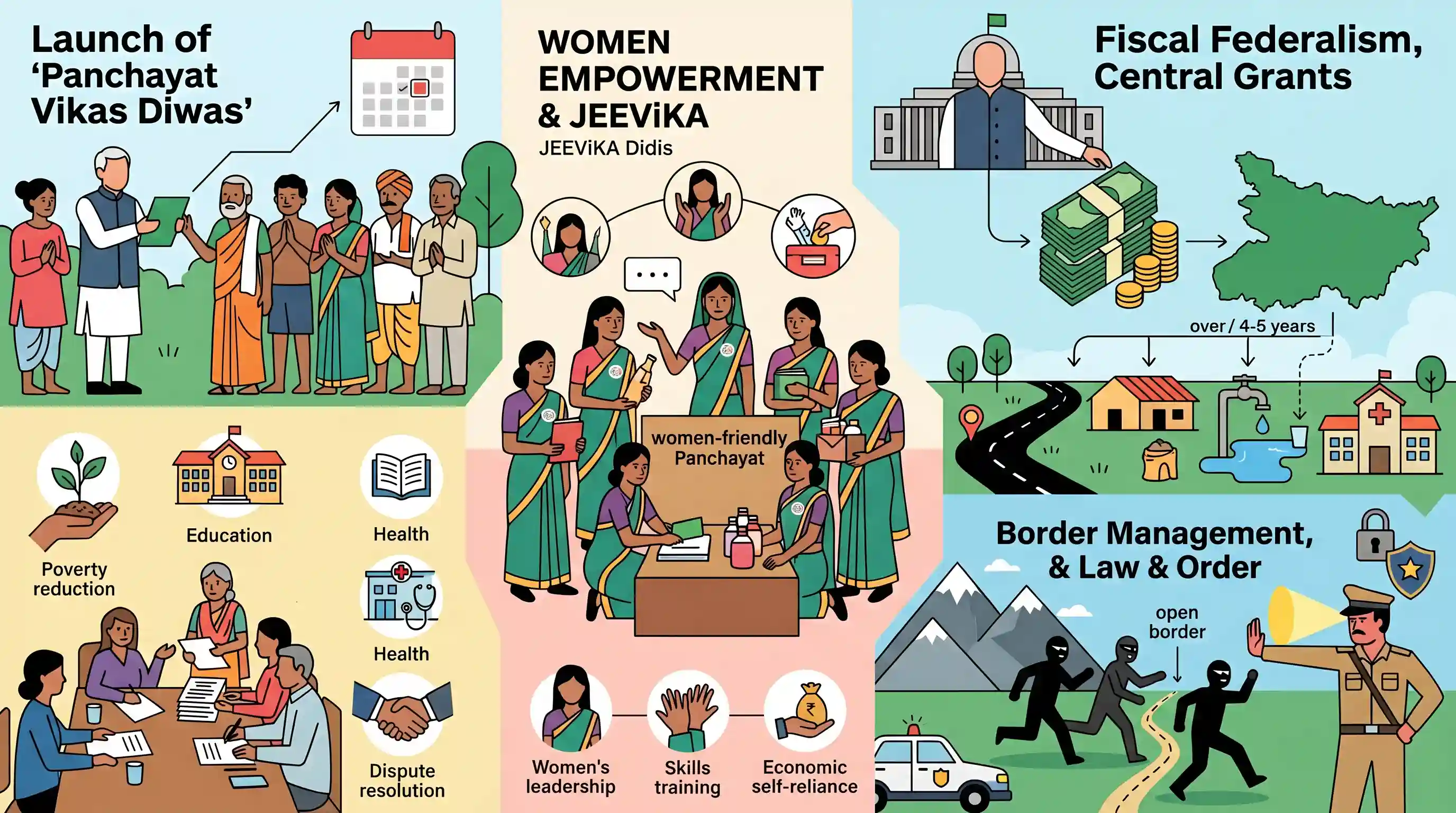
Bihar Chief Minister Samrat Choudhary launched the 'Panchayat Vikas Diwas' initiative, to be celebrated on the last Sunday of every month in all gram panchayats to resolve local issues and draft action plans for poverty reduction, health, and education. The inaugural event took place in Tetiya Gram Panchayat, Munger district with the theme 'Women-Friendly Panchayat', highlighting the key role of Jeevika Didis in women empowerment. The CM also stated that the state expects Rs 50,000-70,000 crore in central funds for rural development over 4-5 years, and warned criminals who have largely fled across the open border to neighboring Nepal.
Key Points
- Panchayat Vikas Diwas will now be observed on the last Sunday of every month in all gram panchayats in Bihar to address local development, sanitation, and social security.
- The inaugural edition of Panchayat Vikas Diwas was held at Tetiya Gram Panchayat in Munger district, under the theme 'Women-Friendly Panchayat'.
- The state government highlighted the contribution of 'Jeevika Didis' in promoting self-reliance among women in rural areas.
- Bihar expects to receive between Rs 50,000 crore and Rs 70,000 crore from the Central government over the next 4 to 5 years for panchayat development and rural infrastructure.
- The government asserted a zero-tolerance policy against crime, noting that strict security actions have forced many criminals to flee across the border to neighboring Nepal.
Important Terms
Panchayat Vikas Diwas

A monthly participatory governance initiative in Bihar celebrated on the last Sunday of each month across gram panchayats, aiming to resolve local issues, draft development plans, and promote rural development.
UPSC context
GS Paper II: Governance & PRIs. Tests knowledge of state-level grassroots administrative reforms and participatory local governance.
JEEViKA (Bihar Rural Livelihoods Project)
A World Bank-assisted socio-economic empowerment project in Bihar that organizes rural women into Self-Help Groups (SHGs) to promote microfinance, institutional capacity building, and sustainable livelihoods.
UPSC context
GS Paper II: Self Help Groups (SHGs); GS Paper III: Poverty Alleviation. Tests understanding of institutional women empowerment models.
Gram Panchayat
The basic village-level tier of local self-government in India, constitutionally established under the 73rd Amendment to handle local administration, development, and civic amenities.
UPSC context
GS Paper II: Constitutional Amendments & Decentralization. Tests core understanding of the basic unit of grassroots democracy.
Panchayat Samiti
The intermediate block-level tier of the Panchayati Raj system in India, acting as a coordinating executive body between Gram Panchayats and Zila Parishads.
UPSC context
GS Paper II: Devolution of Powers and Local Governance. Tests understanding of the three-tier Panchayati Raj structure.
Zila Parishad
The highest district-level tier of the Panchayati Raj system, responsible for coordinating, supervising, and planning developmental works across all blocks within a district.
UPSC context
GS Paper II: Federalism & Local Governance. Tests comprehension of district-level planning and coordination of rural development.
Prelims Trap
The 73rd Constitutional Amendment Act, 1992, constitutionally mandates a minimum of 50% reservation of seats for women in all Panchayati Raj Institutions.
The 73rd Amendment mandates only 33.3% reservation. While Bihar was the first to increase it to 50% in 2006, this is a state-specific legislative choice, not a national constitutional mandate.
Static Concepts Connected
What is the localized Sustainable Development Goals framework for Gram Panchayats?
- Nine thematic areas: The Ministry of Panchayati Raj collapsed the 17 global SDGs into nine localized thematic areas for rural local governance.
- Theme 9 focus: Concentrates on building 'Women-Friendly Panchayats' by mainstreaming gender equality and maternal welfare into Gram Panchayat Development Plans.
How is the Indo-Nepal open border secured and managed?
- 1950 Friendship Treaty: Establishes a porous, open border allowing visa-free movement of citizens between both nations.
- Guarding mandate: Sashastra Seema Bal, operating under the Ministry of Home Affairs, serves as the designated border guarding force.
Cross-Topic Patterns
Porous Borders & Extradition Challenges
How open boundaries under friendship treaties necessitate close bilateral extradition cooperation to prevent cross-border flight of domestic criminal actors.
Fiscal Devolution & Grassroots Governance
Linking Central Finance Commission grant delivery to state-level administrative initiatives like Bihar’s Panchayat Vikas Diwas for localized SDG implementation.

Prelims 2026 may probe the localization of SDGs in PRIs alongside the dual-use security challenges of the open Indo-Nepal border.
Linked PYQs · 3
Linked PYQs · 3
- 2016BPSC_PRELIMSGS1
'JEEVIKA' is an initiative of Bihar Govt for:
- 2022BPSC_PRELIMSGS1
In which year was 50% reservation to women in Panchayat bodies provided in Bihar?
- 2004BPSC_PRELIMSGS1
Which country has territorial boundary link with Bihar state?
