Himachal Reviews Implementation Status of State Cabinet Decisions
Source:theprint ↗
Why It Matters
Shows the functioning and oversight mechanisms (cabinet sub-committees) of the state government in ensuring the execution of cabinet decisions, which aligns with topics of governance and administration in the HPAS examination.
Summary
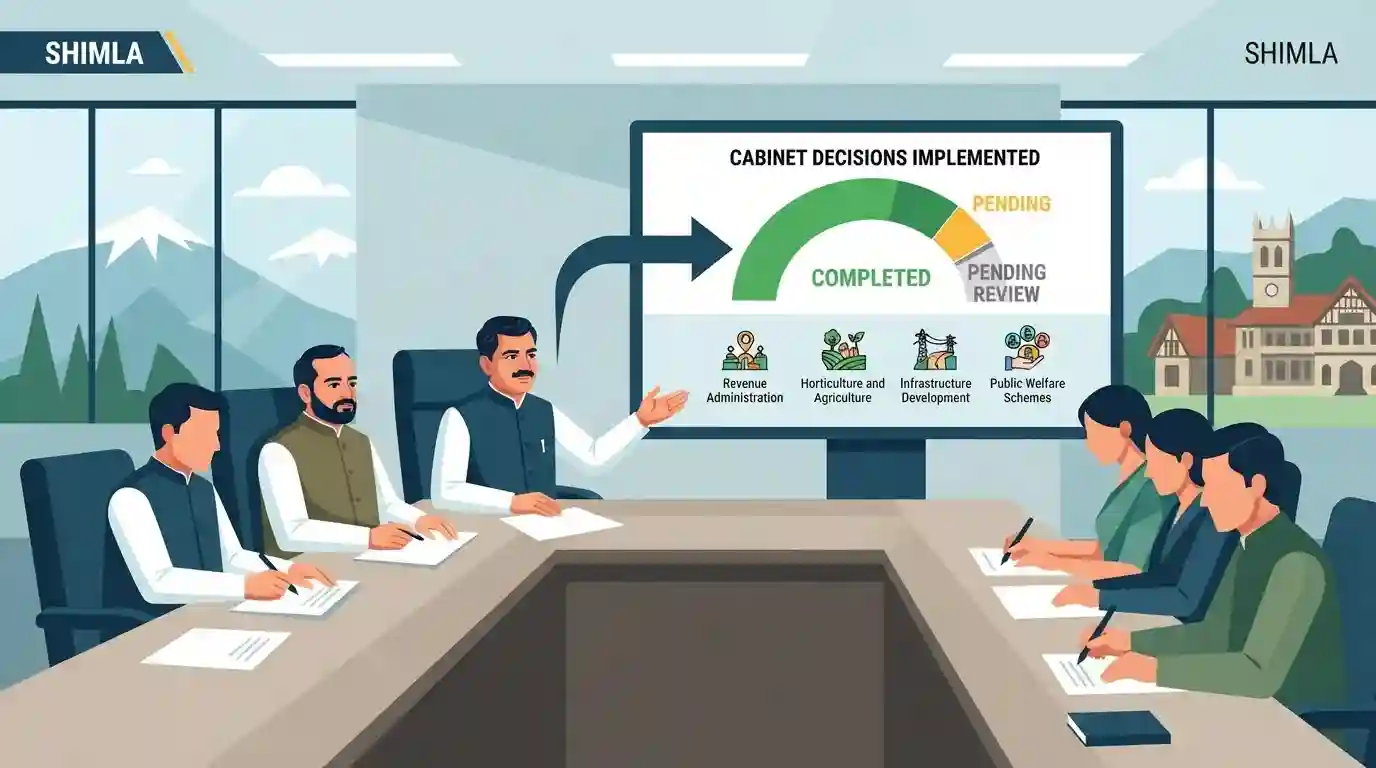
Revenue and Horticulture Minister Jagat Singh Negi stated that the majority of the 1,628 Cabinet decisions made by the Himachal Pradesh government from January 13, 2023, to May 31, 2026, have been fully implemented. Chairing a Cabinet sub-committee meeting in Shimla to review these decisions, Negi directed officials to expedite the execution of the remaining decisions. Minister Rajesh Dharmani was also present at the review.
Key Points
- Himachal Pradesh minister Jagat Singh Negi reviewed the implementation status of 1,628 Cabinet decisions taken between January 13, 2023, and May 31, 2026.
- Most of the cabinet decisions have been fully implemented, while the remaining ones are in the process of implementation.
- Negi chairs a Cabinet sub-committee tasked with reviewing these decisions.
- Detailed instructions were provided to departmental officials to ensure the rapid execution of the pending decisions.
Important Terms
Cabinet Sub-committee

A specialized, smaller group of ministers appointed to analyze specific issues in depth, ensure inter-departmental coordination, and expedite executive decision-making.
UPSC context
GS Paper II (Polity). Tests understanding of executive governance mechanisms, workload distribution, and policy formulation processes.
State Cabinet
The supreme executive and core decision-making body in a state government, comprising the Chief Minister and senior ministers who determine major government policies.
UPSC context
GS Paper II (State Government). Tests understanding of the real executive authority versus the broader Council of Ministers.
State Council of Ministers
The broader executive body in a state, headed by the Chief Minister, which aids and advises the Governor and is collectively responsible to the legislative assembly.
UPSC context
GS Paper II (Polity). Covers Articles 163 and 164, focusing on collective responsibility and executive-legislature relations.
Prelims Trap
State Cabinet Committees are formally established by the Governor under the Rules of Business.
While the Governor frames the Rules of Business for the state under Article 166(3), it is exclusively the Chief Minister who constitutes Cabinet Committees and decides their composition.
Static Concepts Connected
What is the legal status and origin of State Cabinet Committees?
- Extra-constitutional: They are extra-constitutional bodies, not explicitly mentioned in the Constitution.
- Rules of Business: They derive authority from the Rules of Business framed under Article 166(3) for convenient transaction of executive work.
- Setup by CM: The Chief Minister constitutes them, deciding whether they are standing (permanent) or ad hoc (temporary).
How are Cabinet decisions administratively implemented in a State?
- Chief Secretary: Acts as the ex-officio Secretary to the State Cabinet, heading the Cabinet Secretariat.
- Coordination: Maintains inter-departmental harmony and directly tracks the execution of cabinet directives on the ground.
- Administrative Execution: Provides the bureaucratic machinery to execute the political mandates reviewed by Cabinet Sub-committees.
Cross-Topic Patterns
Sub-committees & Collective Responsibility
Tracing the execution of cabinet decisions enforces Article 164(2). Once a sub-committee validates a decision, it solidifies the binding nature of collective responsibility across all state departments.
Rules of Business vs Executive Flexibility
UPSC frequently tests the boundary between Constitutional mandates (Article 166) and the functional flexibility (Rules of Business) given to the executive to independently manage its bureaucratic workload.

Expect a statement-based question contrasting the formation of Union vs State Cabinet committees and the Governor's role in Rules of Business.
Linked PYQs · 3
Linked PYQs · 3
- 2024HPAS_PRELIMSGS1
Consider the following statements : (1) Himachal Pradesh Government approved an outlay of 1200 crore rupees for economic services during 2022-23. (2) Himachal Pradesh Government approved an outlay of 267 crore rupees for rural development during 2022-23. (3) Himachal Pradesh Government approved an outlay of 140 crore rupees for Mahatma Gandhi National Employment Guarantee Scheme during 2022-23. (4) Himachal Pradesh Government approved an outlay of 22 crore rupees for Forestry and Wildlife during 2022-23. Choose the correct answer from the options given below :
- 2024HPAS_PRELIMSGS1
Consider the following statements regarding Panchayati Raj system in Himachal Pradesh. Statement I : In 1949, the Punjab Village Panchayat Act of 1939 was enforced and 132 panchayats were established in Himachal. Statement II : By the end of 1956, there were 466 Gram Panchayats and 26 Tehsil Panchayats in Himachal. Choose the correct option from the following :
- 2025HPAS_PRELIMSGS1
Consider the following statements regarding public finance of Himachal Pradesh : (1) According to Budget Estimate for the year 2024-25, share of revenue expenditure out of total expenditure is around 80 percent. (2) Debt as a percentage of GSDP reached 75.33 during the year 2022-23. (3) State's own tax revenue as a percentage of total revenue for the year 2024-25 (BE) increased to 27.4. (4) During FY 2024-25 (BE) education and health sector were allocated Rs. 9995 and Rs. 8575 crores respectively. Choose the correct answer from the options given below :
