United States Brokered Peace Talks Between Russia and Ukraine
Source:The Hindu ↗
Why It Matters
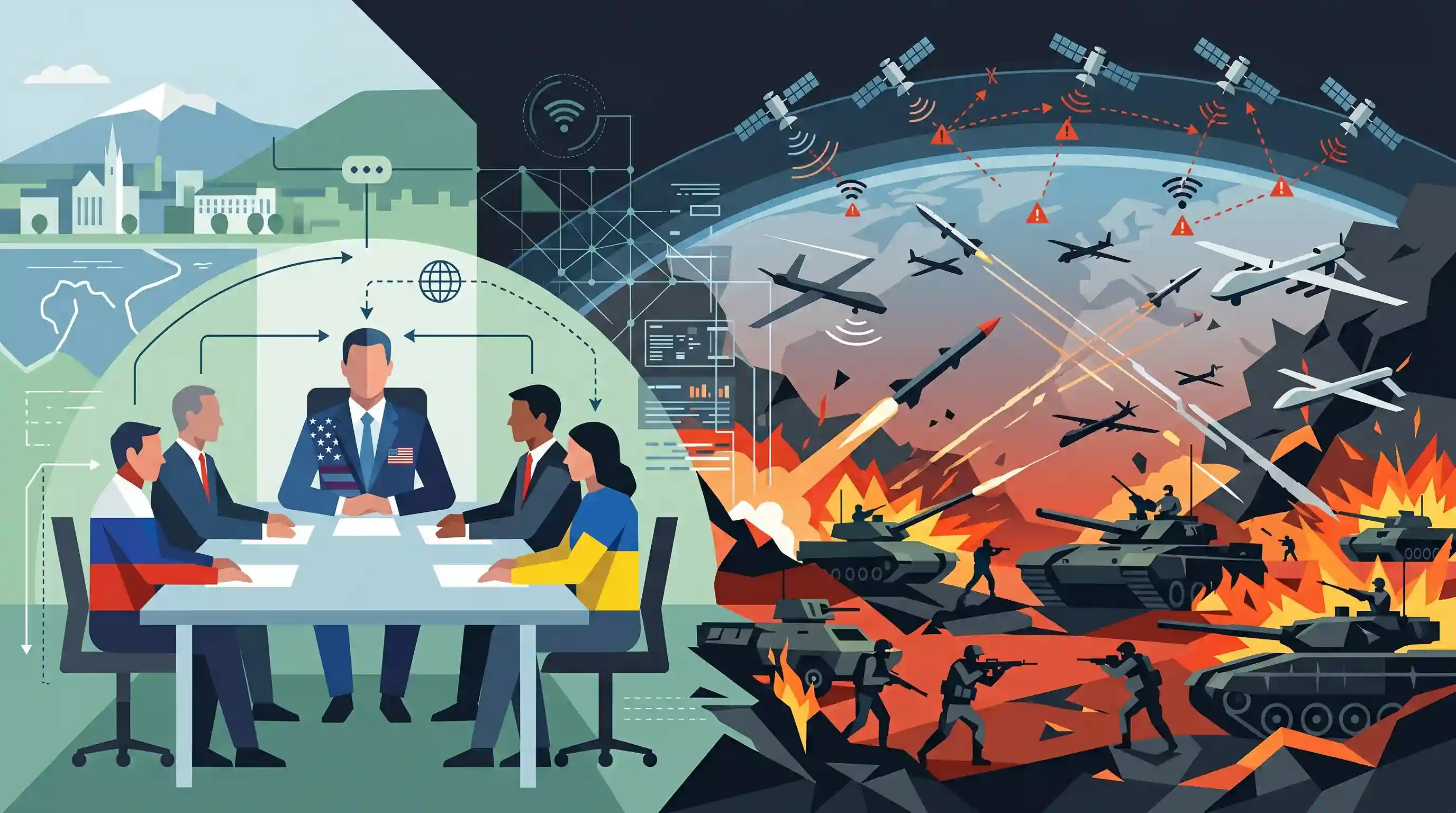
The article provides essential insights into current diplomatic efforts to resolve one of the most consequential geopolitical crises of the decade. It highlights the complexities of modern warfare—intertwining traditional diplomacy, kinetic military actions, and advanced technologies like UAVs and satellite communications—which is highly relevant for GS2 (International Relations) and GS3 (Internal Security & Science and Tech).
Summary
The United States is facilitating high-stakes peace negotiations between Russia and Ukraine in Geneva, aimed at ending the protracted conflict. However, the diplomatic progress is contrasted by a surge in military hostilities on the ground, with both sides intensifying long-range drone and missile attacks. Led by key delegates and driven by the US administration's geopolitical priorities, the talks face a highly volatile backdrop. The ongoing conflict also prominently features modern warfare elements, such as the strategic use of Unmanned Aerial Vehicles (UAVs) and disruptions to vital satellite communication networks like Starlink, highlighting the multi-domain complexity of resolving the crisis.
Key Points
- US President Donald Trump is brokering direct peace negotiations between Russia and Ukraine in Geneva, marking a significant diplomatic intervention.
- The diplomatic talks coincide with escalated military action, as both nations engage in intense cross-border drone and missile strikes.
- Disruptions in satellite communications, such as Starlink, emphasize the growing role of dual-use technologies and the cyber domain in contemporary warfare.
- The negotiations are crucial as they have the potential to significantly reshape European security architecture and influence NATO's strategic posture.
Important Terms
Starlink

A satellite internet constellation by SpaceX using Low Earth Orbit (LEO) satellites. It provides high-speed, low-latency connectivity, proving vital for military and civilian communication in conflict zones like Ukraine.
UPSC context
GS III (S&T/Space); tests knowledge of dual-use technologies and the role of private companies in global security.
Unmanned Aerial Vehicles (UAVs)
Commonly known as drones, these are aircraft operated without an onboard human pilot. They are used for intelligence, surveillance, reconnaissance (ISR), and precision strikes in modern asymmetric warfare.
UPSC context
GS III (Security); tests understanding of evolving military technology and its impact on India's border management.
Multi-domain Warfare
A military strategy integrating capabilities across five domains: land, air, sea, space, and cyber. It seeks to overwhelm adversaries through real-time, coordinated actions across all these fronts.
UPSC context
GS III (Security); relevant for questions on modern warfare doctrines and India's shift toward integrated theatre commands.
NATO
A 32-member intergovernmental military alliance based on the principle of collective defense. Its eastward expansion is a primary point of contention in the Russia-Ukraine geopolitical crisis.
UPSC context
GS II (International Relations); tests knowledge of global groupings and how their policies affect India's strategic interests.
Track 1 Diplomacy
Formal, official negotiations between government representatives or heads of state. This channel is used to resolve high-stakes international conflicts, draft treaties, and secure official ceasefires.
UPSC context
GS II (International Relations); tests understanding of diplomatic tools and India's engagement in bilateral or multilateral dispute resolutions.
United Nations
An international organization established to maintain global peace and security. It facilitates humanitarian aid and serves as a platform for member states to address international law violations.
UPSC context
GS II (International Institutions); tests awareness of the mandates and effectiveness of global bodies in managing major power conflicts.
Prelims Trap
Starlink provides uninterrupted global internet coverage by utilizing a network of Geostationary (GEO) satellites.
Starlink actually relies on a constellation of Low Earth Orbit (LEO) satellites (~550 km) to reduce latency, not high-altitude GEO systems.
Static Concepts Connected
How do Low Earth Orbit (LEO) constellations differ from Geostationary (GEO) satellites?
- Orbit Altitude: LEO operates at 160-2,000 km (like Starlink), while GEO is placed at approximately 35,786 km above the equator.
- Latency Advantage: LEO offers significantly lower data latency (delay), making it ideal for real-time military and civilian communication.
- Coverage Footprint: A single GEO satellite covers one-third of Earth, whereas LEO requires a constellation of thousands for global coverage.
Why is the UN Security Council often paralyzed during major geopolitical conflicts?
- Veto Power: Any of the P5 members (US, UK, France, Russia, China) can unilaterally block substantive resolutions.
- Direct Involvement: When a P5 member is directly involved in a conflict, enforcement mechanisms under Chapter VII inherently stall due to the veto.
- Bypass Limitations: The UNGA can bypass a deadlocked UNSC via the 'Uniting for Peace' resolution, but UNGA resolutions remain non-binding.
Cross-Topic Patterns
Dual-use space technology and warfare
The militarization of commercial LEO satellite networks merges civilian space infrastructure with defense logistics, creating regulatory gray areas under the Outer Space Treaty.
Minilateralism bypassing the UN system
Unilateral mediation by the US reflects a broader trend of ad-hoc diplomacy superseding paralyzed multilateral institutions, similar to the Abraham Accords.

Expect a 2026 Prelims question mixing LEO satellite characteristics (latency, altitude) with the militarization of dual-use space assets.
Linked PYQs · 5
Linked PYQs · 5
- 2025MainsGS2
"The reform process in the United Nations remains unresolved, because of the delicate imbalance of East and West and entanglement of the USA vs. Russo-Chinese alliance.” Examine and critically evaluate the East-West policy confrontations in this regard.
- 2023MainsGS2
‘The expansion and strengthening of NATO and a stronger US-Europe strategic partnership works well for India.’ What is your opinion about this statement ? Give reasons and examples to support your answer.
- 2023MainsGS3
The use of unmanned aerial vehicles (UAVs) by our adversaries across the borders to ferry arms/ammunitions, drugs, etc., is a serious threat to the internal security. Comment on the measures being taken to tackle this threat.
- 2014PrelimsGS1
Turkey is located between
- 2018PrelimsGS1
Which of the following has/have shrunk immensely/dried up in the recent past due to human activities? 1. Aral Sea 2. Black Sea 3. Lake Baikal Select the correct answer using the code given below:
