MoS External Affairs to lead Indian delegation at UN AI dialogue
Source:The Hindu ↗
Why It Matters
The transition toward a formal, UN-backed global framework for AI governance marks a critical shift from fragmented national regulations to multilateral consensus. For India, active participation is vital to representing the global South's developmental interests, ensuring technology transfer, bridging the AI divide, and framing ethical guidelines that balance technological innovation with human rights and safety.
Summary
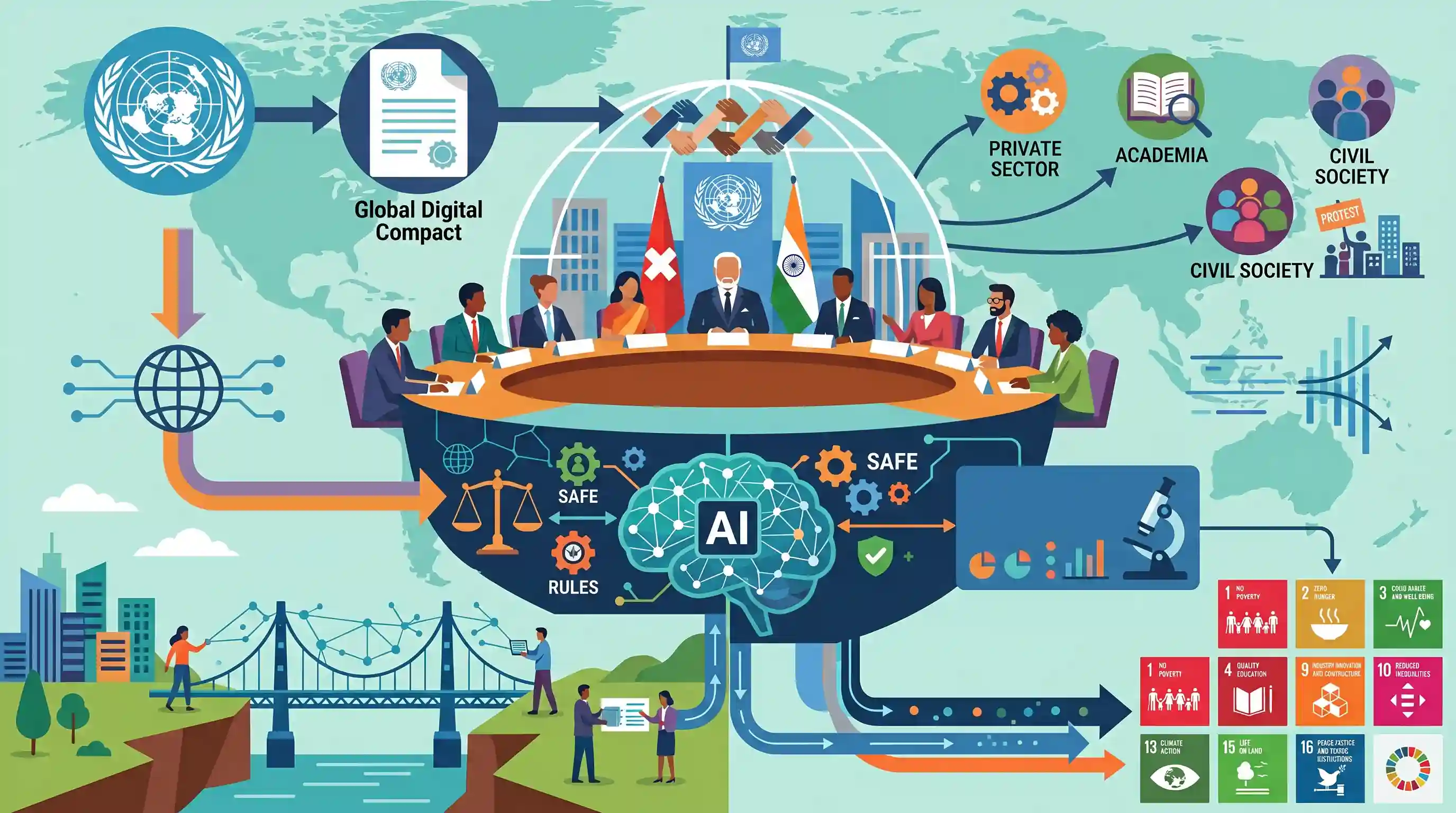
Minister of State for External Affairs Kirti Vardhan Singh will lead the Indian delegation to the inaugural United Nations' Global Dialogue on AI Governance in Geneva, Switzerland. Established under UNGA Resolution 79/325 following the 2024 Global Digital Compact, the dialogue acts as a universal multi-stakeholder forum. Alongside the Independent International Scientific Panel on AI (IISPA), the platform aims to build capacities in developing nations, bridge technological divides, and foster safe, trustworthy, and human-rights-aligned AI governance in pursuit of sustainable development.
Key Points
- Minister of State for External Affairs Kirti Vardhan Singh is leading the Indian delegation to the inaugural session of the UN's Global Dialogue on AI Governance in Geneva (July 6-7, 2026).
- The Global Dialogue is a universal, multi-stakeholder forum established under UN General Assembly Resolution 79/325, following the adoption of the Global Digital Compact under the Pact of the Future in September 2024.
- The Dialogue operates alongside the Independent International Scientific Panel on AI (IISPA), which is delivering its first annual report containing an independent scientific assessment of AI’s capabilities, risks, and opportunities.
- A central goal of the forum is capacity building in developing nations to help direct AI systems toward achieving Sustainable Development Goals (SDGs) and bridging the digital/AI divide.
- The thematic discussions at the Dialogue are clustered around four key pillars: AI's socio-economic implications, bridging AI divides, ensuring safe and trustworthy AI, and safeguarding human rights in the AI context.
- The initiative emphasizes inclusive global governance, ensuring that AI regulations and benefits are not monopolized by technologically advanced nations, but reflect the developmental and ethical priorities of all countries.
Important Terms
Global Digital Compact

A global framework adopted at the 2024 UN Summit of the Future to bridge digital divides, secure digital infrastructure, and foster an open, safe, human-rights-aligned digital future.
UPSC context
GS Paper II (International Relations) & GS Paper III (S&T). Vital for digital governance and global South equity discussions.
Pact for the Future
A landmark UN declaration adopted in September 2024 to revitalize multilateralism, addressing sustainable development, international peace, science-digital cooperation, and global governance reform.
UPSC context
GS Paper II (Multilateral Forums). Crucial for questions on international institutional reforms and global challenge mitigation.
Independent International Scientific Panel on AI
A 40-member independent UN scientific panel established in 2025 to provide evidence-based, non-binding global assessments of AI opportunities, risks, and impacts.
UPSC context
GS Paper III (AI & S&T Policy). Relevant for ethical AI frameworks and international regulatory standards.
UN General Assembly Resolution 79/325
A UN resolution adopted in August 2025 that formally established the Independent International Scientific Panel on AI and the Global Dialogue on AI Governance.
UPSC context
GS Paper II (International Agencies). Tests precise knowledge of specific UN mandates shaping international technology cooperation.
Prelims Trap
The UN's Global Dialogue on AI Governance and the IISPA have the mandate to regulate and inspect military AI applications worldwide.
These UNGA Resolution 79/325 mechanisms are strictly limited to non-military domains and are advisory/scientific, holding no binding regulatory or inspection powers.
Static Concepts Connected
What is the UN Global Digital Compact (GDC)?
- Genesis: Adopted during the UN Summit of the Future in September 2024 as an annexure to the Pact for the Future.
- Core Objective: Aims to close digital divides, expand the digital economy, and secure human-rights-aligned AI governance globally.
What is the Global Partnership on Artificial Intelligence (GPAI)?
- Nature: An international, multi-stakeholder initiative launched in 2020 to guide the responsible development and use of AI.
- India's Role: A founding member that hosted the December 2023 summit, resulting in the developmental-focused GPAI New Delhi Declaration.
Cross-Topic Patterns
AI governance meets India's DPI model
India leverages its Digital Public Infrastructure success to advocate for open-source AI as a global public good, bridging the Global South's technology deficit.
Computational sovereignty vs Digital Colonialism
India's domestic IndiaAI GPU-capacity-building initiatives represent a practical pushback against the concentration of compute power and proprietary AI in Western tech monopolies.

Expect a 2026 question comparing non-military UN AI mechanisms (Res 79/325) with plurilateral frameworks like GPAI on global tech divides.
Linked PYQs · 2
Linked PYQs · 2
- 2024MainsGS4
The application of Artificial Intelligence as a dependable source of input for administrative rational decision-making is a debatable issue. Critically examine the statement from the ethical point of view.
- 2023MainsGS3
Introduce the concept of Artificial Intelligence (AI). How does Al help clinical diagnosis? Do you perceive any threat to privacy of the individual in the use of Al in healthcare?
