India Russia Bilateral Defense Cooperation and Strategic Ties
Source:The Hindu ↗
Why It Matters
The event highlights the enduring strategic, diplomatic, and defense ties between India and Russia. The explicit mention of Russian support against cross-border terrorism underscores mutual security interests, which remains highly relevant for UPSC answers on India's foreign policy and security challenges.
Summary
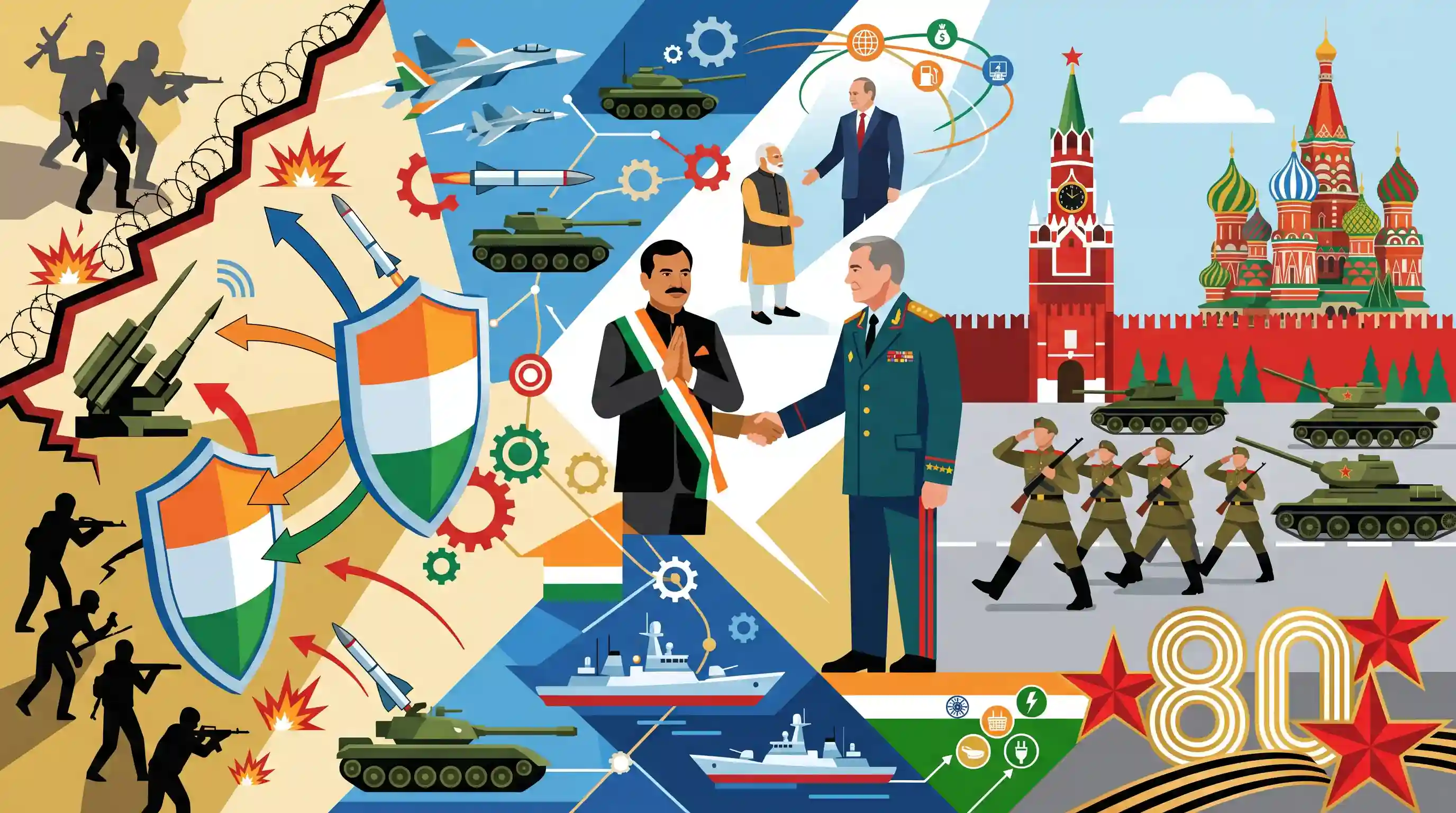
Minister of State for Defence Sanjay Seth represented India at the 80th Victory Day celebrations in Moscow, an event commemorating the Soviet Union's triumph over Nazi Germany in World War II. During his visit, Seth engaged in bilateral discussions with Russian Deputy Defence Minister Col. Gen. Alexander Fomin, focusing on strengthening multifaceted military and military-technical cooperation between the two nations. Seth also conveyed Prime Minister Narendra Modi's congratulations to Russian President Vladimir Putin. Notably, India expressed gratitude for Russia's continued and steadfast support in its fight against state-sponsored cross-border terrorism.
Key Points
- Minister of State for Defence Sanjay Seth represented India at the 80th Victory Day celebrations in Moscow, marking the Soviet Union's victory over Nazi Germany in World War II.
- Bilateral talks were held with Russian Deputy Defence Minister Col. Gen. Alexander Fomin, focusing on deepening "multifaceted military and military-technical cooperation."
- India officially thanked Russia for its steadfast support in combating state-sponsored cross-border terrorism.
- Seth conveyed Prime Minister Narendra Modi's congratulations to Russian President Vladimir Putin during the visit.
Important Terms
Victory Day (Moscow)

An annual Russian holiday on May 9 marking the 1945 surrender of Nazi Germany to the Soviet Union, ending World War II in Europe.
UPSC context
GS-1 (World History) and GS-2 (Bilateral Relations); signifies historical continuity and strategic solidarity between India and Russia.
Military-Technical Cooperation (MTC)
A collaborative framework between nations for defense procurement, technology transfer, and joint research and development of military hardware.
UPSC context
GS-2 (Bilateral Relations) and GS-3 (Security); essential for understanding India’s defense indigenization and long-standing partnership with Russia.
Cross-border Terrorism
Terrorism where perpetrators use a foreign country's territory as a base to attack another, often with the support of a state actor.
UPSC context
GS-3 (Internal Security); a primary security challenge for India and a central theme in its international diplomatic lobbying.
Soviet Union (USSR)
The socialist state (1922–1991) that was India’s primary strategic and military ally during the Cold War era.
UPSC context
GS-1 (World History) and GS-2 (IR); provides the historical foundation for India’s current 'Special and Privileged Strategic Partnership' with Russia.
Special and Privileged Strategic Partnership
The elevated formal status of India-Russia bilateral relations since 2010, reflecting unique trust and cooperation in defense, nuclear energy, and space.
UPSC context
GS-2 (International Relations); defines the highest level of diplomatic engagement between the two nations.
Prelims Trap
"Victory Day observed by Russia marks the global conclusion of World War II after the defeat of all Axis powers."
Victory Day specifically commemorates the Soviet victory over Nazi Germany (European theatre, May 1945). The Pacific war continued until Japan's surrender in September 1945.
Static Concepts Connected
What are the key joint defence mechanisms and platforms between India and Russia?
- IRIGC-M&MTC: The apex Intergovernmental Commission guiding multifaceted bilateral military and military-technical cooperation between the two nations.
- Joint Production: Ties have evolved from a traditional buyer-seller model to joint research and co-development (e.g., BrahMos missiles, AK-203 rifles in UP).
- INDRA Exercise: A joint, biennial tri-services military exercise aimed at enhancing tactical coordination and interoperability between Indian and Russian armed forces.
How does India engage globally to counter state-sponsored cross-border terrorism?
- CCIT Proposal: India proposed the Comprehensive Convention on International Terrorism (CCIT) at the UN in 1996 to universally define and combat terror networks.
- FATF Scrutiny: India utilizes the Financial Action Task Force to diplomatically and financially isolate states that sponsor, fund, and shelter cross-border terror groups.
Cross-Topic Patterns
SCO RATS + Cross-Border Terrorism
India leverages platforms like the SCO (which includes both Russia and Pakistan) to build consensus against state-sponsored terror via the Regional Anti-Terrorist Structure (RATS) mechanism.
Defence Indigenization (GS3)
The shift from importing legacy Russian hardware to joint manufacturing (BrahMos, AK-203 rifles) directly maps to India’s GS3 push for defense indigenization and self-reliance (Atmanirbhar Bharat).

Expect a multi-statement prelims question linking specific joint platforms (BrahMos, AK-203) to India-Russia bilateral defence mechanisms.
Linked PYQs · 3
Linked PYQs · 3
- 2020MainsGS2
What is the significance of Indo-US defence deals over Indo-Russian defence deals? Discuss with reference to stability in the Indo-Pacific region.
- 2015MainsGS1
To what extent can Germany be held responsible for causing the two World Wars? Discuss critically.
- 2017MainsGS3
The scourge of terrorism is a grave challenge to national security. What solutions do you suggest to curb this growing menace? What are the major sources of terrorist funding?
