MoRTH Tightens Disqualification Norms for Highway Failures
Source:Indian Express ↗
Why It Matters
It highlights the regulatory evolution within India's infrastructure sector to enforce quality control, safety, and accountability in PPP models. Understanding variants like HAM and EPC, along with government interventions to address their shortcomings, is directly relevant to GS3 (Infrastructure and Investment Models).
Summary
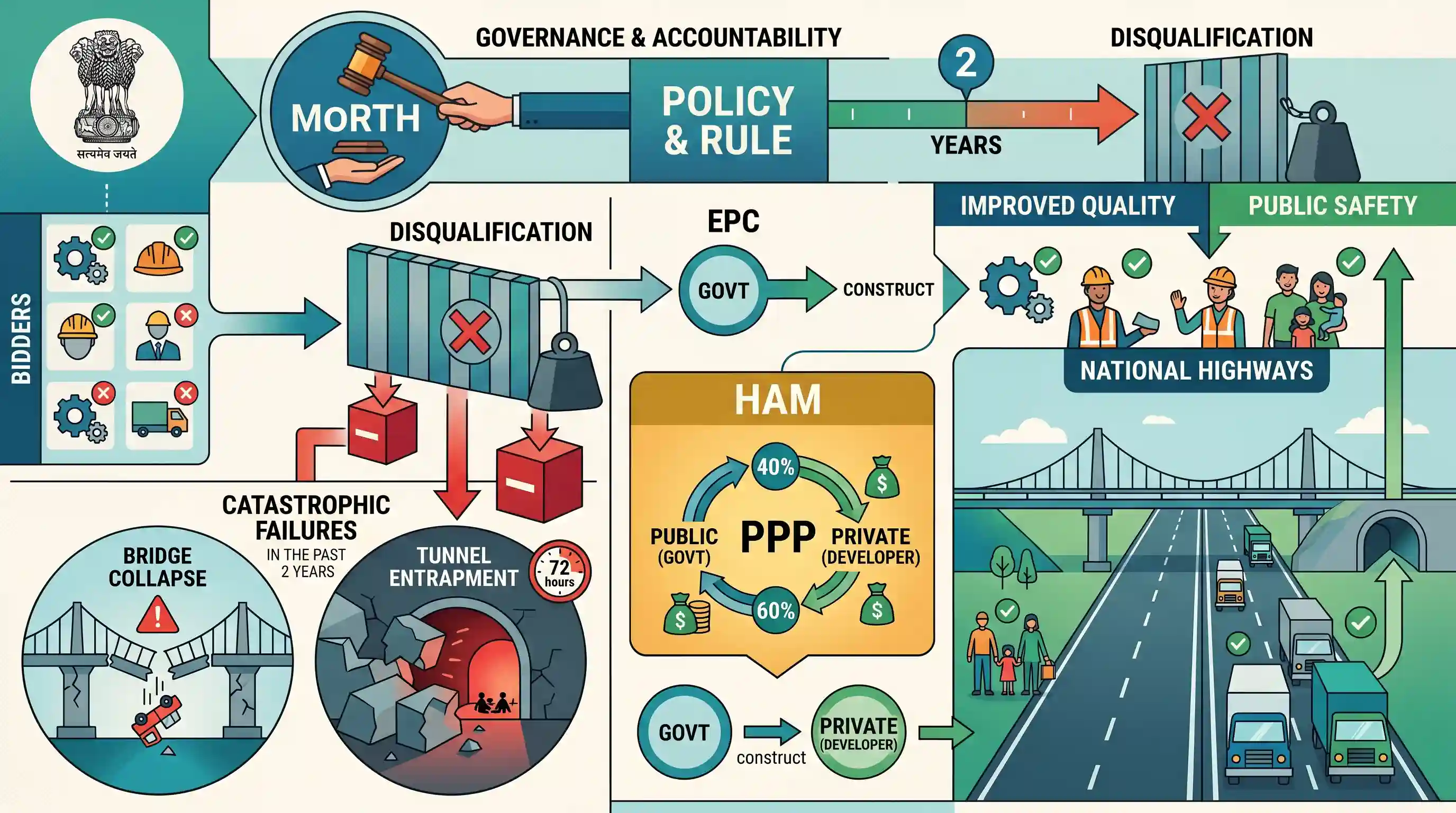
The Ministry of Road Transport and Highways (MoRTH) has tightened bidding norms for highway projects under the Hybrid Annuity Mode (HAM) by introducing stricter disqualification rules to prevent "catastrophic failures." Bidders with a record of severe infrastructure failures—such as bridge collapses or tunnel entrapments—within the past two years will face heavy evaluation penalties, effectively leading to their disqualification. Previously applicable only to EPC contracts, this regulatory shift aims to enforce greater contractor accountability, ensure public safety, and improve the quality of national highway construction under the HAM variant of the PPP model.
Key Points
- MoRTH has extended strict disqualification criteria for catastrophic construction failures to Hybrid Annuity Mode (HAM) highway projects.
- A "catastrophic failure" includes incidents such as structural collapses of bridges or tunnels, severe pavement failures, and human entrapment during construction for over 72 hours.
- Bidders responsible for such failures within the preceding two years will face a 30-mark penalty during technical evaluation, essentially disqualifying them from ongoing and future bids.
- This provision was previously applicable only to Engineering, Procurement, and Construction (EPC) projects, and its extension to HAM aims to enforce contractor accountability and improve infrastructure quality.
- HAM is a Public-Private Partnership (PPP) variant where the government pays 40% of the project cost during construction, and the developer receives the remaining 60% as annuity payments during the operational phase.
Important Terms
Hybrid Annuity Mode (HAM)

A Public-Private Partnership (PPP) model for road construction where the government pays 40% of the cost during construction and 60% as annuities over the project's life.
UPSC context
GS Paper 3: Investment Models; critical for infrastructure financing, risk-sharing between public and private sectors, and minimizing NPA risks in banks.
Engineering, Procurement, and Construction (EPC) model
A contract model where the government funds 100% of the project and the private contractor is solely responsible for design, procurement, and construction.
UPSC context
GS Paper 3: Infrastructure; tests understanding of different project delivery methods and the government's financial/operational burden in infrastructure development.
Public-Private Partnership (PPP)
A collaborative framework between a government agency and a private entity to finance, build, and operate public infrastructure or services, sharing risks and rewards.
UPSC context
GS Paper 3: Infrastructure and Investment Models; evaluates the role of private capital and efficiency in bridging India's infrastructure gap.
Ministry of Road Transport and Highways (MoRTH)
The apex Indian government body responsible for the formulation and administration of rules, regulations, and laws relating to road transport and national highways.
UPSC context
GS Paper 2: Government Policies and Interventions; relevant for regulatory changes and administrative accountability in the infrastructure sector.
Build-Operate-Transfer (BOT)
A PPP variant where a private entity builds, operates, and maintains a project for a specific period before transferring it back to the government.
UPSC context
GS Paper 3: Investment Models; essential for comparing risk allocation (traffic risk vs. annuity) against the newer HAM model.
Prelims Trap
"Under the Hybrid Annuity Model (HAM), the private developer recovers its 60% investment by bearing the traffic risk and collecting tolls."
In HAM, the government (NHAI) retains the traffic and revenue risk. The private developer does not collect tolls; they are paid via fixed annuities by the government.
Static Concepts Connected
How do risk and funding differ across EPC, BOT-Toll, and HAM models?
- EPC Model: Government bears 100% financial and traffic risk. The private entity is only responsible for engineering and construction.
- BOT-Toll Model: The private player builds, operates, and bears both the financial risk and the traffic/revenue risk (collects tolls).
- HAM Model: Government pays 40% upfront; private arranges 60%. Government collects tolls (bears traffic risk) and pays the developer via fixed annuities.
What were the Vijay Kelkar Committee recommendations for revitalizing PPPs?
- Optimal Risk Allocation: Risks should be allocated to the entity best suited to manage them, a principle that heavily influenced the adoption of the HAM model.
- Independent Regulators: Recommended setting up independent sectoral regulators to manage PPP contracts and tariff structures effectively.
- Dispute Resolution: Establish a swift, institutionalized mechanism to resolve disputes and unlock stalled infrastructure projects.
Cross-Topic Patterns
Disaster management dictating PPP bidding
Recent tunnel entrapments (e.g., Silkyara) and bridge collapses directly influenced MoRTH's definition of "catastrophic failure," linking standard infrastructure financing policy directly with disaster management and public safety.
Twin balance sheet crisis to HAM evolution
HAM was introduced to solve the twin-balance-sheet NPA crisis caused by BOT-Toll projects. This new rule signals HAM's evolution from a mere financial fix to a strict quality-control mechanism.

Expect a 2026 Prelims multi-statement question testing the exact distribution of traffic, revenue, and construction risks across EPC, BOT, and HAM.
Linked PYQs · 2
Linked PYQs · 2
- 2022MainsGS3
Why is Public Private Partnership (PPP) required in infrastructural projects ? Examine the role of PPP model in the redevelopment of Railway Stations in India.
- 2014MainsGS3
Explain how Private Public Partnership arrangements, in long gestation infrastructure projects, can transfer unsustainable liabilities to the future. What arrangements need to be put in place to ensure that successive generations' capacities are not compromised?
