Suspicious Military Object Discovered Near River in Kanpur Dehat
Source:The Hindu ↗
Why It Matters
The article highlights localized geographic and administrative units in Uttar Pradesh, such as the Non river, Kanpur Dehat, and Jhansi as a regional security hub. UPPSC Prelims frequently asks detailed questions about Uttar Pradesh's river systems, district borders, administrative headquarters (such as Akbarpur being the headquarters of Kanpur Dehat), and state-level governance initiatives like Dial 112.
Summary
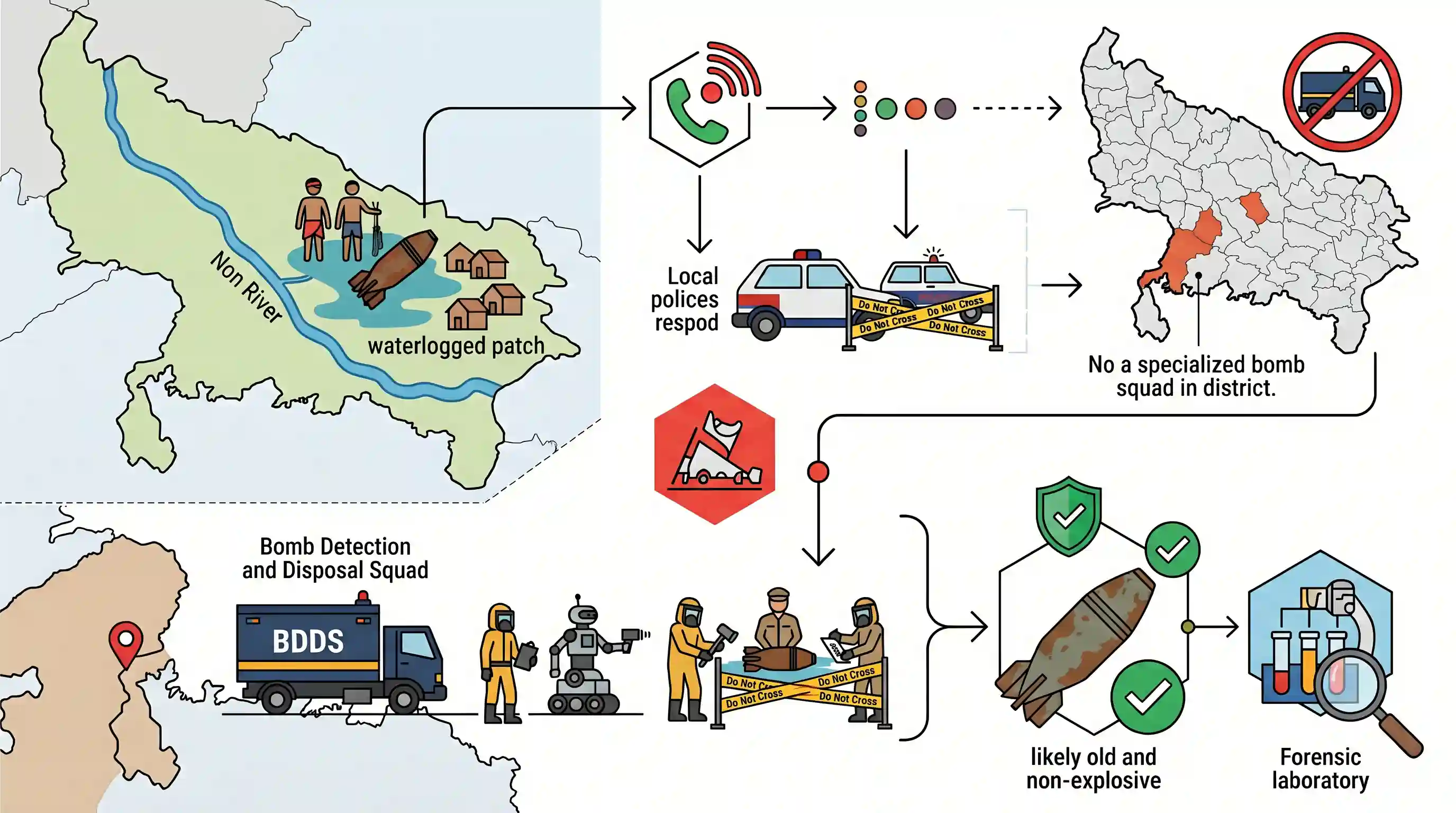
In Kanpur Dehat, Uttar Pradesh, a rusted, mortar-like object was found by local fishermen in a waterlogged patch adjacent to the Non river near Jaswapur village. The incident was reported via the Dial 112 emergency helpline, prompting local police to cordon off the area. Since Kanpur Dehat lacks a permanent specialized bomb squad, a Bomb Detection and Disposal Squad (BDDS) was rushed from Jhansi to safely inspect and neutralize the device. Initial reports suggest the shell is old and likely non-explosive, but a final assessment awaits specialized forensic verification.
Key Points
- A rusted, mortar-like military object was discovered in a waterlogged stretch along the Non river near Jaswapur village, Gajner, Kanpur Dehat.
- Local villagers spotted the suspicious shell while fishing and instantly notified the police through the Dial 112 unified emergency helpline.
- Due to the lack of a localized bomb disposal unit in Kanpur Dehat, a specialized Bomb Detection and Disposal Squad (BDDS) and forensic experts were dispatched from Jhansi.
- Local police under Akbarpur Circle Officer Sanjay Kumar Singh cordoned off the area with sandbags as a precautionary measure.
- Senior police officials, including SP Shraddha Narayan Pandey and ADG Kanpur Zone Anupam Kulshreshtha, stated that while the object appears to be an old, non-explosive shell, detailed forensic analysis will confirm its nature.
Important Terms
Dial 112 (Emergency Response Support System)

A pan-India, single emergency number (112) system merging police, fire, and health services, funded by the Nirbhaya Fund to provide rapid, GPS-enabled distress response to citizens.
UPSC context
GS Paper II (E-Governance) & GS III (Security). Tests emergency administration, public safety delivery, and tech-driven governance initiatives.
Bomb Detection and Disposal Squad (BDDS)
A specialized tactical unit within police and security forces trained to detect, locate, defuse, and safely neutralize explosive devices, minimizing casualties and sabotage.
UPSC context
GS Paper III (Internal Security). Tests tactical counter-terrorism infrastructure, disaster risk reduction, and law-enforcement capabilities.
Non River
A minor river and tributary of the Yamuna River system flowing through Uttar Pradesh's Jalaun and Kanpur Dehat districts, draining into the Yamuna via small ravines.
UPSC context
GS Paper I (Indian Geography). Tests drainage systems of the Indo-Gangetic plain, regional river networks, and physical geography of Uttar Pradesh.
Uttar Pradesh Police
The primary law enforcement agency of Uttar Pradesh, responsible for maintaining public order, crime prevention, and managing localized security emergencies across India's most populous state.
UPSC context
GS Paper II & III. Tests police reforms, federal security arrangements, and state-level law and order machinery.
Prelims Trap
The Noon (Non) and Sengar rivers are minor direct tributaries of the Ganga River in Uttar Pradesh.
UPSC often tests minor regional rivers. While the Pandu River is a Ganga tributary, the Noon (Non) and Sengar rivers actually flow into the Yamuna, despite all three draining the Kanpur region.
Static Concepts Connected
What is the Emergency Response Support System (ERSS) and its origin?
- Unified Helpline 112: Integrates police (100), fire (101), and health (102/108) services into a single pan-India emergency number.
- Nodal Ministry: Administered by the Ministry of Home Affairs (MHA) to ensure a coordinated, real-time emergency response system across states.
- Origin Committee: The system was conceptualized based on recommendations of the Justice J.S. Verma Committee (2013) to ensure women's safety.
What are the key geographical and administrative features of the Kanpur-Yamuna-Ganga Doab?
- River Systems: The Noon (Non) and Sengar rivers flow southwards to join the Yamuna; the Pandu River flows north-east to feed the Ganga.
- Administrative Headquarters: Several UP districts have HQs not matching their names: Kanpur Dehat (Akbarpur-Mati), Sonbhadra (Robertsganj), Jalaun (Orai), and Kushinagar (Padrauna).
Cross-Topic Patterns
River Rejuvenation + MGNREGA asset creation
Linking local river restoration projects (like the Noon River) with MGNREGA labor showcases decentralized, community-led climate adaptation and water conservation strategies under GS-3.
Judicial Activism + Article 21 Expansion
The Supreme Court expanding Article 21 to mandate a 'Right to Trauma Care' directly bridges basic emergency services (ERSS) with constitutional fundamental rights.

The expansion of Article 21 to include 'Right to Trauma Care' alongside ERSS (112) architecture is highly likely to feature in GS-2 2026.
Linked PYQs · 3
Linked PYQs · 3
- 2023UPPSC_PRELIMSGS1
Which of the following statement is correct? (1) Ram Ganga river joins the Ganga at Kannauj. (2) River Betwa joins the Yamuna near Prayagraj. Select the correct answer using the code given below –
- 2020UPPSC_PRELIMSGS1
Consider the following tributaries of River Yamuna and arrange them from West to East : 1. Betwa 2. Ken 3. Sindh 4. Chambal Select the correct answer from the codes given below.
- 2025UPPSC_PRELIMSGS1
Which of the following districts of Uttar Pradesh shares its boundary with only one other district of Uttar Pradesh ? 1. Lalitpur 2. Saharanpur 3. Sonbhadra Select the correct answer from the code given below :
