Regulatory Reforms Needed for Curbing Unhealthy Food Intake
Source:The Hindu ↗
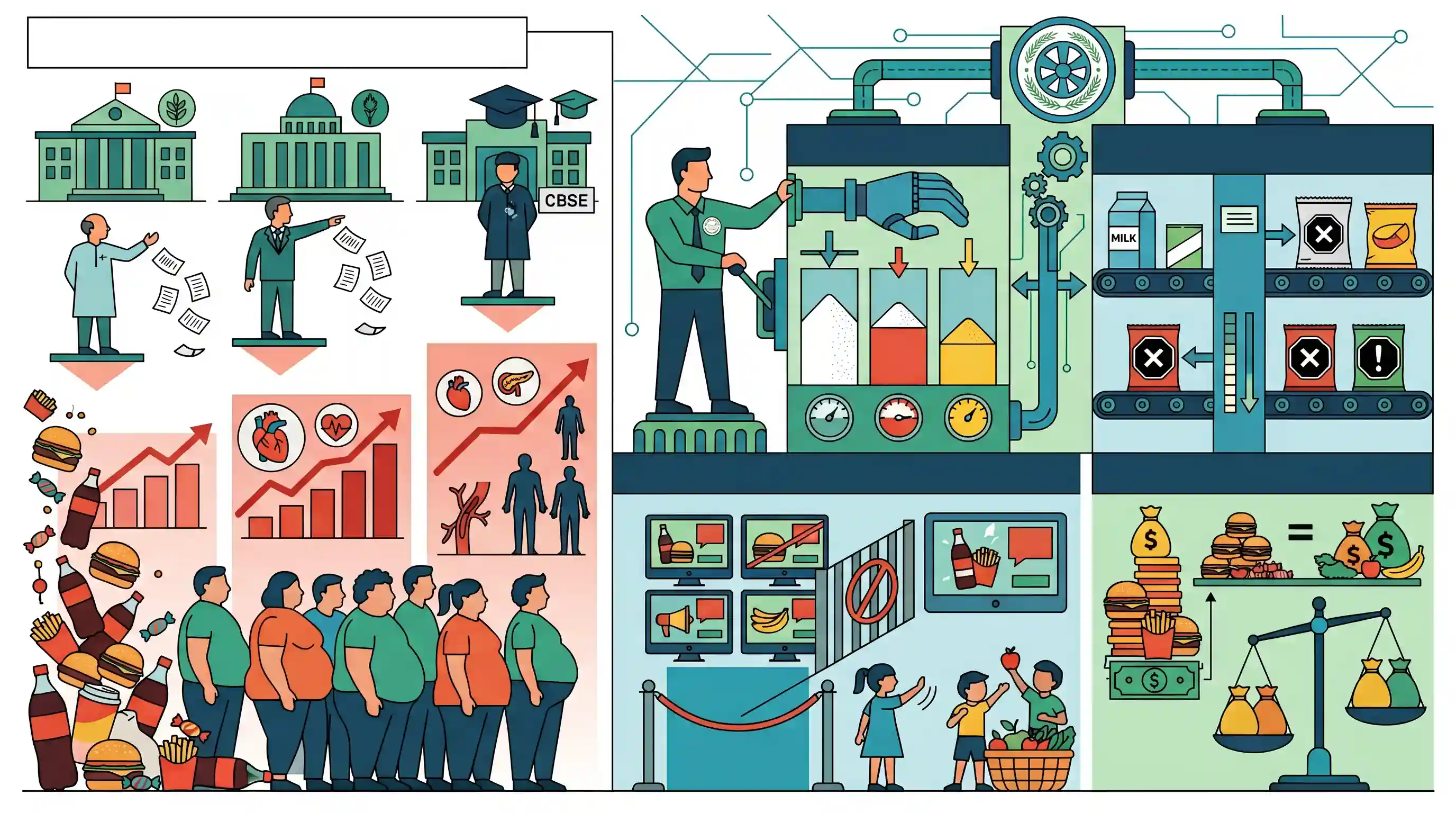
Why It Matters
The regulation of unhealthy food is a critical aspect of public health governance. It highlights the role of statutory bodies like FSSAI and addresses the growing challenge of non-communicable diseases and obesity in India, making it highly relevant for GS Paper 2 (Health, Governance).
Summary
The editorial analyzes recent directives by the Health Ministry and CBSE aimed at curbing unhealthy food intake in India, arguing that such measures are merely symbolic. Highlighting the increasing burden of obesity and non-communicable diseases, the article underscores the need for systemic, legislative actions over piecemeal advisories. It calls for the Food Safety and Standards Authority of India (FSSAI) to establish strict upper limits for sugar, salt, and fat, enforce front-of-package warning labels, restrict junk food advertising directed at children, and implement taxes on HFSS (high fat, sugar, and salt) foods to fundamentally tackle the public health crisis.
Key Points
- The Health Ministry and CBSE have introduced directives, such as displaying nutritional content in canteens and setting up 'sugar boards', to raise awareness about unhealthy eating habits.
- The editorial critiques these steps as largely symbolic and piecemeal, as they focus heavily on un-packaged snacks while leaving the packaged food industry under-regulated.
- India faces a growing public health challenge with rising rates of obesity and non-communicable diseases linked to poor diets.
- Effective regulation requires the FSSAI to define upper limits for salt, sugar, and fat, and to enforce clear front-of-package warning labels (FOPL).
- Robust legislative measures are needed, including restrictions on advertising junk food to children and the imposition of taxes on high fat, sugar, and salt (HFSS) foods.
Important Terms
Food Safety and Standards Authority of India (FSSAI)

A statutory body under the Ministry of Health and Family Welfare, established by the Food Safety and Standards Act, 2006, to regulate food safety, manufacturing, and distribution in India.
UPSC context
GS Paper 2 (Statutory Bodies) and GS Paper 3 (Health/Food Security). Tests understanding of regulatory architecture and consumer safety.
Non-Communicable Diseases (NCDs)
Diseases not transmitted by infection, such as diabetes, cardiovascular conditions, and cancers. They account for roughly 65% of all deaths in India, representing a major public health challenge.
UPSC context
GS Paper 2 (Health/Social Justice). Tests knowledge of India's epidemiological shift and the National Programme for Prevention and Control of NCDs.
HFSS Foods (High Fat, Sugar, and Salt)
Packaged or non-packaged foods containing low levels of protein and fiber but rich in saturated fats, sugar, and salt. These are primary targets for warning labels and taxation policies.
UPSC context
GS Paper 2/3 (Government Policies/Economy). Critical for discussions on public health interventions like the 'Fat Tax' and Front-of-Package Labelling (FOPNL).
Indian Council of Medical Research (ICMR)
The apex body in India for the formulation, coordination, and promotion of biomedical research. It sets national dietary standards, including the 2024 Dietary Guidelines for Indians.
UPSC context
GS Paper 2/3 (Health/S&T). Important for evidence-based policy formulation and the role of research in tackling the triple burden of malnutrition.
Ministry of Health and Family Welfare (MoHFW)
The central ministry responsible for national health policy, family planning, and overseeing primary healthcare infrastructure and regulatory bodies like the FSSAI and ICMR.
UPSC context
GS Paper 2 (Governance/Health). Core entity for health sector schemes, legislative frameworks, and universal health coverage goals.
Prelims Trap
"Front-of-Package Labeling (FOPL) is currently mandatory for all packaged foods in India under FSSAI regulations."
FSSAI has proposed systems like the 'Indian Nutrition Rating', but strict, mandatory warning labels for High Fat, Sugar, and Salt (HFSS) foods are pending implementation.
Static Concepts Connected
What is the statutory mandate and nodal ministry of the FSSAI?
- Statutory Status: Established under the Food Safety and Standards Act, 2006, which consolidated various older acts like the Prevention of Food Adulteration Act, 1954.
- Nodal Ministry: It operates under the Ministry of Health & Family Welfare, not the Ministry of Consumer Affairs or Food Processing Industries.
- Core Mandate: To lay down science-based standards for food articles and regulate their manufacture, storage, distribution, sale, and import to ensure safe and wholesome food.
What is India's national framework for tackling Non-Communicable Diseases (NCDs)?
- NP-NCD: The National Programme for Prevention and Control of NCDs (NP-NCD) targets major lifestyle diseases including cardiovascular diseases, cancer, diabetes, and stroke.
- Global Targets: India is the first country to adopt the WHO's Global Monitoring Framework on NCDs, aiming for a 25% reduction in premature NCD mortality by 2025.
- ICMR Guidelines: The Indian Council of Medical Research (ICMR) regularly releases dietary guidelines to combat the rising dual burden of malnutrition and obesity.
Cross-Topic Patterns
Health Taxes vs. GST Harmonization
Imposing 'fat taxes' on HFSS foods intersects with GST federalism. Kerala's 2016 fat tax was subsumed by GST, highlighting the challenge of using state-level fiscal tools for public health under the current tax regime.
Misleading Ads & Consumer Protection
Regulating HFSS advertisements targeting children bridges public health with the Central Consumer Protection Authority (CCPA)'s guidelines on misleading ads and the broader constitutional Right to Health (Article 21).

Expect a multi-statement Prelims question testing FSSAI's nodal ministry (MoHFW, not Consumer Affairs) alongside the legal status of FOPL.
Linked PYQs · 2
Linked PYQs · 2
- 2024MainsGS2
In a crucial domain like the public healthcare system the Indian State should play a vital role to contain the adverse impact of marketisation of the system. Suggest some measures through which the State can enhance the reach of public healthcare at the grassroots level.
- 2018PrelimsGS1
Consider the following statements: 1. The Food Safety and Standards Act, 2006 replaced the Prevention of Food Adulteration Act, 1954. 2. The Food Safety and Standards Authority of India (FSSAI) is under the charge of Director General of Health Services in the Union Ministry of Health and Family Welfare. Which of the statements given above is/are correct?
