Madhya Pradesh records rising tiger mortality and habitat pressure
Source:odishabytes ↗
Why It Matters
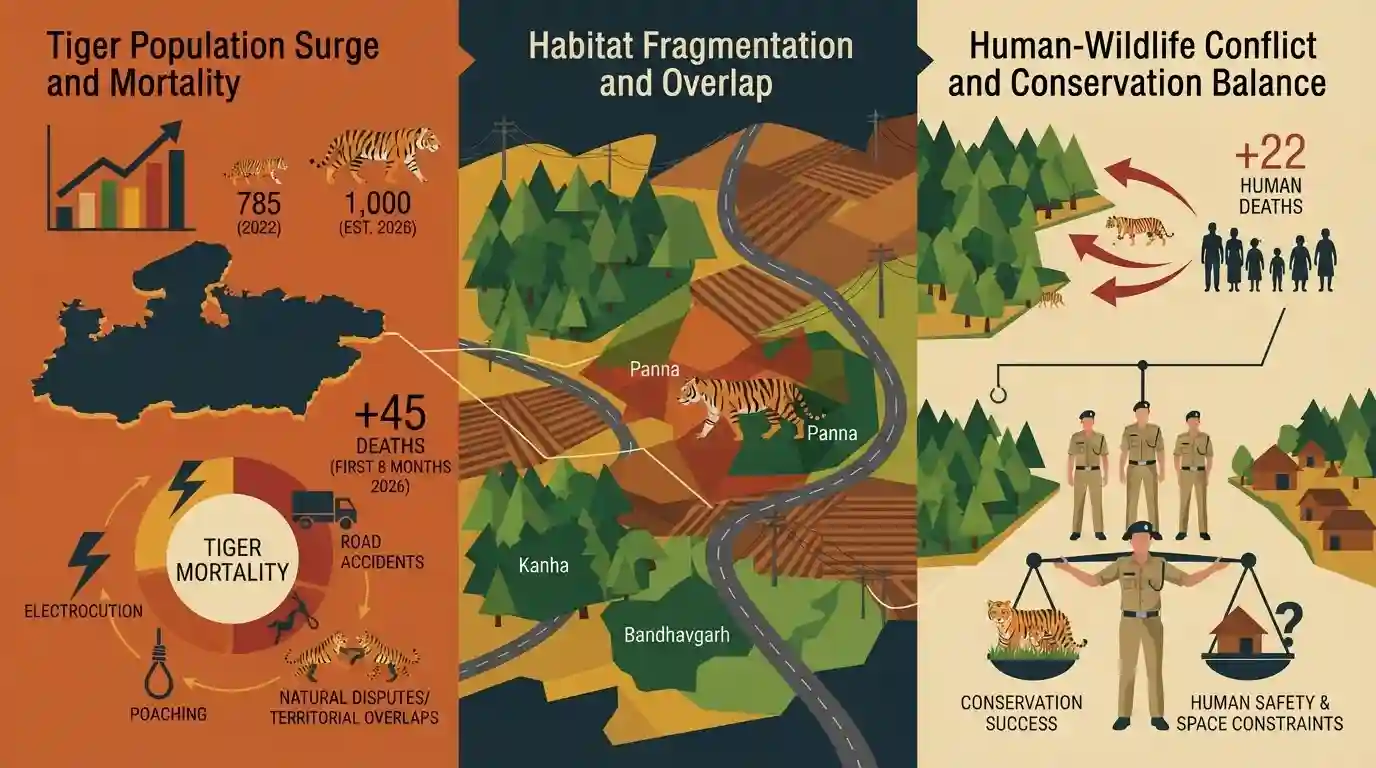
This highlights the critical paradox of successful conservation: an expanding tiger population running out of space, leading to fatal territorial fights and rising human-wildlife conflict. For MPPSC Prelims, candidates must know the major tiger reserves of MP (like Kanha and Bandhavgarh) and understand broader ecological challenges such as habitat fragmentation.
Summary
Madhya Pradesh has reported the deaths of more than 45 tigers in the first eight months of 2026. As the state's tiger population surges to an estimated 1,000, rising from 785 in 2022, the expanding numbers are creating severe territorial overlaps and habitat fragmentation. Causes of tiger mortality range from natural territorial disputes and diseases to human-induced factors like electrocution, road accidents, and poaching. Consequently, human-wildlife conflict has also sharply increased, with 22 people killed by tigers this year. Wildlife officials face the complex challenge of balancing successful conservation efforts across reserves like Kanha, Bandhavgarh, and Panna with the pressing realities of space constraints and human safety.
Key Points
- Madhya Pradesh, known as the 'tiger state' of India, recorded over 45 tiger deaths in the first eight months of 2026.
- The tiger population in the state has grown from 785 in 2022 to an estimated 1,000, intensifying pressure on existing habitats.
- Primary causes of tiger mortality include territorial disputes, diseases, road and rail accidents, electrocution, poisoning, and poaching.
- Human-wildlife conflict is surging, with tigers responsible for 22 out of 50 wildlife-related human fatalities in the state during this period.
- Conservation experts highlight the severe challenge of managing an expanding predator population within fragmented landscapes across MP's nine tiger reserves.
Important Terms
National Tiger Conservation Authority (NTCA)

A statutory body under the Ministry of Environment, Forest and Climate Change, established in 2005. It provides legal backing, funding, and administrative oversight for Project Tiger, the tiger census, and India's tiger reserves.
UPSC context
GS-3 (Environment). Highly tested in Prelims and Mains regarding its statutory origin, MoEFCC affiliation, and tiger conservation mandates.
Habitat Fragmentation
The ecological process where large, continuous natural habitats are broken into smaller, isolated patches by human activities like roads or agriculture. It reduces genetic diversity, blocks migration, and creates ecological traps.
UPSC context
GS-3 (Environment). Tested in topics covering biodiversity loss, edge effects, the importance of ecological corridors, and human-wildlife conflict drivers.
Human-Wildlife Conflict
Negative interactions between humans and wild animals over space and resources, resulting in crop damage, livestock predation, or human casualties, alongside retaliatory killings and habitat displacement for wildlife.
UPSC context
GS-3 (Environment). Key for analyzing conservation ethics, eco-sensitive zone management, and the socio-economic impacts on rural livelihoods.
Bandhavgarh Tiger Reserve
A prominent tiger reserve in Madhya Pradesh's Umaria district, situated between the Vindhya and Satpura ranges. Renowned for its high tiger density, tropical moist deciduous forests, and the culturally significant ancient Bandhavgarh Fort.
UPSC context
Prelims (Geography/Environment). Frequently tested on map locations, state associations, topographical features, and intersections of biodiversity with historical sites.
Prelims Trap
"The recent spike in tiger mortality in Madhya Pradesh is primarily driven by organized poaching."
While poaching exists, the primary drivers of recent mortality are natural territorial disputes and human-wildlife conflict caused by populations exceeding the habitat's ecological carrying capacity.
Static Concepts Connected
What is Ecological Carrying Capacity in the context of Tiger Reserves?
- Definition: The maximum population size of a top predator that a specific habitat or ecosystem can sustainably support without degrading.
- Spillover effect: When capacity is exceeded, dominant tigers push sub-adults into human-dominated buffer zones and corridors, heavily escalating human-wildlife conflict.
- Limiting factors: Prey base density, water availability, and the size of the undisturbed core area dictate this biological threshold.
How are Tiger Reserves notified and managed under the Wildlife Protection Act?
- Notification process: State Governments notify tiger reserves, but only upon the explicit recommendation of the National Tiger Conservation Authority (NTCA).
- Core-Buffer strategy: Core areas are kept strictly inviolate for tiger breeding, while buffer zones allow regulated human coexistence, forestry, and resource use.
- Umbrella species: Conserving tigers under Project Tiger automatically protects the broader ecosystem, co-predators, and prey bases, reflecting the tiger's umbrella status.
Cross-Topic Patterns
Linear infrastructure vs wildlife corridors
Expanding road and rail networks fragment habitats, causing roadkills. UPSC frequently tests the environmental impact of infrastructure, such as the Ken-Betwa river interlinking's effect on Panna Tiger Reserve.
Forest Rights vs Buffer Zone management
Rising human-wildlife fatalities escalate tensions between tribal land rights under the Forest Rights Act (FRA) and the forest department's mandate to strictly regulate tiger reserve buffer zones.

Expect a multi-statement question linking ecological carrying capacity, territorial fights, and linear infrastructure to tiger mortality.
Linked PYQs · 2
Linked PYQs · 2
- 2022MPPSC_PRELIMSGS1
Which of the following National Parks is the first in India to officially introduce a mascot named "Bhoorsingh the Barasingha"?
- 2025MPPSC_PRELIMSGS1
The Government of India passed the Environment (Protection) Act to protect and improve the quality of environment in:
