End-of-life vehicles and air pollution crisis in Delhi NCR
Source:The Hindu ↗
Why It Matters
The issue directly links to environmental governance, policy implementation failures, vehicular pollution control mechanisms, and the efficacy of statutory bodies like CAQM in tackling urban air quality.
Summary
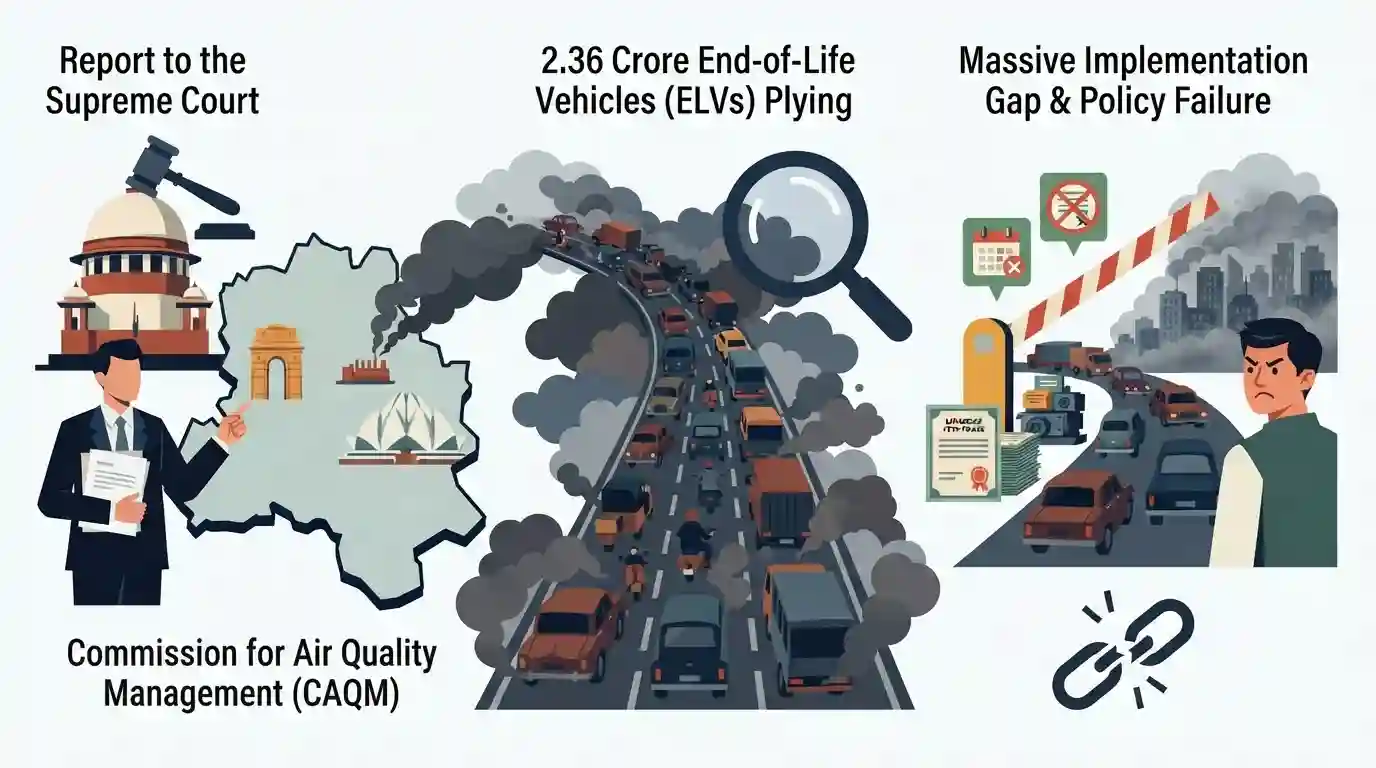
A report submitted by the Commission for Air Quality Management (CAQM) to the Supreme Court revealed that over 2.36 crore end-of-life vehicles (ELVs) are actively plying in the Delhi-NCR region. This highlights a massive implementation gap in executing vehicular age bans and scrappage policies, posing severe challenges to curbing air pollution in Northern India.
Key Points
- A CAQM report submitted to the Supreme Court revealed that over 23.6 million end-of-life vehicles (ELVs) are currently plying in the Delhi-NCR region.
- The data highlights a massive policy implementation gap and enforcement failure regarding the ban on old petrol (over 15 years) and diesel (over 10 years) vehicles.
- Unregulated plying of ELVs significantly exacerbates particulate matter and toxic emissions, worsening the capital's severe air pollution crisis.
- The findings underscore institutional weaknesses in scrappage policy execution and inter-state coordination within the National Capital Region.
Prelims Trap
The Commission for Air Quality Management (CAQM) is an executive body set up by Supreme Court directives similar to the erstwhile EPCA.
The EPCA was an ad-hoc body set up by Supreme Court orders in 1998, whereas CAQM is a statutory body created by an Act of Parliament in 2021.
Static Concepts Connected
What are the mandate, composition, and powers of the Commission for Air Quality Management (CAQM)?
- Statutory Origin: Statutory status created via the CAQM Act, 2021, replacing the earlier Environment Pollution (Prevention and Control) Authority (EPCA).
- Geographic Scope: Jurisdiction covers Delhi and adjoining areas in Haryana, Punjab, Rajasthan, and Uttar Pradesh.
- Regulatory Powers: Power to issue binding directions, entertain complaints, and impose environmental compensation for non-compliance.
Cross-Topic Patterns
Cooperative Federalism vs Statutory Air Governance
The CAQM's statutory powers over Delhi-NCR mirror federal governance tensions seen in inter-state water tribunals and disaster management authorities.
Scrappage Policies and Circular Economy Challenges
Vehicle scrappage bottlenecks connect directly to circular economy frameworks and extended producer responsibility (EPR) mandates in industrial policy.

CAQM statutory mandate and vehicle scrappage implementation gaps are prime candidates for Prelims matching statements or Mains governance Qs.
Linked PYQs · 2
Linked PYQs · 2
- 2020MainsGS3
What are the key features of the National Clean Air Programme (NCAP) initiated by the Government of India?
- 2021MainsGS3
Describe the key points of the revised Global Air Quality Guidelines (AQGs) recently released by the World Health Organisation (WHO). How are these different from its last update in 2005? What changes in India's National Clean Air Programme are required to achieve these revised standards?
