Over 100 Fall Ill in Jhalawar Mass Food Poisoning Incident
Source:etvbharat ↗
Why It Matters
Mass food poisoning incidents expose vulnerabilities in public health infrastructure and food safety regulations during large gatherings. They highlight the crucial role of state Food Safety Departments and emergency medical response systems in managing localized health crises.
Summary
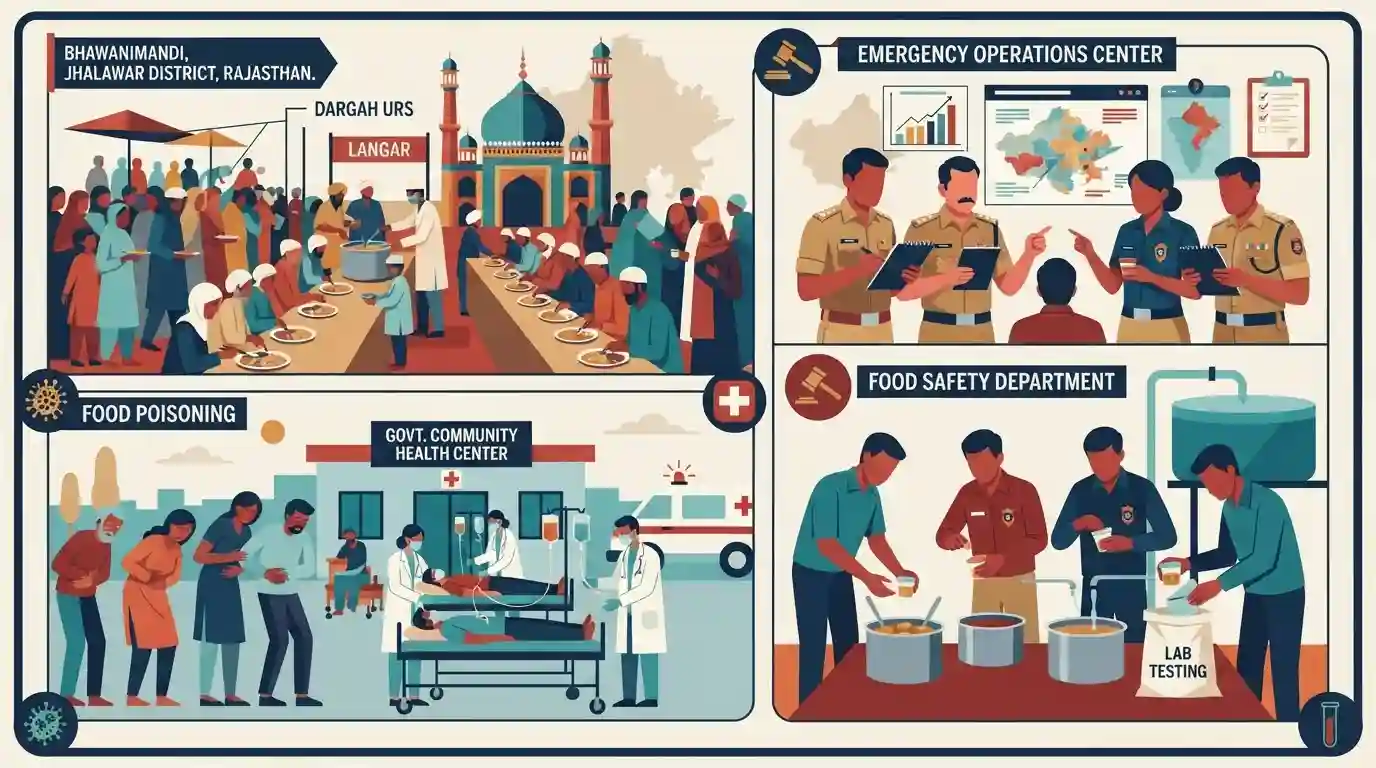
Over 100 people fell ill due to suspected food poisoning after consuming food at a langar organized for a Dargah's Urs in Bhawanimandi, Jhalawar district, Rajasthan. Patients reported acute symptoms of vomiting and diarrhea and were promptly admitted to the local Government Community Health Center and surrounding private facilities. The sudden mass casualty incident prompted immediate action from the local administration, with medical teams and officials rushing to manage the crisis. The Food Safety Department has collected samples of the food and water served at the event for laboratory testing. This incident highlights ongoing challenges in enforcing food safety and hygiene protocols during large-scale public and religious gatherings.
Key Points
- Over 100 individuals in Bhawanimandi, Jhalawar experienced suspected food poisoning after eating at a langar during a Dargah's Urs.
- Patients exhibited symptoms like vomiting and diarrhea and were quickly admitted to the Government Community Health Center and private hospitals.
- Local administration, including medical teams and the Sub Divisional Officer, mobilized to handle the sudden influx of patients.
- The Food Safety Department collected food and water samples from the event to identify the source of contamination, emphasizing the need for hygiene at large gatherings.
Important Terms
Community Health Centre

A 30-bed block-level public medical facility in India providing secondary healthcare and specialist care, serving a rural population of 80,000 to 1,20,000 under the National Health Mission.
UPSC context
GS Paper 2 (Health/Social Justice): tests knowledge of public health infrastructure, rural-urban disparities, and the three-tier medical system.
Food Safety Department
The state-level enforcement wing that implements the Food Safety and Standards Act, 2006, conducting surveillance, licensing, and testing to ensure safe food consumption.
UPSC context
GS Paper 2 & 3 (Governance/Food Security): evaluates understanding of regulatory frameworks, enforcement challenges, and public health safeguards in food systems.
Department of Health and Family Welfare
The principal government administrative division responsible for public health policies, disease control programmes, healthcare infrastructure management, and executing state-sponsored health insurance schemes.
UPSC context
GS Paper 2 (Governance/Health): tests knowledge of health governance, social sector policies, federal health responsibilities, and public expenditure challenges.
Prelims Trap
"Project BHOG is an initiative by the Ministry of Culture to promote religious tourism."
Project BHOG is not a cultural or tourism scheme; it is a food safety initiative by FSSAI (Ministry of Health & Family Welfare).
Static Concepts Connected
What are the statutory powers of a Food Safety Officer under the FSS Act, 2006?
- Search and Seizure: FSOs have powers equivalent to a police officer with a search warrant, allowing them to enter and inspect premises independently.
- Sample Collection: Authorized to draw suspected food/water samples from any establishment and send them to certified laboratories for testing.
- Enforcement Actions: Can issue improvement notices, seize adulterated articles, or prohibit the sale of unsafe food items to prevent mass casualties.
How does bacterial intoxication cause acute food poisoning?
- Pre-formed Toxins: Intoxication occurs when bacteria (like Staphylococcus aureus) release heat-stable enterotoxins into food prior to consumption.
- Rapid Onset: Causes a highly accelerated onset of symptoms (often within hours), as the body reacts to the ingested toxin rather than waiting for bacterial colonization.
- Heat Resistance: While standard cooking might kill the bacteria, it frequently fails to destroy the pre-formed enterotoxins, leaving the food poisonous.
Cross-Topic Patterns
Project BHOG & Religious Administration
FSSAI's Project BHOG targets food safety at religious gatherings, balancing state public health mandates (Article 47) with religious administrative freedoms (Article 26).
Hadoti Geography & Pathogen Growth
Jhalawar's location in the Hadoti plateau (Rajasthan's highest rainfall region) creates a warm, humid micro-climate that drastically accelerates bacterial proliferation and enterotoxin release in mass-prepared food.

Expect a 2026 Prelims statement swapping FSSAI's Project BHOG with a Ministry of Culture scheme, testing institutional mandates.
Linked PYQs · 3
Linked PYQs · 3
- 2024RPSC_PRELIMSGS1
Which of the following celebrated awareness has the highest awareness among students about the diseases?
- 2021RPSC_PRELIMSGS1
In which of the following districts are subtropical mountainous forests found?
- 2016RPSC_PRELIMSGS1
The Chief Minister Free Medicine Scheme was implemented in Rajasthan on
